While the inflation rate climbed above economists’ expectations in January, the overall outlook for bank customers in the United States offers some modest optimism.

According to JD Power data, 34% of customers are financially healthy,[1] the highest rate in more than a year. While the improvement isn’t a massive leap by any means, it is an encouraging metric following the holiday season.

As some customers begin to find their financial footing, concerns persist about anything that could potentially set them back, particularly the risk of credit or debit card fraud. And for almost half of customers, debit card fraud casts a bigger shadow than unauthorized credit card purchases.

Financial Health Gets a Slight Boost                                                      

The number of customers who are financially healthy rose to 34% in January, while 41% of bank customers were in the vulnerable category. Both numbers reflect 13-month bests in their respective categories, albeit a modest improvement.


U.S. Bank Financial Health Trend February 2025


The percentage of bank customers who say the cost of goods is increasing faster than their income rose to 66%. Vulnerable customers saw an increase to 78% and over extended customers saw an increase to 59%, perhaps an indication that the improvements in financial health will not be long-lasting.


U.S. Bank Financial Health Are Card Providers Providing Enough Security February 2025


Security of Cards

Almost half (49%) of customers say that banks offer the same level of security protection for both their debit and credit cards. This rate is highest among healthy (56%) and stressed (52%) customers.


U.S. Bank Financial Health Are Card Providers Providing Enough Security February 2025


When asked which type of fraud is easier to resolve—debit or credit card—nearly half (47%) of customers said their credit card was easier to manage. Whether that perception is true or not, it does chart a course for banks and/or card issuers that are looking to bolster confidence in their security. More messaging may be needed about the security of their debit cards and issue resolutions if/when those instances of debit card fraud occur.
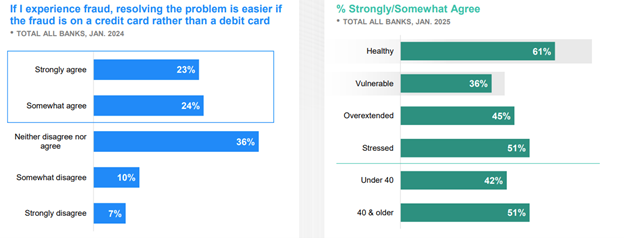
 

U.S. Bank Financial Health Experience Debit or Credit Card Fraud February 2025


Safe and Sound

Whether customers’ financial health builds on this past month’s incremental gains or not, credit and debit cards play a big overall role in the overall picture. And with banks and issuers hoping to build confidence in the security of their products, more communication is needed around the safety of debit cards.

Customers need to feel secure to store card information, especially those who could have their financial situation go from bad to worse with even a minor incidence of fraud. Communicating that banks and issuers prioritize the same support around any incidence of fraud will undoubtedly boost utilization of debit cards, which may lead to better budgeting and customers paying lower interest rates. Time will tell if banks can effectively deliver this message.


Find out More

This Banking and Payments Intelligence Report is based on responses from 4,000 retail bank customers nationwide and was fielded in January 2025. It was authored by Jennifer White, senior director of banking and payments intelligence at JD Power. Please contact us at the numbers below to connect with Ms. White or to learn more about the underlying research.


Media Contacts

Brian Jaklitsch; East Coast; 631-584-2200; [email protected]

Geno Effler, JD Power; West Coast; 714-621-6224; [email protected]


[1] JD Power measures the financial health of any consumer as a metric combining their spending/savings ratio, creditworthiness, and safety net items like insurance coverage. Consumers are placed on a continuum from healthy to vulnerable.

A new year has arrived, but the same financial malaise persists. Inflation ticked up in December 2024 and the Consumer Price Index saw a 2.9% year-over-year increase, which is keeping bank customers in the United States on their heels.

According to JD Power data, 31% of customers are financially healthy[1], a rate that has largely remained unchanged since the summer. As a result, customers are trying to decipher new ways to get a handle on their finances, with many turning to banks in the hopes of a more holistic view of their finances. Part of that search includes an increased interest in open banking, which is the practice of banks securely exchanging financial information with other financial institutions or third parties, such as financial advice apps, digital payment processors and other service providers. 

Financial Health Remains Unchanged                                                 

The number of customers who are financially healthy remained the same in December at 31%, while 44% of bank customers fall into the vulnerable category.

J.D. Power Financial Health Trend January 2025

The number of bank customers who say the cost of goods is increasing faster than their income also remained steady at 65%. Vulnerable customers saw a slight decrease to 74%, while healthy customers actually rose slightly to 51% from 49%.

J.D. Power Cost of Inflation January 2025


A Holistic View

As customers continue to grapple with a tenuous financial landscape, many are expressing a bigger interest in seeing a complete picture of their finances in one place. One way to accomplish that is through more comprehensive financial aggregator tools. Overall, 41% of bank customers say it is extremely important for a bank’s mobile app to show the balances of their external accounts, up from 32% from May.

J.D. Power Financial Health Importance of External Bank Info in Mobile Apps January 2025

That interest has grown across all financial health segments, with stressed customers seeing the biggest jump in interest since the question was last asked in May 2024. Even older customers (40 and older) saw an increase of 9 percentage points.

J.D. Power Financial Health Importance of External Bank Info in Mobile Apps by Financial Health Type January 2025


Open for Business

The desire for more complete financial tools is indicative of an overall customer trend toward open banking. While historically, only customers and their banks have had access to their financial data, open banking is now enabling the development of new financial services products and offerings. By creating an easier flow of information from the bank to third parties, customers are finding improved ways to manage their money, make payments, and gain access to credit. With the practice gaining popularity with customers, the onus now shifts to banks to meet customers where they are and support better experiences—even when their customers are working with third parties.

Overall, more than one-third (36%) of banking customers are aware of open banking, with overextended (54%) and younger (53%) customers most familiar with the practice.

J.D. Power Financial Health Opening Banking Awareness January 2025

There is also a strong relationship between open banking and financial aggregator tools. For example, customers who are aware of open banking are more likely to use financial aggregator tools and understand the value of these tools.


A Better Understanding

With many customers still stuck in the same financial predicaments for the better part of two years, many seem to have a genuine interest in new ways to get a handle on their finances, and a willingness to try new solutions. For banks, that means they’ll have to be receptive to customer desires and tailor their products to those needs. 

Open banking and better financial aggregator tools allow customers to glean complete insights into their finances and that is a vital component of understanding how to take the next step. Banks that can provide this intelligence stand ready to benefit from a more informed and, eventually, more financially healthy customer base.

Find out More

This Banking and Payments Intelligence Report is based on responses from 4,000 retail bank customers nationwide and was fielded in December 2024. It was authored by Jennifer White, senior director of banking and payments intelligence at JD Power. Please contact us at the numbers below to connect with Ms. White or to learn more about the underlying research.

Media Contacts

Brian Jaklitsch; East Coast; 631-584-2200; [email protected]

Geno Effler, JD Power; West Coast; 714-621-6224; [email protected]


[1] JD Power measures the financial health of any consumer as a metric combining their spending/savings ratio, creditworthiness, and safety net items like insurance coverage. Consumers are placed on a continuum from healthy to vulnerable.
Cracking the Code on Affluent Clients: Trust, Technology, and Opportunity

VIDEO: Financial Services Intelligence Update — January 2025

When it comes to affluent consumers, one thing stands out above all else: trust. It’s not just important—it’s the ultimate differentiator. As wealth transfers between generations and new technologies reshape the industry, JD Power’s latest research offers exclusive insights into how banks and wealth firms can meet—and exceed—the expectations of their most valuable clients.

In the newly released JD Power Affluent Client Trend Report, JD Power combines several benchmark studies to provide valuable insights into the affluent and emerging affluent customer base. Drawing on data from more than 250 financial institutions, we highlight key trends and strategies that can drive loyalty and growth with these valuable customers.

To explore how firms can better serve this critical demographic, JD Power’s Craig Martin, Executive Managing Director at JD Power, joined Miles Tullo, Managing Direct, for a deep dive into the evolving landscape of affluent clients.

Key Insights for Winning Affluent Clients’ Trust and Loyalty in 2025

  1. Trust Is Multifaceted: While banks earn high marks on transactional trust—ensuring secure, efficient daily operations—wealth firms excel in building holistic, goals-based relationships.
  2. Generational Wealth and Opportunity: Younger consumers represent untapped potential, but firms need tailored strategies to engage this demographic.
  3. Technology Meets Strategy: As artificial intelligence and digital tools transform the financial industry, aligning these innovations with human-centric approaches will be essential for success.

Understanding the Affluent Client

Craig Martin explains that affluent clients are not a monolithic group. Their behaviors, preferences, and trust levels vary across age groups and wealth tiers. While Baby Boomers typically have established financial relationships, younger affluent consumers represent a significant growth opportunity for both banks and wealth firms.

“Understanding the affluent consumer requires delving into the nuances of these groups and addressing what truly builds trust. It’s not just about satisfaction—it’s about creating loyal brand advocates,” Martin said.

Trust: The Cornerstone of Client Relationships

Trust emerged as a central theme in the conversation. The report reveals that wealth firms are generally more successful at establishing high trust levels than banks. Affluent clients have different trust expectations depending on whether they interact with a bank or a wealth manager.

“For banks, trust is often linked to transactional reliability—keeping data secure, offering seamless transfers, and maintaining technical soundness,” Martin explained. “For wealth managers, trust goes beyond transactions, requiring a focus on relationship-building and personalized advice.”

A Data-Driven Approach to Growth

The Affluent Client Trend Report offers more than just trends—it provides actionable insights. By analyzing the behaviors of over 10,000 consumers, the report outlines ways firms can:

  • Leverage AI and digital tools to personalize services.
  • Adapt strategies for generational wealth transfers.
  • Prioritize high-value opportunities in a competitive landscape.

Martin emphasized the need for strategic resource allocation: “Firms don’t have unlimited budgets or personnel. The challenge lies in determining how to prioritize investments in technology, people, and processes to meet the evolving needs of affluent clients.”

 When it comes to affluent consumers, trust is more than just a factor—it’s the key to winning their loyalty

Preview the Affluent Client Report 

The JD Power Affluent Client Trend Report is now available for preview. The report offers exclusive insights into the behaviors and expectations of affluent consumers, along with key trends and strategies for driving loyalty and growth. Preview the report today. 

Preview now: Affluent Client Trends Report Preview

Craig Martin is the executive managing director, dedicated to driving positive change in the financial services sector and helping clients achieve superior business outcomes by focusing on their customers. 
Craig’s insights have been featured in numerous publications addressing customer experience and the correlation between customer satisfaction and business success.

Miles Tullo is Managing Director of Financial Services at JD Power. He oversees client engagement with financial services clients in North America. Drawing from extensive experience in payments and lending, Miles brings valuable expertise to clients and contributes regularly to JD Power’s thought leadership initiatives.

As we approach the end of the year, the major storylines that have developed in the credit card industry are creating ripple effects through the entire financial landscape.

Even as inflation dropped to its lowest level since February 2021, customers are still trying to find their footing and they are leaning on their credit cards to help.

Using data from the JD Power 2024 U.S. Credit Card Satisfaction Study we have identified the biggest trends in the credit card industry this year and analyzed how customers are behaving in response to these trends. From late fees to card delinquencies to revolving card debt, here are three issues set to define the year ahead.

The Spirit of the Late Fee Cap            

This past March, the Consumer Financial Protection Bureau (CFPB) announced that it would be capping credit card late fees at $8 per occurrence. The news came as a welcome sign for customers. In the spring, 25% of credit card customers told JD Power that they had paid a late fee in the past 12 months, and 73% of those had paid more than $8.

But in May, the American Bankers Association (ABA) and U.S. Chamber of Commerce filed a legal challenge and a federal judge agreed, which blocked the CFPB’s plan to curb fees. The cap could be resurrected. In September, Former President Donald Trump made a campaign promise that, if elected, he would support a cap on credit card interest rates.

While the spirit of the rule seems consumer friendly, it’s worth noting that neither the late fee nor interest rate cap proposals would immediately affect the majority of U.S. cardholders. Only 18% of U.S. cardholders say they have paid more than an $8 late fee, and 24% of cardholders report having an interest rate above 10%. It’s likely these numbers are larger, as most cardholders don’t know such pricing details about their credit cards and may not be aware of even benefitting from such policy caps. Still, some think the policy will resonate with customers and as an early mover gesture. Notably, PNC and Wells Fargo have already begun reducing credit card late fees.

As is often the case, when one issuer finds success in a strategy, others follow. Keep an eye out for more issuers offering late fee caps to try to build goodwill with their existing customers while enticing new ones.

Are Card Delinquencies Really on the Rise?

While high consumer prices and inflation fatigue may make it seem like credit card payment delinquencies are on the rise, JD Power data finds that the level of revolving card debt and card late payment fees is flat year over year.

That said, cardholders do say they are having a harder time being able to pay their bills—credit card or other—on time now than they did in 2023 (ability to pay fell to 4.26 in 2024 vs. 4.29 in 2023 on a 5-point scale). While some brands are seeing their customers’ ability to pay bills on time fall significantly, brands with more financially healthy[1] customers and that have a single product focused on credit building are seeing improvements.

As issuers find more ways to attract desirable customers, some may opt to narrow their focus and tailor their marketing strategies to customers that are actively looking to consolidate or pay down their debt. Look for issuers to try to build awareness for their debt management tools as well, hoping to build engagement and bolster customer awareness and education.

Rich in Miles

After years of pent-up travel demand during the pandemic, customers are once again taking to the skies, and they’re doing so in record numbers. But after airline rewards credit cards came under attack at a May CFPB hearing, some analysts wondered if customers are actually racking up big credit card debt just to accrue airline miles.

According to JD Power data, 40% of airline cardholders have revolving debt, which is significantly below 51% all card average. Airline cardholders are also significantly more financially healthy (61% vs. 46% all card average) and are much more likely to say that their debt is completely manageable. Of course, there are exceptions, but by and large, airline cardholders tend to manage their finances relatively well.

It makes it clear why smaller carriers have an issue with bigger brands that can offer airline card miles: these types of customers are extremely attractive and they’re drawn to this perk. And while that may make it difficult for smaller carriers to compete in the marketplace for customers, it also places an onus on companies to find a way to match that kind of value proposition and offer a service that is as attractive as discounted airfare.

Finding the Opportunity

As issuers take appraisal of the developments of 2024, the experiences of the past 12 months offer a roadmap to new strategies for 2025. The marketplace is moving in a new direction, and a new breed of customers are prioritizing different things. How they are interacting with their credit cards, and what they hope to gain from a relationship with an issuer should influence these next steps.

Issuers that can digest this information and meet customers where they are will not only reap the benefits of increased customer loyalty and retention, but they will become more attractive in a very competitive marketplace.

Find out More

This Banking and Payments Intelligence Report is based on responses from 38,852 credit card customers nationwide and was fielded from June 2023-June 2024. It was authored by John Cabell, managing director of banking and payments intelligence at JD Power. Please contact us at the numbers below to connect with Mr. Cabell or to learn more about the underlying research.


Media Contacts

Brian Jaklitsch; East Coast; 631-584-2200; [email protected]

Geno Effler, JD Power; West Coast; 714-621-6224; [email protected]


[1] JD Power measures the financial health of any consumer as a metric combining their spending/savings ratio, creditworthiness, and safety net items like insurance coverage. Consumers are placed on a continuum from healthy to vulnerable.

Banking and Payments Intelligence Report
December 2024

The holidays have arrived, and with them the annual surge in consumer spending. But against the backdrop of the highest jump in consumer prices in seven months, and with many bank customers in the United States still reeling from the past two years of inflation, there are some big financial health concerns to contend with this holiday season. Are the nation’s banks up to the task of helping their customers through this challenging time? Many bank customers feel they are not. 

According to JD Power data, 20% of customers say their bank does not offer any emergency services to support them during their challenging times, while only 36% feel completely confident that their bank provides financial education resources to help them manage their finances effectively.

With customers stretching their spending to meet the demands of the season, this puts the onus on banks to boost awareness around their emergency products to give their clients some peace of mind.

Financial Health Remains Stagnant                                                        

The number of customers who are financially healthy[1] decreased slightly in November to 31%, while 44% of bank customers fall into the vulnerable category. These levels have remained largely consistent for the bulk of 2024.


Financial Health Remains Stagnant

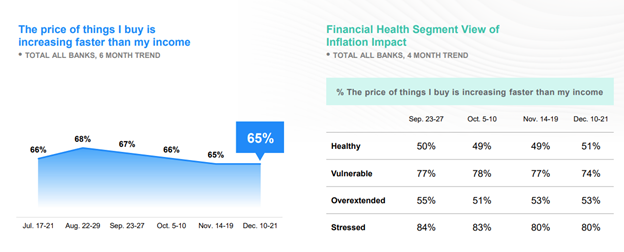
The number of bank customers who say the cost of goods is increasing faster than their income actually dropped slightly to 65%. Overextended customers saw a slight increase to 53%, while stressed customers dropped to 80% from 83%.

The Price of Things I Buy is Increasing Faster December 2024 J.D. Power Polaris

Bank Backup?

Amid this period of widespread economic uncertainty, it seems that many banks have struggled to instill confidence in their customers. Just 35% of customers say that their bank will completely help protect them against economic fluctuations, while 17% said banks will not protect them at all. Financially vulnerable customers and those over 40 years old were least likely to agree that banks would protect them.

Bank Backup December 2024 J.D. Power Polaris

To address concerns like these, many banks and financial institutions have introduced emergency support services, such as payment assistance programs. However, only 33% of bank customers completely agree that their banks offer emergency support services, such as micro-loans, lines of credit and fee waivers, while 20% say their bank does not offer any help at all.

Polaris 12 24 Picture number 2


Customers are also dismissive of the notion that their banks empower them to meet life’s financial challenges. Just 31% completely agree that banks empower them, while 12% said not at all. More than half (57%) say somewhat, which implies there are customers in the middle that can be won over. 

Does your bank empower you to meeting life's financial challenges December 2024 J.D. Power Polaris


The Battle for Trust

If banks made an impression on customers during the era of 7% inflation, it certainly fails to resonate today. Many institutions built out huge awareness campaigns around emergency support services like fee waivers, but it’s clear that not all customers received the message. That means that banks need to go the extra mile now to win the hearts and minds they failed to on the first go-round.

No matter the economic conditions, customers’ financial health can ebb and flow throughout the year, and regardless of what the economic headlines say about topline inflation and economic recovery, many customers are still struggling with financial health. If banks can show the same kind of investment in helping customers out in an emergency before another tough stretch happens, it may resonate more than when customers are simply trying to keep their heads above water.    

Find out More

This Banking and Payments Intelligence Report is based on responses from 4,000 retail bank customers nationwide and was fielded in November 2024. It was authored by Jennifer White, senior director of banking and payments intelligence at JD Power. Please contact us at the numbers below to connect with Ms. White or to learn more about the underlying research.

Media Contacts

Brian Jaklitsch; East Coast; 631-584-2200; [email protected]

Geno Effler, JD Power; West Coast; 714-621-6224; [email protected]


[1] JD Power measures the financial health of any consumer as a metric combining their spending/savings ratio, creditworthiness, and safety net items like insurance coverage. Consumers are placed on a continuum from healthy to vulnerable.

With inflation down from last holiday season and the U.S. Transportation Security Administration (TSA) having reported record-setting travel records this past Labor Day weekend, it seems the stars are aligned for a blockbuster holiday travel season. 

But according to JD Power data, bank customers in the United States aren’t necessarily readying to take to the roads and the skies in droves for the holidays this year. In fact, more customers say that they will remain home for the holidays this year than in 2023. 

That development may come as a surprise to some, with customers presumably having gained some financial breathing room during the past few months. And for those who will travel, 70% will travel by air and/or stay overnight. But with customers suffering from the fatigue of persistently high consumer prices, some are just content to forego traveling altogether.


Financial Health Remains Steady                                

The number of customers who are financially healthy1 increased slightly to 33%, while 44% of bank customers fall into the vulnerable category. Notably, these levels reflect year-over-year improvements, which may imply a slightly higher holiday spending budget.

Financial Health Remains Steady November 2024 J.D. Power Polaris


The number of bank customers who say that the cost of goods is increasing faster than their income held steady at 67%. Overextended customers saw a drop from 55% to 51%, potentially another harbinger of increased customer spending.

The Price of things I buy is increasing faster than my income November 2024 J.D. Power Polaris


A Tame Turkey Day?

As Thanksgiving draws closer, bank customers have relatively modest holiday plans. The number of customers who say they will not travel during the holiday season increased to 46% from 39% a year ago. These levels are highest among vulnerable and stressed customers, as well as those over the age of 40.

How much travel are you expecting to do over the holiday season J.D. Power November 2024 Polaris

Among those who do plan to travel, 43% say they plan to stay overnight in a hotel, motel, bed and breakfast, or an inn, while 27% say they plan to travel by air to their destination, 24% say they plan to stay at an overnight short-term rental, and 16% plan to rent a car. This implies that those who do travel are likely to spend a significant amount on their travel. This is particularly true of overextended and customers under the age of 40.

For the holiday travel do you plan to do any of the following November 2024 J.D. Power Polaris


Holiday Helpers

After years of pent-up travel demand that accumulated during the pandemic, some customers are being more prudent about how and when they travel for the holidays. Still, there’s a big sentimentality to walking into your childhood home for Thanksgiving dinner. For those who do decide to take a trip in these next few weeks, banks can be valuable partners in guiding their travel spending.

Overextended customers are more likely to travel for the holidays than healthy customers, which means that budgeting tools could be a huge area of focus for banks even before the Black Friday shopping begins. Banks that can be active participants in helping customers make wiser travel decisions will likely be rewarded by thankful customers who will have a bit of a nostalgic hangover in the form of the reality of holiday shopping.


Find out More

This Banking and Payments Intelligence Report is based on responses from 4,000 retail bank customers nationwide and was fielded in October 2024. It was authored by Jennifer White, senior director of banking and payments intelligence at JD Power. Please contact us at the numbers below to connect with Ms. White or to learn more about the underlying research.

Media Contacts

Brian Jaklitsch; East Coast; 631-584-2200; [email protected]

Geno Effler, JD Power; West Coast; 714-621-6224; [email protected]


[1] JD Power measures the financial health of any consumer as a metric combining their spending/savings ratio, creditworthiness, and safety net items like insurance coverage. Consumers are placed on a continuum from healthy to vulnerable.

With banking satisfaction among small business decision-makers reaching new heights, banks are capitalizing on fresh opportunities to support and grow their relationships with these important customers. In this episode of JD Power Monthly Intelligence Update, Paul McAdam, Senior Director of Banking and Payments Intelligence and Miles Tullo, Managing Director of Financial Services, share the latest insights from the JD Power 2024 Small Business Satisfaction Study and why satisfaction is trending up.

Small Business Sentiment: Their Banks

Paul McAdam explains, “Small businesses are feeling good, with a significant improvement in satisfaction for the second consecutive year. They’re especially appreciative of the increased client-centric, proactive, and personalized service they’re receiving.”

According to our recent study, small business satisfaction is on the upswing, driven by:

  • Client-Centric Service: Banks are placing greater emphasis on personalized, proactive support.
  • Improved Credit Access: Steady credit availability is empowering small business growth.
  • High Retention Rates: Business owners are more likely to return for future services, a positive indicator of satisfaction.

Renewed Energy in Small Business Banking

There’s renewed interest in small business banking on both sides—banks and clients alike. Banks are increasingly looking at this line of business for growth, motivated by:

  • Rise in New Startups: Post-pandemic, the rate of small business startups has remained robust.
  • Dual Relationship Benefits: Small businesses often bring personal accounts with them, blending retail and business banking for deeper partnerships.

Top Performers in Small Business Banking

The 2024 U.S. Small Business Banking Satisfaction Study measures satisfaction based on seven key factors: trust, staff, convenience, account offerings, time and cost savings, digital channels, and issue resolution. The study reflects feedback from 6,976 small business owners or financial decision-makers using business banking services.

These banks are ranked the highest based on their Overall Satisfaction performance:

  1. Capital One 
  2. Chase
  3. Regions Bank
  4. Huntington
  5. Bank of America

See the full rank chart here.

Building Lasting Relationships in Small Business Banking

While small business banking satisfaction is on the rise, there are still crucial areas for banks to address. Proactive communication is essential as businesses seek guidance on saving money and managing fees amidst rising costs. Relationship managers are increasingly important, with satisfaction levels rising this year, but digital tools are also vital for providing ongoing support. Curious about how banks can tackle these challenges and enhance the customer experience —watch the full video now.

Where can you find more insights like this?  

The JD Power Small Business Satisfaction Study evaluates small business owners’ satisfaction with leading financial institutions. It uncovers opportunities for banks to enhance their support for small businesses in today’s market and beyond. The insights from this study highlight which banks excel in managing small business relationships and the reasons for their success. This study is available in both the U.S. and Canada.

READ THE LATEST PRESS RELEASE – US

READ THE LATEST PRESS RELEASE – CA


More About These Experts 

Paul McAdam is a Senior Director of Banking and Payments Intelligence at JD Power. Clients rely on his expertise to gain a better understanding of how to improve the customer experience, with a particular emphasis on the regional banking segment. His research at JD Power has led dozens of research programs that have enabled leading U.S. banks and global financial technology companies to quantify market demand and measure customer experience.

Miles Tullo is the managing director of the JD Power Financial Services team. He oversees client engagement for the Financial Services Practice in North America and recently led the development and launch of the JD Power U.S. Consumer Point of Sale Payment Program. Drawing from over 20 years of experience in banking, payments, and mortgage lending, Miles brings valuable expertise to clients.

Inflation isn’t the only stressor for bank customers in the United States. Data breaches have emerged as a big concern, and the National Public Data breach (NPD) is only bound to exacerbate those worries.

Nearly nine in 10 bank customers are worried about personal information data breaches. It’s an alarmingly high number, and it may be set to move even higher, as 44% of customers are currently aware of the NPD breach.

Banks can take heart in the fact that most customers who are aware of the breach did act to protect their identity, but they may be failing to properly educate their customers on their exposure risk. Just 50% of customers say they received an alert from their financial partner about their data being compromised.

Financial Health Stays Stagnant
        
The number of customers who are financially healthy  declined slightly to 31%, while 45% of bank customers fall into the vulnerable category.

Polaris Oct 2024 Total All Banks

The number of bank customers who say that the cost of goods is increasing faster than their income decreased slightly (67%). Notably, stressed customers did see an increase to 84%, from 82%.

Polaris Oct 2024 Tracking Consumer Recognition of Inflation

Data Privacy Starts Becomes a Top Concern

While inflation worries have begun to dip, a new customer stressor has reared its head: data breaches. An alarming 88% of bank customers are worried about personal information data breaches—a fear that spans all financial health status and age. That is despite that only 44% are aware of the NPD breach that some estimates say may have affected up to as many as 2.9 billion people.

Polaris Oct 2024 Are consumers aware of the recent national public data breach

Among those aware of the breach, 61% acted swiftly to confirm whether they were personally affected. Healthier customers are more likely to have acted, but age does not appear to make a difference in response. Troublingly, though, only 50% of those aware say they received an alert from a financial institution.

Polaris Oct 2024 Does Breach Awareness Lead to Action

The good news is that customers are checking their credit scores with greater regularity than their credit reports. Nearly half (48%) of all customers have checked their score in the past month, with the highest levels among older and financially health customers. 

Polaris Oct 2024 Do Consumers Use Credit Freezes

Locking Down the Data

With inflation levels low enough to temporarily tamp down customer concerns about the cost of goods, data breaches have taken the mantle as a pressing issue. But banks do have it within their power to be key partners in helping customers avoid becoming victims of identity theft.

Customers—particularly those under the age of 40 and those in poor financial health—need guidance from informed partners on how they can help lock up their personal data. That includes offering the best advice on how to monitor their credit, the difference between the credit reports and scores, how to effectively freeze their credit, and what warning signs they should be looking for along the way. Financial partners that can engage by customers will likely establish vital bonds of trust and will benefit from more customer loyalty and higher levels of engagement.

Find out More

This Banking and Payments Intelligence Report is based on responses from 4,000 retail bank customers nationwide and was fielded in September 2024. It was authored by Jennifer White, senior director of banking and payments intelligence at JD Power. Please contact us at the numbers below to connect with Ms. White or to learn more about the underlying research.

Media Contacts
Brian Jaklitsch; East Coast; 631-584-2200; [email protected]
Geno Effler, JD Power; West Coast; 714-621-6224; [email protected]
 

Inflation is the bugaboo that just won’t go away. As the U.S, Presidential election hits a fever pitch, the persistently high cost of consumer goods is a huge talking point among the candidates and the voters.

That may be surprising to some, as the rate of inflation finally dropped below 3% this summer and, at its current 2.5%, represents a 73% drop from the 9.1% high that was reached in June 2022. But according to JD Power, the percentage of bank customers in the United States who are financially healthy[1] has only modestly improved, while the number of customers who say the cost of goods is increasing faster than they can afford has increased in the past month.

It’s a fact that is difficult to reconcile, leading some analysts to wonder just how reliable some customer feedback is. Notably, 28% of customers say they do not track their own financial status, leaving banks with the uphill task of building products and offering services to a clientele that is often in the dark about their actual situation and needs.

Inflation Becomes the Ultimate Enigma

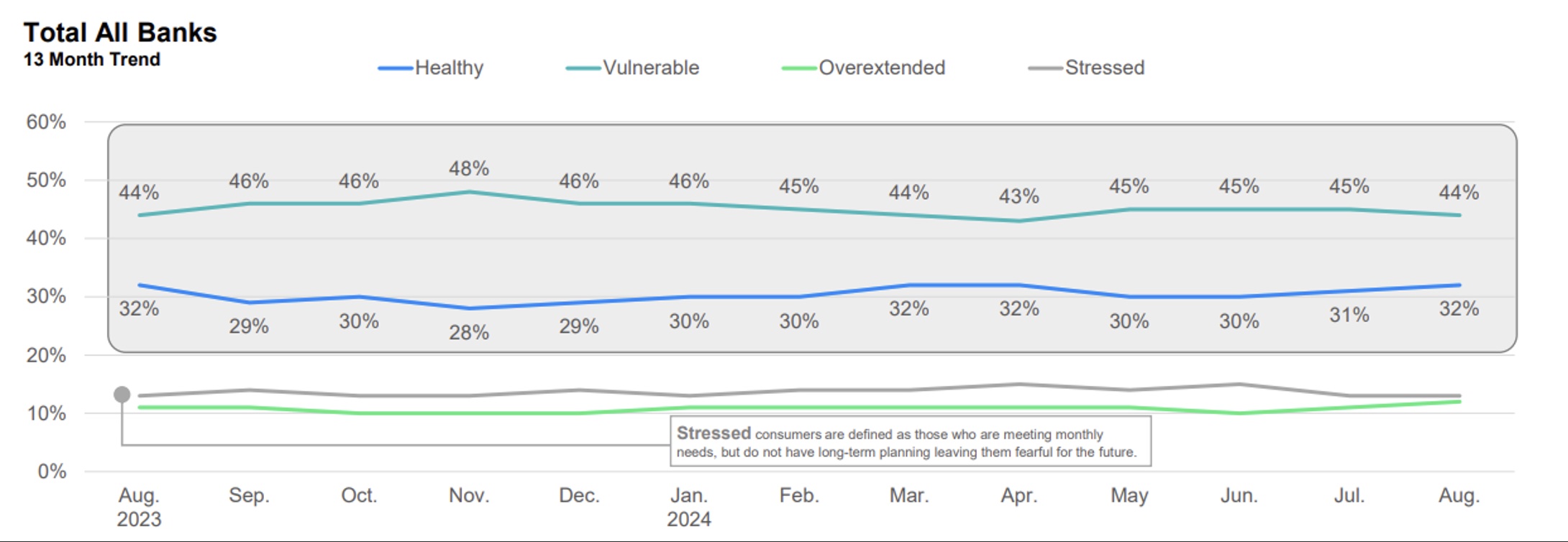
The number of customers who are financially healthy rose slightly to 32%, while 44% of bank customers fall into the vulnerable category.

Total All Banks

For the first time in four months, the number of bank customers who say that the cost of goods is increasing faster than their income increased (68%). That rise comes amid the lowest inflation numbers in recent memory.

Price of things increasing faster than income

Relief Hard to Come By, But Lack of Tracking Breeds Confusion

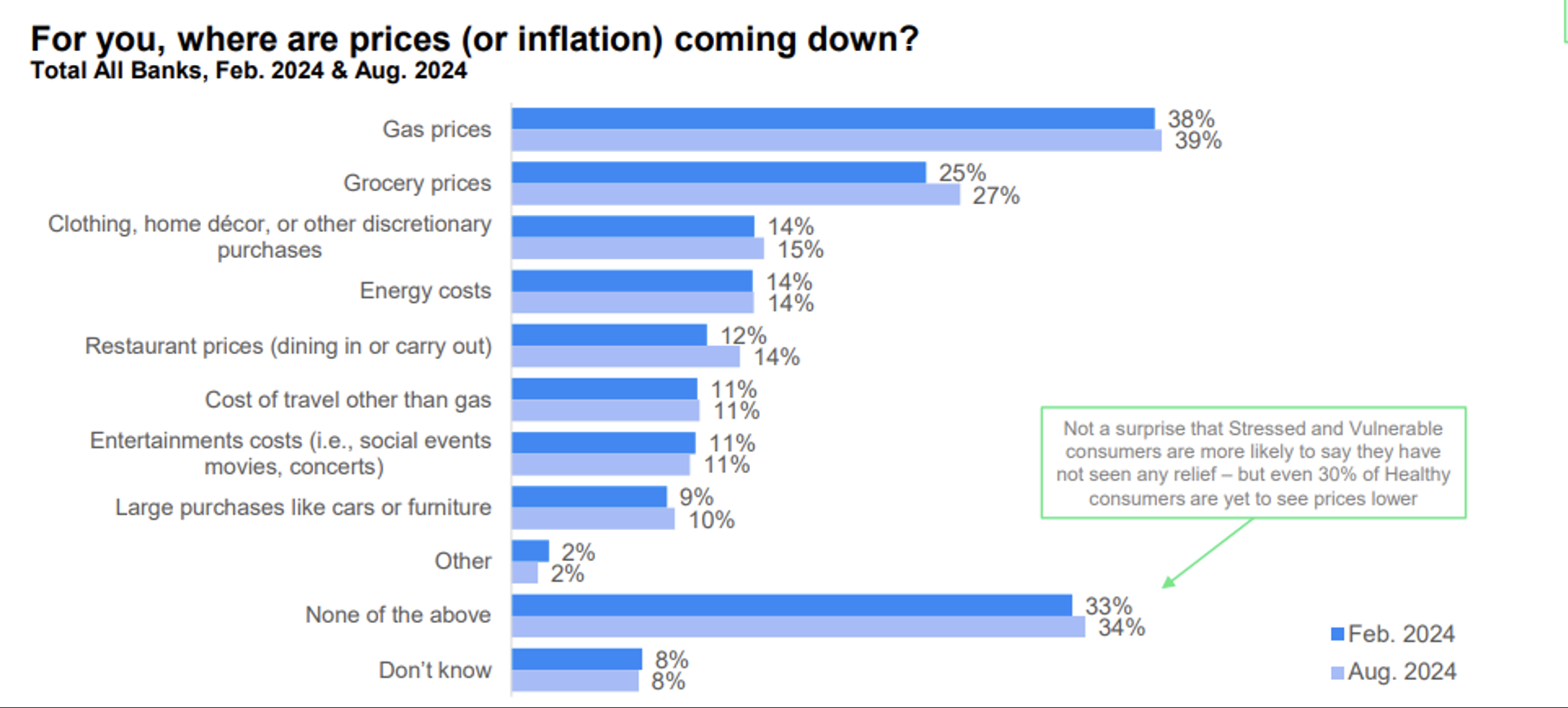
When asked about where they have experienced relief from inflation, customers express modest improvement from six months ago. Grocery and restaurant prices show the most improvement, but shockingly, 34% of customers say prices have not gone down for any goods. Those rates are highest among financially stressed and vulnerable customers, but even 30% of healthy customers say they have not felt any relief.

Where are prices going down

Even as customers continue to express struggles, there seems to be a disconnect between what customers feel and what they actually know. While some customers are using either banking digital tools or a personally made system, a surprisingly high 28% of customers admit that they do not track their finances with any digital tool or other system.

Full picture view finances

A Need for Clarity

Even with inflation easing, it is clear that customers are not feeling immediate relief. After being under duress for more than two years, financial health improvements are likely to lag inflation’s downward trend. That means that inflation is still a factor in many Americans’ day-to-day financial decisions.

For banks, this creates an interesting dilemma. With so many customers making choices, both financial and political, based on inflation, yet such a sizeable portion of them refusing to track their finances, it is difficult to build an outreach strategy. Banks will need a multi-pronged approach that incorporates financial literacy, vigilance, and planning to help customers out of the cycle of stress that they’ve been experiencing.

Find out More

This Banking and Payments Intelligence Report is based on responses from 4,000 retail bank customers nationwide and was fielded in August 2024. It was authored by Jennifer White, senior director of banking and payments intelligence at JD Power. Please contact us at the numbers below to connect with Ms. White or to learn more about the underlying research.

Media Contacts

Brian Jaklitsch; East Coast; 631-584-2200; [email protected]

Geno Effler, JD Power; West Coast; 714-621-6224; [email protected]

[1] JD Power measures the financial health of any consumer as a metric combining their spending/savings ratio, creditworthiness, and safety net items like insurance coverage. Consumers are placed on a continuum from healthy to vulnerable.

Customers Growing More Optimistic about Potential of AI in Financial Services, But Skepticism Remains

It seems that financial services customers are technologically optimistic at heart.

While forecasts of artificial intelligence (AI) integrations often bring a gloom and doom, man vs. machine, dystopian dynamic, it seems that customers generally are encouraged at the prospect of further implementation of generative AI (GenAI) tools and solutions at their respective banks. To get a sense of just how optimistic they are, JD Power surveyed more than 2,000 financial services customers in the United States about their utilization and opinions of AI.

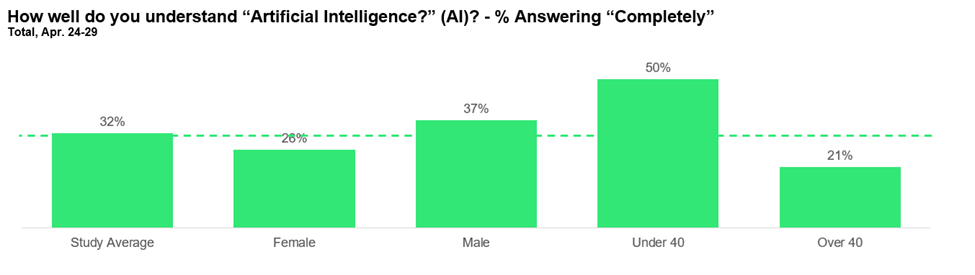
According to JD Power, 54% of all customers say they have used some version of a generative AI tool, and 32% say they have a complete understanding of AI. That level of comprehension and adoption has fueled a largely positive view of the technology, as 50% of customers are optimistic that AI will at least somewhat enhance their lives.

But an undercurrent of skepticism still exists, as customers can’t shake concerns about security, an increased risk of fraud, and loss of human support. The good news is that these fears provide financial institutions with a roadmap toward broader adoption for their AI solutions.

 AI Usage Rises, But Trust Issues Persist            

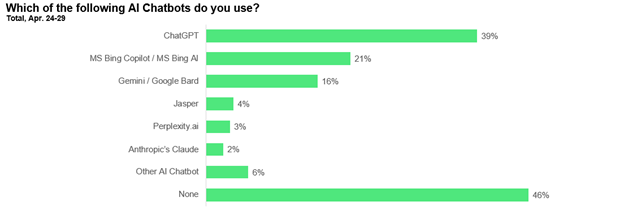
The use of AI chatbots among customers is on the rise. Overall, 54% of customers say they have used a GenAI tool. That level is significantly higher among national bank customers (66%) than regional banks (42%). Unsurprisingly, chatbot usage is higher among customers under the age of 40 (72%). 

Which if the following AI Chatbots do you use

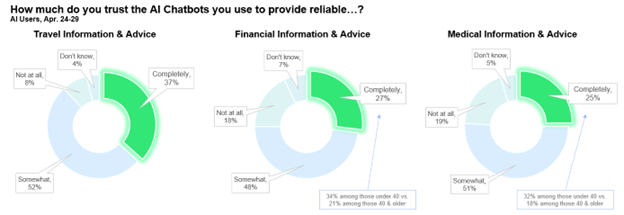
When asked how confident customers feel about using AI chatbots for specific purposes, just 27% of customers said they trust AI for financial information and advice. When compared with other categories of advice, this ranks lower than travel information (37%), but slightly ahead of medical information (25%).

How much do you trust AI Chatbots you use to provide reliable


Understanding the Tech

Some of the above hesitation undoubtedly comes from a lack of understanding of how GenAI solutions work. Despite this tech becoming increasingly common, there is a widespread lack of comprehensive knowledge about GenAI. While most customers have used GenAI, just 32% of customers claim to possess a full understanding of AI solutions, a rate that is highest among those under 40 years old.

How well do you understand AI

While customers are confident that AI tools will provide some added convenience, they are a lot more skeptical about the positive impacts to their financial situation. While 72% of customers agree or strongly agree that AI tools will provide easy, convenient self-service in the near future, only 42% believe AI will improve personal finances. The difference highlights an important gap for financial services firms to close.

How much do you agree that the use of AI in FS will provide the following benefits in near feature

Finding the Opportunity

Customers are most likely to be receptive to personalized alerts and recommendations that can help them, but many are wary of allowing AI to control the actions and the application of personal security measures.

Nearly two-thirds (62%) of bank customers say they would immediately try AI-driven personalized account alerts to help avoid service charges and fees, 44% would use automated phone voice assistants to resolve a customer service problem, and 42% would take personalized product recommendations from an AI agent.

Please indicate your willingness to engage with your primary bank on

Given the fact that customers are clearly open to AI tools, the onus is on financial institutions to communicate to their customers a clear understanding of how AI works and its benefits. These solutions can help customers and banks forge a symbiotic relationship to improve workflows and bolster personalized advice and alerts, but there must be buy-in from the customer to make that happen. By getting insights into how and when customers are most likely to use AI, banks can tailor their outreach accordingly. Those that do it well stand to win big with customers, both new and existing.  

Find out More

This Financial Services Intelligence Report is based on responses from 2,001 financial services customers nationwide and was fielded in April 2024. It was authored by Ila Ghosh, senior director of financial services intelligence at JD Power. Please contact us at the numbers below to connect with Ms. Ghosh or to learn more about the underlying research.

Media Contacts

Brian Jaklitsch; East Coast; 631-584-2200; [email protected]

Geno Effler, JD Power; West Coast; 714-621-6224; [email protected]

This month, we’re diving into the results of our flagship U.S. Credit Card Satisfaction Study. With insights from over 39,000 cardholders across 283 cards and 19 major issuers, this study reveals key trends shaping the credit card industry. Miles Tullo, Managing Director of Financial Services and John Cabell, Managing Director of Payments Intelligence, discuss the widening gap in satisfaction between revolvers and transactors. 

A Widening Divide

According to the results of the 2024 U.S. Credit Card Satisfaction Study, the satisfaction gap between credit card revolvers and transactors is wider than ever. “While there has always been a difference, this year we saw a dramatic shift,” John Cabell notes. Those who manage to stay financially healthy continue to enjoy their rewards cards and benefits. Meanwhile, those grappling with debt are facing increasing dissatisfaction as interest rates, fees, and account terms become more critical factors in their overall experience.


What Does This Mean for Issuers? 

The implications for credit card issuers are clear: financial health isn’t just a consumer issue; it’s a business imperative. As dissatisfaction grows among financially stressed cardholders, issuers must refine their strategies. Offering support that goes beyond standard customer service, particularly around managing interest charges and fees, can make all the difference. The focus should be on proactive financial health support, which has long been a gap in the credit card industry.

The Path Forward 

For issuers, this year’s results are a wake-up call: Consumer satisfaction is a moving target, and the credit card industry must continue to evolve to meet the changing needs of cardholders. The study highlights that satisfaction varies significantly depending on cardholder priorities:

  • For Revolvers: Account terms, such as credit limits, interest rates, and fees, dominate as top concerns. With financial pressures mounting, these cardholders are more likely to feel the pinch of their credit card’s terms.
  • For Transactors: Rewards remain a key driver of satisfaction. Interestingly, benefits like free FICO score tracking have seen a surge in both awareness and usage, helping to boost satisfaction among this group.

Get the complete breakdown of this year’s study by watching the full video.

Watch the Full Video

Where can you find more insights like this?  

The JD Power U.S. Credit Card Satisfaction Study is the most comprehensive and independent survey of credit cardholders available. Designed to help both consumers and issuers, it provides valuable insights into satisfaction ratings for the largest credit card brands. The study establishes a quality benchmark for personal card issuers and delivers a deep understanding of customers’ needs, expectations, and preferences at both the brand and product levels.
Read the press release


More About These Experts

John Cabell serves as the Senior Director of Banking and Payments Intelligence at JD Power, where he leads strategic direction and oversees the execution of our credit card studies. With over 25 years of experience in customer experience (CX) across the banking, payments, and mortgage industries, John brings deep expertise to his role. He holds an MBA from the Raymond A. Mason School of Business at William & Mary and a bachelor’s degree in Economics and French from the Virginia Military Institute.

Miles Tullo is Managing Director of Financial Services at JD Power. He oversees client engagement for the Financial Services Practice in North America and recently led the development and launch of the JD Power U.S. Consumer Payment Program. Drawing from over 20 years of experience in both payments and mortgage lending, Miles brings valuable expertise to clients.  
 

With the inflation rate in the United States stubbornly stuck around 3%, more bank customers are trying to find ways to manage the higher cost of goods, even if their overall financial health[1] has not necessarily improved.

According to JD Power, the percentage of U.S. bank customers who are financially healthy has remained steady, but the overall level of concern regarding inflation has fallen sharply. This implies consumers are finding workarounds for higher consumer prices.

Unfortunately for banks, it seems that customers are finding these workarounds without the benefit of using the personal financial management tools they’ve developed to provide this type of guidance. Customers say they find these tools clunky and hard to interpret, which represents a missed opportunity for banks to provide valuable insights to the customers that need them the most.

Financial Health Largely Flat as Inflation Concerns Wane                                           

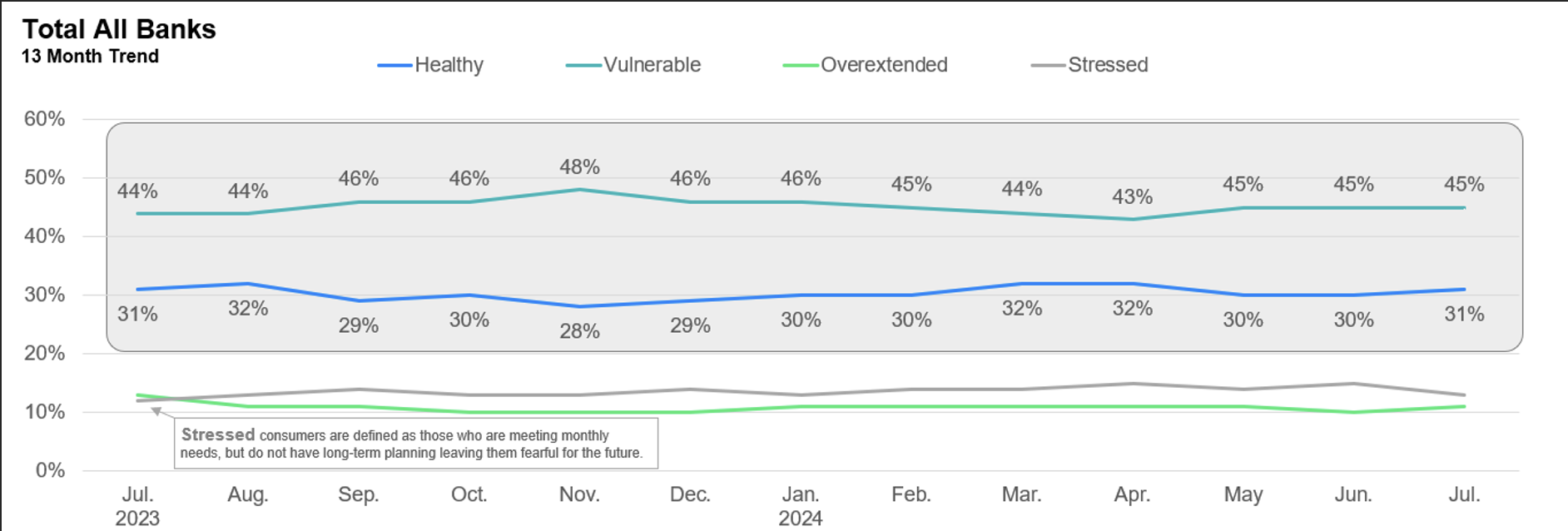
The number of customers who are financially healthy remains steady at 31%, while 45% of bank customers fall into the vulnerable category.

FS August Image 1

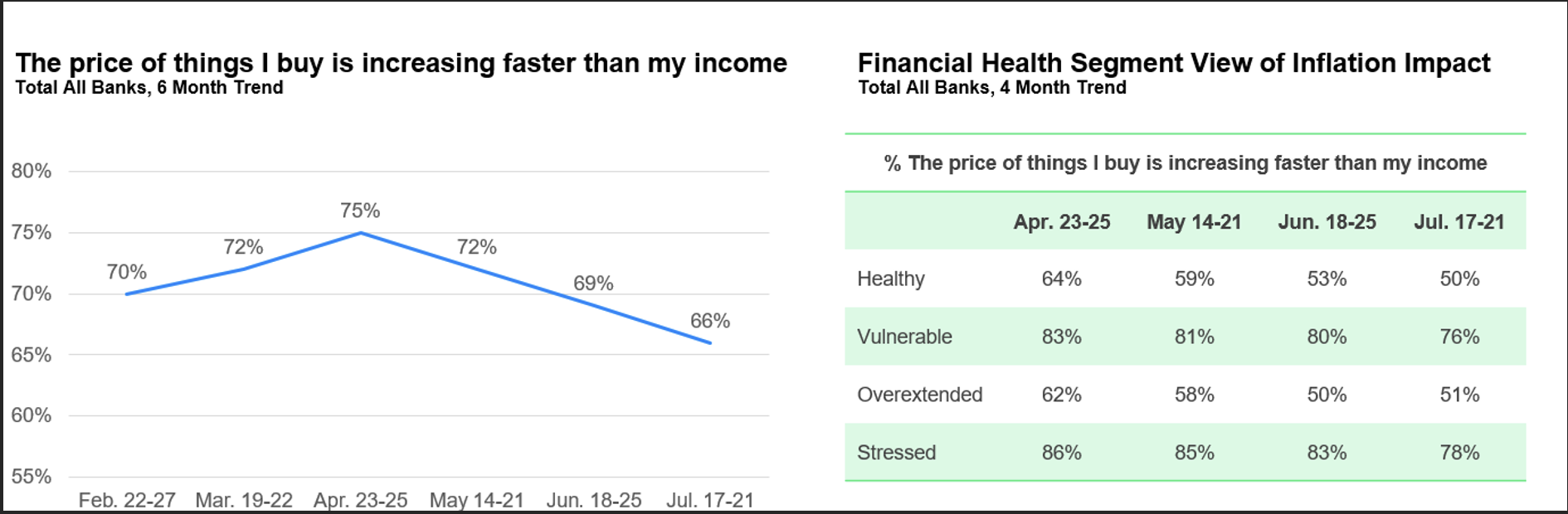
For a third consecutive month, the number of bank customers who say that the cost of goods is increasing faster than their income decreased. Nearly two-thirds (66%) of customers say they are struggling to keep up with the cost of goods, which is the lowest level this calendar year by far.

FS August Image 2

Management Tools Come Up Short

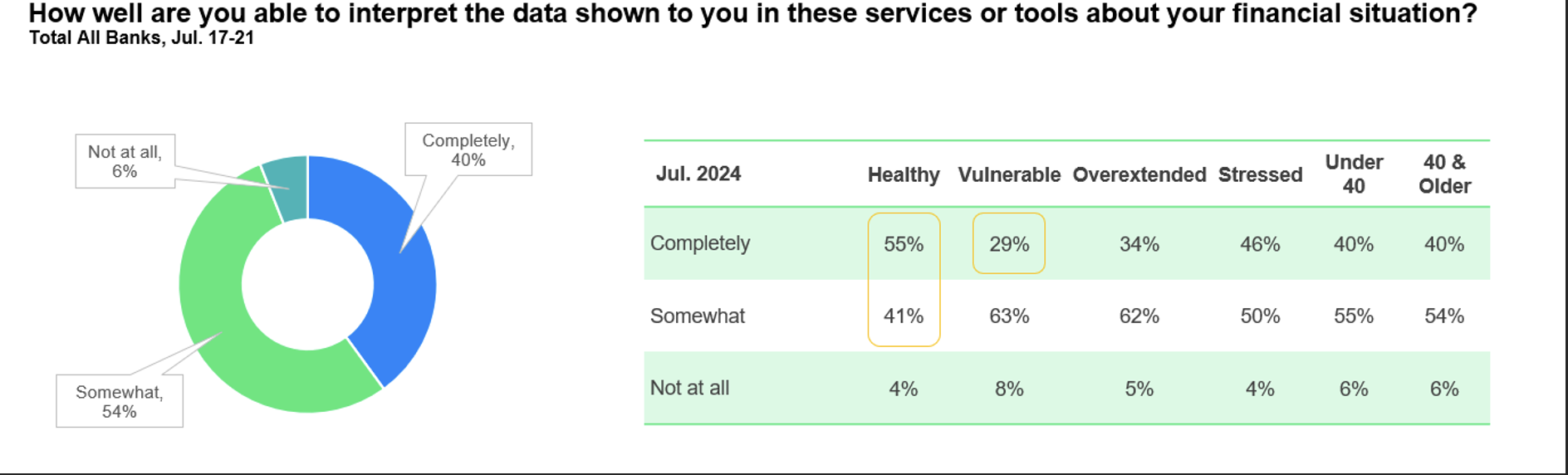
As customers acclimate to higher prices, banks have tried to offer personal financial management tools for support. Unfortunately, many are finding these tools to not be particularly helpful. In fact, just 40% of customers say that they completely understand the data presented to them in their bank’s personal financial management tool. That leaves an interpretation gap for more than half of users, one that widens as financial health status declines.

FS August Image 3

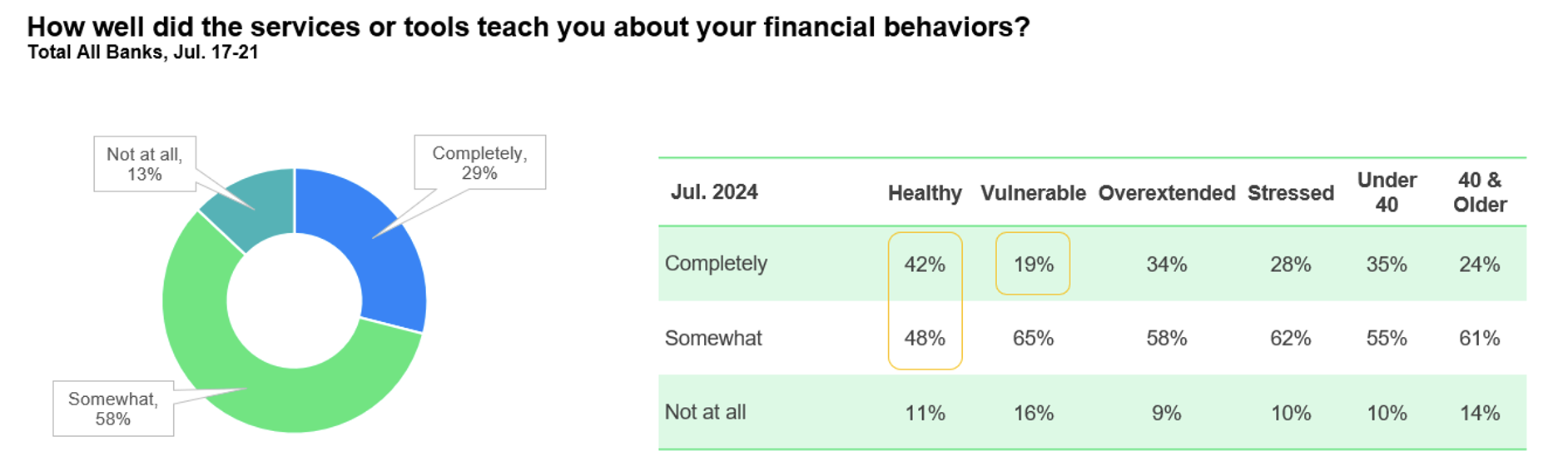
When asked specifically if personal financial management tools helped teach them about their money management behaviors, just 29% said they completely understand their spending habits thanks to these tools. That rate drops to 19% for vulnerable customers.

FS August Image 4

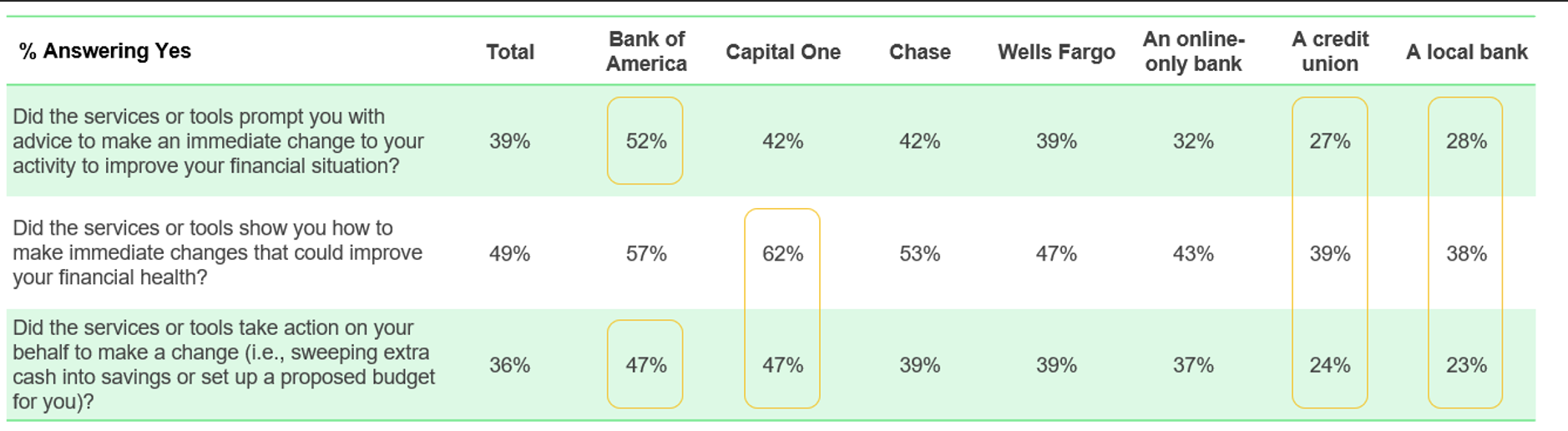
What’s more, customers are finding these tools to be too passive. Just 39% of customers said that their bank’s management service prompts them with advice to make an immediate change to their financial activity to improve their situations, while only 36% said the tools took action on their behalf (i.e., putting more money into savings or setting up a proposed budget).

FS August Image 5

Becoming Proactive

While the easing anxiety over inflation is certainly worth celebrating, the fact that most customers’ financial health has not changed is an indication that these modest improvements may not be sustainable. Simply growing numb to higher consumer goods isn’t the same as bolstering a customer’s finances, and that’s where most banks have an opportunity to intervene.
Personal financial management tools can be a game-changing solution for customers, particularly those searching for some relief. But if the data and insights provided aren’t digestible to the customer, there is no way to make them actionable. Customers are expressing a willingness to try these tools and have clear preference on what they want them to look like. Banks must find a way to make the solutions not only easier to understand, but more proactive to help customers take key steps toward better financial health. Banks that can do this stand to build trust and forge valuable relationships with their customers.
Find Out More

This Banking and Payments Intelligence Report is based on responses from 4,000 retail bank customers nationwide and was fielded in July 2024. It was authored by Jennifer White, senior director of banking and payments intelligence at JD Power. Please contact us at the numbers below to connect with Ms. White or to learn more about the underlying research.

Media Contacts

Brian Jaklitsch; East Coast; 631-584-2200; [email protected]

Geno Effler, JD Power; West Coast; 714-621-6224; [email protected]


[1] JD Power measures the financial health of any consumer as a metric combining their spending/savings ratio, creditworthiness, and safety net items like insurance coverage. Consumers are placed on a continuum from healthy to vulnerable.