Europe’s electric vehicle (EV) market continued a trend of double-digit growth at the start of 2026. As plug-in hybrid (PHEV) sales soared, two Chinese brands enjoyed success in the region. Tom Hooker, Autovista24 journalist, breaks down the figures.

Both battery-electric vehicle (BEV) and PHEV sales enjoyed a strong start to 2026 in Europe, following a record-breaking 2025.

PHEVs recorded a 33.5% increase to 101,548 deliveries in January, according to EV Volumes. This was the first time the technology surpassed six-digit sales figures in the first month of the year. The result was in stark contrast to the PHEV market’s global performance, as it endured a 20.6% decline in the same period.

Yet this was still some way behind the 188,752-unit total accrued by BEVs. However, this did represent smaller growth of 12.7%. Combining the two technologies, overall EV sales in Europe grew by 19.2% in January to 290,300 units.

PHEVs’ share of Europe’s EV market increased to 35% in the month, up 3.8 percentage points (pp) year on year. In turn, BEVs took a 65% hold, down from 68.8%.

BYD and Jaecoo’s PHEV success

Two Chinese models shot out of the starting blocks in January, topping Europe’s PHEV market. First was the BYD Seal U, the continent’s 2025 best-seller. Second was the Jaecoo J7, which placed ninth in last year’s PHEV rankings.

The BYD SUV recorded 6,713 sales, giving it its third consecutive monthly first-place finish. Its total was up 261.9% from 12 months earlier, as its share rose 4.2pp to 6.6%.

Jaecoo’s J7 followed with 4,166 deliveries. The model has become a strong contender in the European PHEV market after deliveries began taking off in February 2025. Its share stood at 4.1% in January 2026, 0.5pp ahead of the nearest challenger.

Contrasting European PHEV fortunes

The Volvo XC60 was the first of three European models vying to shine domestically. The SUV led the sector 12 months ago, however, it started 2026 with a 26.4% sales decline. This equated to 3,619 units, handing it a 3.6% share, down from 6.5%.

Behind was the Volkswagen (VW) Tiguan, which took second place behind the BYD Seal U last year. Yet the Tiguan started 2026 with a 1.2% drop to 3,547 deliveries. Amid increasing competition, the PHEV’s share of overall volumes fell by 1.2 pp to 3.5%.

However, not all European PHEVs suffered a decline in January. The Mercedes-Benz GLC saw sales rise 75.9% to 3,475 units, securing fifth. It captured 3.4% of the market, up 0.8pp year on year.

PHEV shares slip

The Ford Kuga landed sixth with 3,089 sales. This represented a 4.6% increase on 12 months prior. Even so, its share slipped by 0.9pp to 3%. Seventh was the Hyundai Tucson after a 18% improvement to 2,806 deliveries. The SUV also suffered from increased competition, with its share falling by 0.3pp to 2.8%.

A similar story could be seen in eighth. The Toyota C-HR saw its slice of the PHEV market drop from 3.6% to 2.7%. Its volumes were stagnant from January 2025, down 1.3% to 2,726 units. Conversely, sales of the BMW X3 soared by 47.2%, ensuring a ninth-place finish. Its 2,697-unit total translated to a 2.7% share, up 0.3pp year on year.

The VW Golf came 10th, with an even greater increase of 81.2% to 2,558 sales. It made up 2.5% of total PHEV volumes, up 0.6pp from January 2025. The hatchback was the only non-SUV present in the PHEV top 10.

SUVs were not far off from filling out January’s top 10. Just seven units behind the VW Golf sat the BMW X1, followed by three further SUVs. This highlights how the body type is dominating PHEV sales in Europe.

Skoda’s strong start to 2026

Europe’s BEV best-sellers list featured a more diverse range of body types. Yet an SUV still led the way, as the Skoda Elroq returned to first place. 2025’s second-place finisher posted 8,146 sales in January. This gave the all-electric model a 4.3% share of Europe’s BEV market.

The combined deliveries of the Renault 5 and the Alpine A290 narrowly missed out on victory. Just 45 units behind the lead, the duo’s 8,101-unit total was up 75.5%, as its share soared from 2.8% to 4.3%.

Last year’s best-selling BEV in Europe, the Tesla Model Y, took third. Its 7,130 deliveries were up 21.2% compared to 12 months prior.

The crossover made up 3.8% of all-electric volumes, a 0.3pp improvement from January 2025. This was a good result considering its typical delivery pattern is weighted towards the end of the quarter.

Slowing sales for VW models

In fourth, the Skoda Enyaq was some way back from the leading trio. Its 5,475 deliveries were down 18.4% year on year, as its share slipped 1.1pp to 2.9%. The VW ID.3 was 70 units behind as its sales stagnated. The BEV recorded 5,405 units in January, down 0.3%. In turn, its hold fell by 0.3pp to 2.9%.

VW’s other ID models suffered poor results. The ID.7 managed sixth with 4,735 new models leaving dealerships. This translated to a 19.6% slump, while its share went from 3.5% to 2.5%.

The ID.4, which led the market 12 months previously, sat seventh in January 2026. It endured a 33.2% drop in sales to 4,541 units. The all-electric model took a 2.4% share, down 1.7pp year on year.

VW was not the only German brand to see declining deliveries. The BMW iX1 landed eighth after a 1.6% fall to 4,042 units. Meanwhile, the Audi Q4 e-tron suffered a greater drop of 12.1% to 4,002 sales. Both models recorded a 2.1% share, down from 2.5% and 2.7%, respectively.

The Citroen e-C3 took 10th with 3,671 deliveries. This was a 20.5% increase on 12 months prior, while its hold saw a marginal 0.1pp uptick to 1.9%. The Audi Q6 e-tron was 31 units back, narrowly missing out on making January’s top 10 table.
Global electric vehicle (EV) sales declined at the start of 2026. The plug-in hybrid vehicle (PHEV) market felt the largest drop, but did all models experience the same fall? Autovista24 editor Tom Geggus explores the numbers.

According to the latest data from EV Volumes, the global EV market fell by 9.5% year on year in January. In total, 1,156,731 PHEVs and battery-electric vehicles (BEVs) were sold in the new passenger car market.

Even with the inclusion of extended-range electric vehicles, PHEVs felt a sizeable drop, with 381,254 deliveries. This result was down by 20.6% from the figures recorded in January 2025. It marked a sizable downturn from the 1.6% growth recorded in December.

However, the powertrain only accounted for a third of the global EV market in January. BEVs made up the remaining 67%. The pure-electric powertrain recorded 775,477 sales, which equated to a year-on-year drop of 2.8%. This was the first BEV drop since February 2024, according to EV Volumes.

So, while the global PHEV market saw a larger fall, it made up a smaller proportion of the international EV market. However, in terms of units, there were 99,109 fewer PHEVs sold in January, but only 22,044 fewer BEVs. But did all models see similar declines?

Balanced fall of PHEV models

Of the top 10 best-selling PHEVs in January, five models recorded sales declines while the remainder enjoyed positive results. This confirms the rapidly changing face of the market, with new offerings challenging established players for dominance.

The Fang Cheng Bao Tai 7 saw sales first kick off in the third quarter of 2025. Since then, it has seen volumes accelerate, taking the lead of the global PHEV market. In total, the model recorded 17,553 deliveries, making up 4.6% of all the powertrain’s sales.

Exemplifying the market split, the BYD Song Plus, also known as the Seal U, saw its sales drop by 47.3%. These 13,293 units accounted for 3.5% of the global PHEV market, down from 5.2% in January 2025.

Another more established leader, the BYD Song Pro, recorded a delivery decline of 39.5%. Its 12,590 sales made up 3.3% of all PHEV sales, down from 4.3% in January 2025, putting it in third.

New PHEV challenge

The Aito M7 saw a sales uptick of 41% to 11,901 units in fourth. This meant its market share increased by 1.3 percentage points (pp) to 3.1%. Behind it, the BYD Qin Plus recorded a 47.4% sales drop, with 8,353 units moved. Its share fell by 1.1pp to 2.2%.

In sixth, the Zeekr 9X captured 1.7% of the global PHEV market with 6,602 units sold. With deliveries commencing in September last year, this confirms a steep upward curve in buyer interest.

Seventh went to the BYD Seal 06. Its 6,405 sales equated to a 57.3% decline from January 2025. This pushed its market share down from 3.1% to 1.7%. Behind it, the Jaecoo J7 saw its share grow by 1.1pp to 1.5%. This was thanks to a 208.8% increase in demand to 5,802 units.

Ninth went to the Volvo XC60 as its share only slid by 0.1pp to 1.4%. However, its sales slumped by 25.1% year on year to 5,362 units. With 5,316 sales, the Aito M8 was in hot pursuit, taking 1.4% of the market as well. The chief difference is that the M8 first recorded sales in April 2025, while the Volvo XC60 is a familiar market presence.

New BEVs racing to top

The global BEV market was led by a familiar model at the start of this year. The Tesla Model Y recorded 54,786 deliveries, down by 11.2% year on year. This meant its hold on the market weakened by 0.6pp to 7.1%.

The Xiaomi YU7, which first recorded sales in June 2025, saw 37,956 units delivered, equating to a 4.9% share. The Nio ES8, also known as the EL8, represented 2.4% of all BEV volumes with 18,558 units. Following the launch of its third generation in September last year, it has seen sales climb.

The BYD Seagull, also known as the Dolphin Surf, came fourth in the month with 17,448 sales. This was down 19.6% on January 2025 as its share hit 2.2%, down 0.5pp. After first recording sales in September last year, the Li Auto I6 finished fifth with 16,876 units moved. It accounted for 2.2% of all BEVs sold.

The Tesla Model 3 came next as it moved 16,535 units, down 35%. Its market share dropped to 2.1% from 3.2% a year ago. The Geely Geome Xingyuan, also known as the EX2, finished seventh. Its sales declined by 41.6% to 16,442 units, capturing 2.1% of the market, down 1.4pp.

The BYD Dolphin finished eighth with 15,812 sales, up 60.3%, allowing it to increase its stake to 2% from 1.2%. After first recording sales in September 2025, the Aito M7 reached 13,129 sales in January, equating to a 1.7% share.

The BYD Yuan Up, also known as the Atto 2, came 10th. Its sales fell by 29.1% year on year to 11,702 units. This gave it a 1.5% share, down from 2.1% a year earlier.

The UK’s zero-emission vehicle (ZEV) mandate is scheduled for review. But with other countries amending their policies, will the UK’s targets be amended sooner, or later? Autovista24 special content editor Phil Curry reports on SMMT Electrified 2026.

The UK automotive industry needs a review of the ZEV mandate, otherwise it could fall behind in the electrification race. That was the main message from the recent SMMT Electrified conference.

Held in London’s QEII Centre, the event brought together automotive industry executives, regulators and suppliers. They discussed the current state of the UK’s electric vehicle (EV) market.

The conference followed shifting emissions policies in Europe and the dropping of mandated targets in Canada. Meanwhile, the UK Government remains committed to the ZEV mandate. This is despite overall battery-electric vehicle (BEV) registrations failing to meet the 2024 or 2025 targets.

The cost of reaching targets

The ZEV mandate calls on carmakers to meet an increasing share target of zero-emission models in their annual registrations. It first came into effect in 2024, with a 22% requirement for passenger cars. This increased to 28% for 2025, while the target is 33% next year.

This increases annually, reaching 80% by 2030. However, the biggest jump in the requirement comes between 2027 and 2028, with a 14 percentage point rise in the target, to 52%.

The Department for Transport (DfT) released a report on the morning of the conference. It highlighted that all carmakers had complied with the ZEV mandate in 2024. Manufacturers had used conversion flexibility, while also borrowing future credits, with some banked for future years.

However, SMMT chief executive Mike Hawes highlighted the costs that the industry faced in meeting ZEV mandate targets.

‘Non-compliance is not an option, but compliance comes at a massive cost,’ he told journalists, including Autovista24, during a press conference prior to the event. ‘In the first two years of the mandate, carmakers have spent up to £10 billion (€11.6 billion) in discounting on BEVs. That is in addition to the billions spent on new products, new technologies, and so forth.

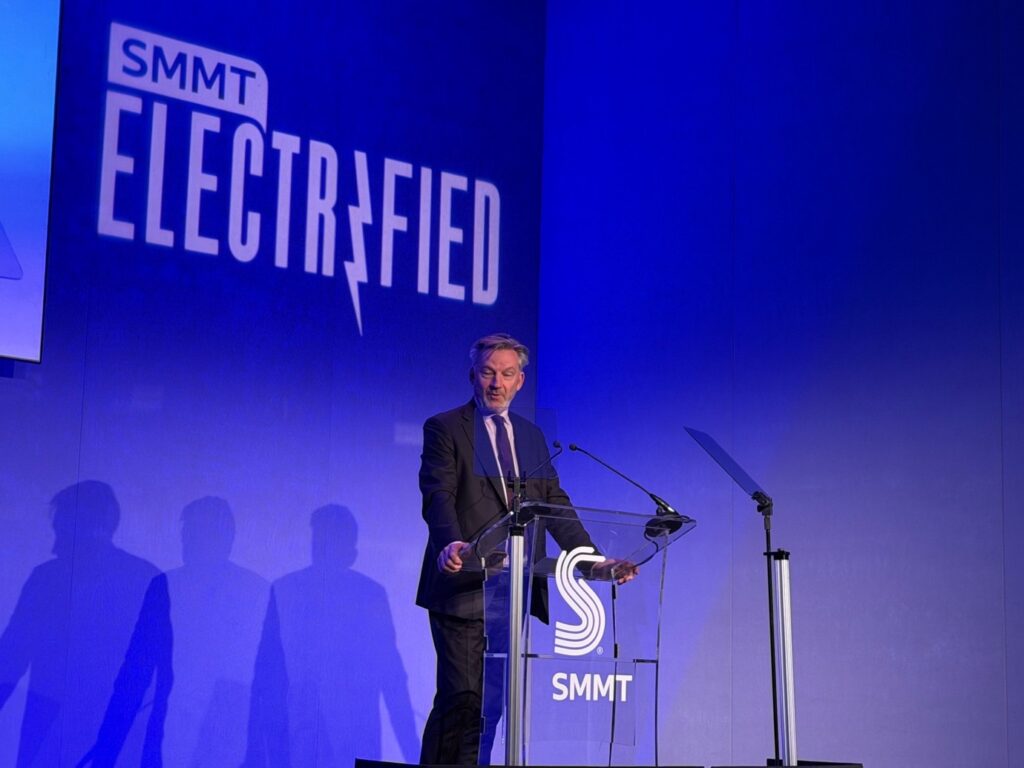
Mike Hawes speaking at SMMT Electrified 2026
SMMT chief executive Mike Hawes

‘In 2025, the average discount on a BEV model was £11,000. However, the payment for non-compliance to the ZEV mandate is £12,000 per model. Compliance comes with a tremendous cost, either in incentives, fines, or the need to purchase trading credits.

‘Therefore, while the DfT report shows that carmakers have met the requirements of the mandate in 2024, compliance does not necessarily mean that the mandate is deliverable,’ he stated.

Further ZEV mandate challenges

One issue impacting BEV uptake appears to be costs for consumers. The technology has long been touted as a more affordable alternative to petrol and diesel in terms of use.

However, there is often a cost difference between charging domestically and using public plug-in points. In addition, the implementation of vehicle excise duty (VED) last year increased costs.

A pay-per-mile scheme, known as eVED, for BEVs and plug-in hybrids was also announced in 2026. This is set to be introduced in 2028, at a point when the ZEV mandate target is set to jump. For carmakers, this could be a problem. The affordability of BEVs will be reduced, but the requirement for carmakers will leap forward.

‘Additionally, the flexibilities introduced last year will expire from 2029,’ added Hawes. ‘I do not know of anyone in the industry who thinks we will get to 80% of ZEVs by 2030. Beyond that, we still have a lack of clarity.

‘We have neither the regulation nor the certainty about exactly which technologies can be sold. But what we do know is the gap between ambition and demand is too great. The UK’s attractiveness, not just as a market, but as a manufacturing location, evaporates. De-carbonisation, if we get this wrong, can mean de-industrialisation.’

Good intentions of the ZEV mandate

Hawes stated that the UK’s automotive industry is committed to reducing emissions and working towards net-zero. ‘But sometimes, to reach a destination, you have to take a diversion. When the facts change, you have to adapt,’ he continued.

‘When the ZEV mandate was conceived, the world was a different place,’ Hawes stated. In line with statistics published by the SMMT during the event, he outlined that battery costs were 30% higher in 2025 than anticipated in 2021. Meanwhile, BEVs were 17% more expensive within the same timeframe.

In addition, industrial energy costs were 80% higher than expected, Hawes stated. The costs of public EV charging at 50kW points were 120% higher than thought when the ZEV mandate was first discussed, he added.

‘We need it reviewed now and resolved now. Without change, the sector, the economy, mobility and decarbonisation itself are in jeopardy. So, government needs to be bold enough to lead the change to make sure that we have a system that is fit for the future,’ he concluded.

Carmakers back early review

The ZEV mandate issue remained a constant throughout SMMT Electrified 2026. Carmakers in attendance also backed the need for a review of the current strategy.

‘The ZEV mandate needs to be more aligned to where consumer demand is. Investment is so heavy in the market, then some of the vehicles sold will be loss-making. If you are in that scenario, and you are forced to increase supply as the ZEV mandate does, then that calls investments into question,’ highlighted Eurig Druce, SVP, group managing director at Stellantis UK.

‘If you cannot make a return on investment in a country, then the ability of a company to invest and create the growth that the government is looking for is absent. Therefore, we need to make some quick decisions, and a review next year is too late. We need a review now, to help us make the right decisions on investments,’ he continued.

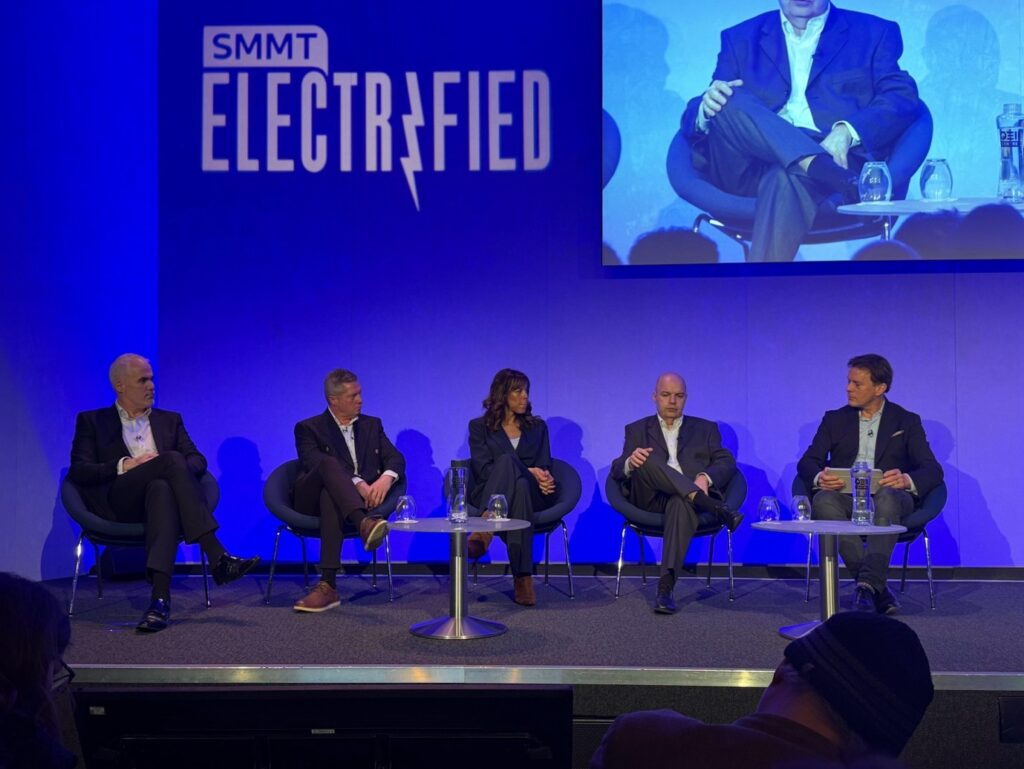
Carmaker panel at SMMT Electrified 2026
From left to right: Patrick McGillycuddy, managing director at JLR UK, Richard Finchett, deputy managing director at Toyota Manufacturing UK, Nicole Melillo Shaw, Managing Director at Volvo Car UK, Eurig Druce, SVP, group managing director at Stellantis UK

But while development of BEVs continues, the route of discounting is not one that carmakers want to be going down.

‘We put a lot of investment into developing and building the advanced technology in BEVs. The last thing anyone wants to do is bring out a car with that much investment, and then start discounting from the beginning. It is unsustainable. So I think we need to make sure that we are allowing for demand to catch up with supply,’ pointed out Nicole Melillo Shaw, managing director at Volvo Cars UK.

A different approach

Patrick McGillyCuddy, managing director at JLR UK, further underlined the issue of confusion among consumers. ‘We have a very ambitious ZEV mandate, and then we have the eVED, which is proposed to come at a critical time in that journey,’ he said.

‘This causes confusion, and consumers will hesitate. Then we hesitate, and you get an uncertain environment. We produce most of our vehicles in the UK for global export, therefore we have to recognise that different parts of the world are moving at a different pace,’ he added.

Ford Motor Company chair and managing director, Lisa Brankin, also brought up the issue during a candid fireside chat.

‘When it comes to a review, the government needs to consider the customer in two areas. They need to knock down the barriers to entry, but also understand and prevent confusing messages.

‘Last year, for example, we had the launch of the Electric Car Grant incentive scheme. That helped drive sales forward. But a few months later, there was the announcement of eVED. The two messages did not align, so the government really needs to be mindful of what it is saying if the end goal is electrification,’ she said.

Failure from success

Brankin also highlighted how the ZEV mandate directed focus away from Ford’s achievements in 2025. Instead, it suggested failure in the company’s performance, she explained.

 Lisa Brankin and Katie Derham at SMMT Electrified 2026
From left to right: Lisa Brankin, chair and managing director, Ford Motor Company, Katie Derham, host and broadcaster

‘Our sales grew by 20% in 2025, which was a great success. But we count it as a failure as we got to just under 24% of the fleet being ZEVs, when the target in the mandate was 28%. We are moving in the right direction, but not meeting targets,’ she stated

‘We have invested heavily in our facilities in Europe to build EVs, but we are having to discount heavily to meet targets. We may also be forcing people into vehicles that maybe they do not necessarily want, or maybe are not appropriate for them,’ she said.

Brankin also pointed to the changes in other ZEV policies that have taken place around the world. ‘Canada has made a change, and our closest partners in the EU have already made adjustments. That was carried out in a matter of months rather than over a longer period. So, I would say to the UK government to get on with it, start the review, decide, and make the announcement this year,’ she continued.

Government committed to 2027 ZEV mandate review

Taking to the stage at SMMT Electrified 2026, Keir Mather MP, minister for Aviation, Maritime and Decarbonisation, spoke of the success of the UK’s EV market. He highlighted that the country had the largest BEV share of Europe’s major economies, as a result of ambition, partnership and investment.

Autovista24 analysis shows that in 2025, the UK saw its BEV share reach 23.9%, with 473,348 units. While this share was higher than the 19.1% achieved in the closest market, Germany, the volume of BEVs was lower. In 2025, the country saw 545,142 units delivered.

Mather also stated that the EV transition in the UK is being backed by tens of billions of pounds in public and private investment. But he acknowledged that the ZEV mandate is potentially a challenge for the industry.

‘Is [the ZEV mandate] ambitious? Yes, of course it is, and we as government are committed to giving you the tools you need to make it happen. The industry successfully complied with the 2024 target, using the flexibilities built into the mandate, and provisional 2025 data also looks promising,’ he commented.

‘We are committed to publish a review of the mandate early in 2027, and we are listening, and we are engaging with stakeholders across the industry.’

When asked about the potential for an early review, as called for throughout the conference, Mather stated: ‘Work on the review needs to begin this year. But early 2027, we feel, is the right point to make sure that we can see properly where the pressure points lie in this ZEV mandate and make sure that it continues to work for manufacturers.’

What were the key talking points from SMMT Electrified 2026? Plus, a look at Renault’s new strategy and major robotaxi collaborations. Autovista24 editor Tom Geggus presents the latest Automotive Update podcast.

Autovista24 special content editor Phil Curry joins the Automotive Update from SMMT Electrified 2026 in London. Plus, a dive into Renault Group’s plan to drive growth in the run up to 2030. Also, a look at which companies will work with Wayve on new autonomous vehicle technology.

Subscribe to the Autovista24 podcast and listen to previous episodes on Spotify, Apple and Amazon Music.

Inside SMMT Electrified 2026

SMMT Electrified 2026 focuses on the UK automotive industry’s transition to electric vehicles (EVs) and other zero-emission technologies.

Among a wide range of topics, this year’s event focused in on key policies that could shape EV production and demand in the UK. This included the ZEV mandate, which SMMT chief executive Mike Hawes said requires an ‘urgent review.’ This is due to the domestic EV market not reaching its full growth potential, he explained.

Subsequently, industry figures called for further ZEV mandate clarity at the event. Patrick McGillycuddy, managing director at JLR UK, highlighted customer confusion. This uncertainty has been exacerbated by the looming pay-per-mile EV charge. Meanwhile, Lisa Brankin, Ford UK chair and managing director, pointed out that carmakers are facing challenges in meeting the ZEV target.

Renault’s new era

Renault Group has announced ‘futuREady’, its new strategic plan. Central to the initiative is an aim to sell over two million cars by 2030. These targets will be enabled by the launch of 36 new models.

In Europe, the Renault brand will launch 12 models spanning the A and B segments, as well as new models in the C and D segments. International markets will see 14 new vehicles launched by the brand between now and 2030.

Elsewhere within Renault Group, Dacia plans to electrify two-thirds of its sales in 2030. The brand will also look to increase the number of EVs in its range from one to four. Meanwhile, Alpine will launch the next generation of its A110, as well as building on the A290 and the A390. 

François Provost, CEO of Renault Group, stated: ‘futuREady, our new strategic plan, is a crucial step in the future of Renault Group. In an environment that is even more competitive, we can build on solid fundamentals: our brands, our products and our financial results.’ 

Wayve hello to new autonomous collaborations

UK-based autonomous driving company Wayve has announced a new robotaxi collaboration with Uber and Nissan. The trio hope to launch a pilot in Tokyo later this year. The project will integrate Wayve’s AI autonomous driving system into a Nissan base vehicle. This will then be connected with Uber’s ride-hailing platform.

Elsewhere, Wayve will also work with Qualcomm on a pre-integrated advanced driver-assistance and automated driving system for carmakers. This will provide support for entry-level hands-off driving assistance, as well as for eyes-off automated driving.

China’s plug-in hybrid (PHEV) market struggled in 2025, but could December’s results suggest a slowing battery-electric vehicle (BEV) market? Autovista24 special content editor Phil Curry examines the market and the best-selling models of 2025.

China’s electric vehicle (EV) market ended 2025 with growth. But the BEV and PHEV results in December suggest that 2026 could prove to be a difficult year.

In total, 8,097,866 BEVs were sold across 2025, a rise of 27.6% year on year, according to EV Volumes’ latest data. Meanwhile, 5,072,986 PHEVs made their way to customers in China, an increase of 4.2%.

A slowdown in the plug-in hybrid market across 2025 altered the powertrain dynamics in the country. During December alone, PHEV sales fell by 4.2%, with 558,513 units leaving dealerships. This was the sixth monthly decline in a row, according to the latest EV Volumes figures.

Yet the BEV market also slowed in December. With 788,471 units delivered, volumes increased by 4% year on year. This was the lowest growth since June 2024. This meant the combined EV market recorded 1,346,984 deliveries, a rise of just 0.5% compared to the same month in 2024.

So, BEVs accounted for 61.5% of all EV sales last year, an increase of 4.9 percentage points (pp). This meant PHEVs took 38.5% of the market, down from 43.4% a year prior. With PHEV sales in decline, the country’s EV market will be hoping December is not a precursor for what is to come.

China’s best-selling PHEV: the BYD Qin Plus

BYD dominated China’s slowing PHEV market in 2025. The carmaker placed seven models in the country’s top 10, however, only one of these achieved year-on-year growth.

The best-selling PHEV in China last year was the BYD Qin Plus. Having placed second in 2024, it jumped to the top of the chart with 281,413 sales in 2025. However, this was down by 17.6% compared to its volumes in the previous year. The result was good enough for a 5.5% market share, a drop of 1.5pp.

In December, the BYD Qin Plus topped the PHEV chart with 40,000 sales in the month. This was an increase of 31.1% compared to December 2024. The result was good enough for the model to achieve a 7.2% market share, up by 2pp.

In second place at the end of 2025 was the BYD Seal 6, which achieved 188,525 sales across 12 months. This was a 2.6% decline year on year, while its market share of 3.7% was down 0.3pp.

December saw the model suffer its worst volume result since it first recorded sales in May 2024. Just 6,111 units were sold, a 77.1% decline year on year. This left it in 27th position, while the Qin Plus increased its lead in the annual chart.

Changing times in China

Third in 2025 went to the BYD Song Pro as it recorded 180,661 sales. This was a drop of 28.3% year on year. The model took fourth in December, as 18,373 units made it to Chinese roads, a decline of 27.6%.

The Song Pro was helped in the annual chart by a terrible month for the fourth-placed BYD Song Plus. It ended December 44th in the monthly chart, with just 4,000 sales, an 88.3% volume decrease.

This was in stark contrast to its performance in Europe. Known in the region as the Seal U, it topped both December’s and the annual best-selling PHEV chart.

In China, the Song Plus achieved 166,764 deliveries between January and December. This was a decline of 51.4%, the worst percentage drop recorded in the PHEV top 10. Having won the title in 2024, its market share of 3.3% was down by 3.7pp.

The first non-BYD model was the Li Auto L6 in fifth. With 166,174 deliveries, it ended the year just 590 units behind the BYD Song Plus. However, its volumes were down by 13.6%. This gave the model a similar 3.3% market share. The L6 was helped by a ninth-place finish in December’s table, although the 12,334-unit tally was down by 55.6%.

Making their mark

The BYD Qin L recorded 162,817 sales across 2025. It was another BYD model to see sales drop, down by 29.1% year on year. In December, the model finished 13th with 10,000 sales.

The newest model in the 2025 top 10 was the Aito M8 in seventh. With sales first recorded in April 2025, it achieved a total of 148,934 deliveries, to grab a 2.9% market share. It was helped by a sixth-place finish in December, with 17,123 sales.

The BYD Song L took eighth. It was the only model from the brand in the top 10 to record growth. Furthermore, it was only one of two PHEVs in this list to see its sales increase at all. With 141,686 deliveries, it achieved a 16.5% improvement year on year. December saw the model finish eighth as well, with 13,000 deliveries, although this was down by 42.1%.

The BYD Destroyer 05 jumped to ninth, with 127,509 sales, a 40.5% decline. Having started the year strong, sales slipped from March onwards. Although the 123,137-unit total for 2025 was 496.7% up compared to 2024.

The Galaxy Starship 7 was not helped by a 32nd-place finish in December. Just 5,190 units were delivered, the model’s worst volume total since its launch. Having started the year strongly, declining fortunes across 2025 meant it finished 10th in the annual table.

New models fight for places

Many of the 2025 top 10 secured their place in the chart thanks to strong performances early in the year. But five different models made the table in December alone, suggesting 2026 could see more competition than ever.

Finishing second was the Fang Cheng Bao Tai 7, with 34,086 deliveries. It was followed in third by the Aito M7, with 26,468 units delivered, a 97.3% year-on-year increase. Fifth went to the BYD Sea Lion 6, with 17,380 units sold. The BYD Seal 5 was seventh with 16,484 deliveries in just its third month on the market.

Rounding out December’s table was the WEY Gaoshan, with 10,846 sales. This was a record result for the model, which has been on the Chinese market since September 2023. It was also the second time it achieved a five-digit volume in its history, following another impressive performance in November.

China’s best-selling BEV: The Geely Geome Xingyuan

China’s best-selling BEV in 2025 was the Geely Geome Xingyuan. With 471,410 deliveries, it powered to the top spot in its first full year on sale. It comfortably beat 2024’s BEV leader, the Tesla Model Y, taking back the market for domestic brands. It achieved a 5.8% market share across 2025.

In December, the Geely Geome Xingyuan placed second with 41,619 deliveries, a rise of 152.4% year on year. This was good enough for a 5.3% market share, up 3.1pp.

Taking second in the annual table was the Wuling Mini, with 431,617 sales. This was an increase of 65.3% compared to 2024, while its 5.3% market share was up 1.2pp.

The model had a rollercoaster 2025, with strong results in the last months of the year. It topped monthly sales tables in September, October and November, helping it take second in 2025. This run ended in December, as the Mini placed sixth with 19,076 deliveries, down 49.5% year on year.

Rounding out the top three last year was the Tesla Model Y. After taking the best-selling BEV title in 2024, it slipped down the rankings with 425,337 sales, a drop of 11.4%. This meant its 5.3% market share was down by 2.3pp compared to 2024.

Yet the US BEV did claw back some of its gap to the second-placed Wuling Mini in December. It topped the monthly sales, with 65,874 units, a rise of 6.5%, in line with its usual end-of-quarter delivery peak. However, results earlier in the year left it battling the domestic brands across 2025.

BYD Seagull fails to fly

The BYD Seagull, which took second in 2024, fell to fourth place last year with 310,956 sales. This was a drop of 29.7%. It was responsible for 3.8% of all BEV deliveries in China last year, down from the 7% achieved in 2024. December was a difficult month for the Seagull, with 18,307 units taking to Chinese roads, a 62.5% decline.

The Xiaomi SU7 was the fifth-best-selling BEV in China last year, with 258,065 sales. This was an 85% increase compared to 2024, with a 1pp jump in market share to 3.2%. Its position was not helped by a 16th-place finish in December’s table, with 11,024 deliveries, its worst volume of the year.

In sixth was the BYD Yuan Up, with 217,814 deliveries between January and December. This was an increase of 61.5% compared to 12 months prior, bucking the trend of BYD declines. It achieved a 2.7% hold of China’s BEV total, a rise of 0.6pp. December saw the model finish in seventh, with 18,766 deliveries, a 1.2% rise.

The Tesla Model 3 ended 2025 in seventh with 200,361 units making their way to customers. This was an increase of 13.3% compared to 2024, although its market share fell 0.3pp to 2.5%. The US BEV was helped by a strong December, where it placed fourth with 27,969 sales. This was a 32.9% improvement on the year prior.

Strong positions despite poor results

The Xpeng M03 took eighth in 2025 with 177,150 units. This was a 264.7% rise against 2024’s figures. Its 2.2% market share was up from 0.8% the year before. The model had a steady year in 2025, although it placed 12th in December with 14,183 sales.

The Geely Panda Mini was the ninth-best-selling model of 2025, with 162,108 deliveries, an improvement of 23.2%. However, with increased competition, the model’s market share fell 0.1pp to 2%. This was despite placing just 54th in December’s sales chart, with 4,373 units, its lowest volume recorded in a month since January 2023.

However, this was not enough for the BYD Dolphin to take advantage. The model jumped into the annual top 10 with 160,745 sales, up by just 0.1%.

Ones to watch in 2026

Four models made December’s top 10 best-selling BEVs list, while not entering the yearly table. Leading this group was the Xiaomi YU7 in third, with 38,927 sales. The model has proven popular since its launch in June 2025.

The Nio ES8 achieved a record result, despite deliveries starting around March 2018. December saw the model record 20,354 sales, a 1,933.4% increase year on year. It was only the second time the ES8 had recorded five-figure deliveries after November’s tally.

Having started deliveries in August 2025, the ArcFox T1 made its top 10 debut in December, with 17,170 sales. This was good enough for ninth. Meanwhile, the Li Auto I6 took 10th with 16,080 deliveries in its fourth month on the market.

European deliveries of battery-electric vehicles (BEVs) and plug-in hybrids (PHEVs) reached new highs in 2025. For both powertrains, however, the best-selling model did not hail from a domestic carmaker. Autovista24 journalist Tom Hooker reveals the two EV champions.

Europe’s historic EV performance in 2025 was a joint effort between BEVs and PHEVs. Both technologies contributed to the continent’s record-breaking plug-in growth, with double-digit improvements of around 30% year on year.

BEVs enjoyed a 29.9% sales increase to 2,598,165 units, according to EV Volumes’ latest data. This was the powertrain’s biggest full-year percentage growth since 2021.

PHEVs saw a smaller volume of 1,283,160 units. However, this represented a steeper rise of 34.2% compared to 2024, the technology’s best year-on-year improvement in four years. The result marks a significant comeback for PHEVs, which suffered full-year declines in 2022, 2023 and 2024.

PHEV’s notable volume growth translated to a bigger slice of the EV market. Plug-in hybrids made up 33.1% of all new EV deliveries in Europe during 2025. This was an increase of 0.8 percentage points (pp) year on year, and 0.2pp ahead of its 2023 share.

While BEVs remained dominant, the powertrain’s share fell from 67.7% in 2024 to 66.9% in 2025.

BEV’s remarkable growth

All-electric cars witnessed a remarkable increase in deliveries during December, which gave the EV figures a final boost. Volumes surged by 52.3% year on year to 311,801 units.

This was the biggest percentage growth recorded since August 2023. The result also completed a 12-month run of consecutive double-digit improvements.

PHEV’s December was also impressive, with a total of 127,251 sales equating to a 40.1% increase year on year. This result displayed consistency, the determining factor in the technology outpacing new BEV growth in 2025.

PHEVs started the year poorly, with two declines in January and February. Since March, however, the powertrain recorded 10 double-digit gains, six of which surpassed the 40% mark. Meanwhile, BEVs only managed to clear this threshold in December.

New EV sales by country

Amid relatively balanced new BEV and PHEV growth, some countries saw their EV market shares surge, while others stalled. Within Europe’s new all-electric car market, Germany recorded the highest number of sales. 20.8% of BEVs sold in Europe last year were delivered in Germany, up 1.9pp year on year.

The UK, which led Europe’s BEV market in 2024, fell to second despite a double-digit improvement. It accounted for 18.2% of all BEV sales in Europe, down 0.9 pp.

Third was France, which saw a steeper share decline of 1.8pp to 13%. Norway finished fourth, enjoying the biggest year-on-year volume increase of any country in the top five. Sales soared by 50.7%, as its share rose by 0.9pp to 6.6%.

The Netherlands came fifth, with its market hold decreasing by 0.5pp to 6.1%, even with deliveries improving by 20.6%.

In the PHEV market, Germany also topped the standings, again helped by strong sales growth. Its share surged by 4.2pp to 24.2%. The UK followed with a 17.6% hold, stable from 2024.

After posting the sixth-highest new PHEV volumes in 2024, Spain jumped to third in the table, thanks to a 118.3% rise in sales. Consequently, its market share went from 6.1% to 10%.

France faced falling PHEV deliveries in fourth. This caused its share to slump, dropping from 15.2% in 2024 to 8.6% in 2025. Italy was fifth with a 7.6% market share, up 2.1pp year on year. The country witnessed an 85.7% uptick in PHEV sales during 2025.

Europe’s best-selling new EV revealed

While EV adoption speeds varied across European countries last year, one model emerged as a clear champion.

After taking the title in 2022, 2023 and 2024, the Tesla Model Y was victorious in 2025. With 150,605 sales, the crossover was not only the best-selling BEV, but the best-selling EV overall. It captured 5.8% of the all-electric car market, and it sat 56,518 units ahead of its closest competitor.

Following its usual quarterly reporting pattern, the Model Y also dominated the BEV standings in December. This was thanks to 23,732 sales. However, despite its lead, its volume represented a 17.4% decline year on year.

This forms part of a waning trend for the Model Y in Europe. The crossover’s full-year sales total marked a drop of nearly 60,000 units compared to 2024. It also represented a loss of over 100,000 units from 2023.

Skoda’s new SUV secures second

Second place was claimed by the Skoda Elroq, which posted 94,087 units between January and December 2025. This was an impressive feat considering the compact SUV began series production in January 2025.

Sales showed no signs of slowing in December, with a best-ever monthly total of 12,645 units. This was enough to put it in second in the monthly BEV table.

The combined sales of the Renault 5 and Alpine A290 took third in the full-year standings, with 90,770 units. Like the Skoda Elroq, European deliveries began in 2024, building into a record result in December 2025. The hatchbacks saw 11,903 deliveries during the month, up 86.4% year on year, securing third.

The Tesla Model 3 finished fourth in 2025, posting 86,612 sales. Unusually, the sedan ended the year with a delivery drop compared to November. This contradicts the BEV’s regular trend of recording higher sales at the end of the quarter. Yet, its 11,227-unit total was still enough for fourth in December, despite representing a 26.9% fall year on year.

Last-minute position changes

Fifth went to the Volkswagen (VW) ID.3, as it posted 78,899 deliveries in its fifth full year on the market. December was its highest volume month, with 8,451 new models leaving dealerships, its best figure since June 2024. This also equated to a 76.1% improvement year on year, putting it sixth in the monthly standings.

Just 576 units behind was the Skoda Enyaq, with 78,323 sales in 2025. Of this total, 7,437 units came in December alone, a 2.9% increase on 12 months prior and its highest monthly volume since March 2025. However, with other models seeing steeper growth in December, this was only enough for ninth place.

A further 335 units back was the VW ID.4, with 77,988 deliveries. Like many other BEVs, December marked a high point for the model in 2025. Its 8,565-unit total was its best since July 2023 and equated to a 57% rise on December 2024. It placed fifth in the monthly table, just ahead of its sibling, the ID.3.

Record results

Another all-electric offering from VW’s ID range secured eighth with 76,528 sales: the ID.7. It achieved a new monthly delivery record in December, with 8,359 units, up 49.2% year on year.

Overall, five VW Group models featured in Europe’s BEV best-sellers table in 2025. Additionally, Audi’s Q4 e-tron and Q6 e-tron models placed 11th and 12th.

BMW’s iX1 took ninth, with 67,618 deliveries. This was helped by a strong December, where the SUV placed seventh. A total of 8,423 new models left dealerships, its best-ever monthly figure and up 55.1% year on year.

The Kia EV3 rounded out the full-year standings in 10th, as the crossover SUV posted 66,350 sales in 2025. The model failed to make December’s table.

Instead, placing 10th in December was the Audi Q4 e-tron, with 7,180 sales. This was an increase of 19.6% year on year and meant five models from VW Group made the monthly top 10.

BYD’s new PHEV champion

Europe’s PHEV market crowned a new champion in 2025: the BYD Seal U. The SUV led the way with 66,611 sales from January to December, giving it a 5.2% share. It marked BYD’s maiden win in Europe, as the PHEV fended off strong competition from domestic models.

The model also topped December’s monthly standings, with 8,606 deliveries translating to a year-on-year increase of 213.9%.

Its closest rival, the VW Tiguan, was 6,109 units behind across the year, with 60,502 new models leaving dealerships in 2025. The model recorded 4,827 sales in December, an improvement of 28.5%.

Third went to the 2024 victor, the Volvo XC60, which recorded 58,979 deliveries. The PHEVs’ sales pace slowed in December, as it suffered a 6.5% decline to 5,981 units.

New sales trail off

Some distance behind in the full-year standings was the Ford Kuga in fourth, with 44,500 sales. This was still more than it achieved in 2024 when it placed second, highlighting the increased competition in Europe’s PHEV market.

Volumes trailed off in the final quarter of the year, culminating in a weak December. The Kuga delivered 2,722 units in the month, its lowest figure since May 2024.

The Mercedes-Benz GLC enjoyed a much stronger end to 2025, finishing in fifth with 39,373 units. It finished in the same place in December’s standings, with 4,576 deliveries. This was the fourth consecutive month where sales passed the 4,000-unit threshold.

Just one unit behind in the yearly table was the MG eHS. This was a lucky escape for the GLC, as the MG eHS stormed to second in December’s table with surging sales. Its 6,000-unit total was up 223.6% compared to 12 months prior. The result also marked the PHEV’s largest-ever monthly volume.

These moves came at the expense of the BMW X1, which took seventh in the full-year table. The model posted 39,226 units in the 12-month period. As its closest rivals placed highly in December, the SUV could only manage eighth. The X1 suffered a 19.5% year-on-year drop in the month to 3,083 units.

Jaecoo’s accelerating progress

The Toyota C-HR claimed eighth in 2025 with 35,356 units. In December, the PHEV enjoyed a 114.1% sales jump to 3,194 units. Taking ninth was the Jaecoo J7, thanks to 29,587 deliveries in 2025.

Strong monthly results towards the end of 2025 helped to accelerate its progress, including a sixth-place finish in December. Rounding out the yearly table was the Cupra Formentor, which took 10th. The PHEV posted 29,327 deliveries from January to December.

Key new EV market trends

This meant that the top 10 best-selling PHEVs in Europe last year were all SUVs. This contrasted with the BEV chart, which included other segments such as hatchbacks.

However, compared to the BEV best-sellers list, the PHEV top table featured a higher variety of brands. For the latter, 10 different carmakers filled the top 10 spots, while six marques placed in the BEV standings.

These trends could change by the end of this year, as new EVs continue to enter the market. Competition is set to increase as volumes grow further. This will make it harder for individual models and brands to solely dominate the BEV or PHEV standings.

Which new battery-electric vehicle (BEV) and plug-in hybrid (PHEV) models recorded the greatest sales volumes in 2025? How did regional dynamics dictate the best-seller tables? Autovista24 editor Tom Geggus unpacks the data.

Following two years of global new PHEV sales growth outpacing all-electric cars, 2025 saw BEVs surge ahead. With 13,697,372 units taking to roads around the world, the powertrain recorded year-on-year delivery growth of 26.7%. This is according to the latest data from EV Volumes.

Meanwhile, PHEV deliveries slowed to an increase of 11.1%, down significantly from the 55.2% acceleration in 2024. Last year saw 7,217,499 plug-in hybrids making their way to customers.

Much of this came down to China’s slowing PHEV market. The country was responsible for 70.3% of the powertrain’s sales, meaning declining results impacted the global market. In contrast, Spain saw triple-digit sales growth for the technology, but it made up a far smaller global share of just 1.8%.

Between the two, the US made up 4.6% of the world’s PHEV market, with sales up 4.8%. Then came Germany with 62.5% growth and a 4.3% share. The UK had the fourth largest PHEV market, accounting for 3.1% of sales globally. The country saw deliveries increase by 34.5%.  

The slowdown was highlighted by an increase in December’s global volumes of just 0.9%, as 758,073 sales were recorded.

BEVs bounce ahead

In contrast, China saw its BEV market pick up speed last year, with growth reaching 27.6%. Despite a smaller portion of global sales compared to PHEVs, it still dominated global deliveries at 59.1%.

This was still far ahead of the next biggest market, the US, which saw sales fall by 3.9%. In total, 8.7% of all-electric car sales took place in the country.

Given China’s slowing EV market and emissions regulation changes in the US, the dynamic of the global EV sector could shift in 2026 and beyond.

Germany followed with 4% of the global BEV market as sales increased by 43%. The UK was 0.5 percentage points (pp) behind with a 3.5% share as sales increased by 24.2%. France saw all-electric sales increase by 13.6% as it made up 2.5% of all-electric deliveries.

In December, BEVs managed a global increase of 12.4%, as 1,376,827 units made their way to customers.

Best-selling BEV: Tesla Model Y

The Tesla Model Y was the world’s best-selling BEV of 2025. With new variants and designs launched, it was the only electric vehicle (EV) to exceed the one-million delivery mark. In total, 1,085,521 units made their way to customers as it retained the market lead it has held since 2022.

However, within an increasingly competitive space, the model saw its sales fall by 7.5% year on year. This meant its market share shrank from 10.9% in 2024 to 7.9% last year.

Most of the Model Y’s sales in 2025 took place in China. Given the country’s greater EV market development, this should come as little surprise. However, the US was only 9.2pp behind, with 30% of the model’s overall sales taking place there.

Behind these two formidable markets came South Korea, Turkey and Canada, representing 4.6%, 2.9% and 2.6% of the BEV’s sales.

The Tesla Model Y was helped by a strong December. 129,650 units were sold in the month, boosted by its traditional quarterly reporting period. This was, however, 4.3% down year on year.

Tesla takes second as China dominates

The second-best-selling BEV last year had four things in common with the market leader. It was another Tesla, it saw updates in 2025, it retained its position from 2022 onwards, and its deliveries fell.

The Tesla Model 3 saw sales decline by 5.5% to 499,685 units in 2025. This meant its market share dropped by 1.3pp to 3.6%.

The Model 3 saw 40.1% of its sales take place in China. But once again, the US was only 9.1pp behind at 31%. The all-electric sedan saw positive uptake in the UK, with 3.1% of its deliveries occurring in the market.

In December, the Model 3 placed second thanks to Tesla’s quarterly reporting. It achieved 55,198 sales, a 5.6% dip year on year.

The Geely Geome Xingyuan, also known as the EX2 in some locations, ended the year in third. A relative newcomer in the BEV market, it first recorded sales in September 2024. It saw a marked increase of 800% to 473,948 units as its market share jumped by 3pp to 3.5%.

While the Tesla Model Y and Model 3 each recorded sales across more than 75 markets, the Xingyuan contrasted heavily. It only posted deliveries in four markets, China, Brazil, Mauritius and Colombia.

However, the latter three markets noted relatively minimal sales compared to China. It saw 99.5% if its sales take place domestically. The model is scheduled to enter major European markets in 2026.

The Geome Xingyuan saw 43,185 sales in December alone, as it increased volumes by 161.9% year on year. This capped an impressive first full year on sale for the Chinese BEV.

Eight Chinese BEVs in top 10

The Xingyuan began an avalanche of BEVs from Chinese carmakers. Eight of the top 10 in the best-sellers list came from the country.

The Wuling Mini was fourth as it saw sales climb by 65.3% to 431,779 units. This gave it a market share of 3.2%, up from 2.4% in 2024. The BYD Seagull, also known as the Dolphin Surf in some markets, took fifth. However, its sales fell by 13.3% to 409,550 units. This took its share down by 1.4pp to 3%.

The Xiaomi SU7 came sixth as its market share increased by 0.6pp to 1.9%. This was thanks to year-on-year sales growth of 85.3%, reaching 258,824 units.

With a similar 84.2% rate of growth, the BYD Yuan Up, also known as the Atto 2, recorded 252,441 deliveries. Its share climbed by 0.5pp to 1.8%.

The BYD Dolphin saw a 4.6% rise in sales to 227,352 units. Even though this was a better volume than in 2024, greater competition meant the BEV saw its market share shrink. It accounted for 1.7% of all BEV deliveries, down from 2%.

The BYD Yuan Plus, also known as the Atto 3, saw sales decline by 33.7% to 225,133 units. This resulted in a 1.5pp decline in share to 1.6%. In 10th, the Xpeng M03 enjoyed a 264.7% sales increase to 177,150 units. Its grip on the market increased to 1.3% from 0.4% in 2024.

Best-selling PHEV: BYD Song Plus

While BYD was able to capture four of the top-10 best-selling BEV positions, it excelled in the PHEV market. In total, it claimed seven of the best-selling slots in the year, including first place.

The best-selling PHEV in 2025 was the BYD Song Plus, known in some markets as the Seal U. This extended its winning streak, after it claimed the title in 2024. Last year it recorded 328,094 sales, taking 4.5% of the market.

However, like the majority of BYD’s PHEVs in the top 10, it saw its deliveries fall compared with 2024. Its volumes declined by 9.8%, while its share was eroded by 1.1pp to 4.5%.

At 50.8%, the Song Plus saw over half of its sales take place in China. Single-digit shares were recorded in 49 other markets. This included Turkey, Mexico, the UK and Brazil, accounting for 7.8%, 7.5%, 6.3% and 5.5% of its sales respectively.

The end-of-year success came despite a fall in monthly performance. It ended December in fifth, with 22,226 units delivered, a 49.1% year-on-year decline.

Qin Plus takes second

In comparison, the Qin Plus was the second-most popular PHEV of 2025, but only recorded sales in 10 countries. China accounted for the vast majority of its deliveries at 96.2%. Globally, its volumes declined by 15.9% to 292,572 units. This meant it took a 4.1% market share, down 1.3pp.

The model still topped the PHEV chart in December, thanks to 40,818 deliveries, a 30.1% increase compared to the same month in 2024.

The BYD Song Pro took a marginally larger fall. Its share stumbled by 1.4pp to 3.2% as its sales decreased by 22% to 231,143 units. While China accounted for 78.2% of its sales, Brazil managed 10.5%, followed by Mexico at 4%. Highlighting the Song Pro’s struggles, it ended December in fourth, with its 24,070 sales down by 26.4%.

The BYD Seal 6 took fourth in the global PHEV top 10 at the end of 2025. Its sales increase by 3.1% to 206,136 units. This made it one of two BYD models in the top 10 to achieve this positivity. However, this was not enough to stop its market share from slipping. It accounted for 2.9% of all PHEV sales last year, down from 3.1%.

The first non-BYD model in the top 10 was the Li Auto L6 in fifth. It saw sales drop by 13.2% to 166,965, taking a 2.3% share, down 0.7pp. The BYD Qin L took sixth with a 2.3% grasp on the market. This reflected a drop of 1.2pp as sales slowed by 29.1% to 162,817 units.

The BYD Destroyer 05 took seventh in 2025 even as its deliveries dropped by 32.7% to 150,677 units. Its share also took a downturn, hitting 2.1% from 3.4% in 2024.

Share increases possible                                                      

The top seven highest-performing PHEVs in the world all saw their grip on the market weaken in 2025. However, this was not the case throughout the top 10.

After first recording sales in April 2025, the Aito M8 claimed a share of 2.1% with 148,934 deliveries. The BYD Song L came ninth, as its share increased to 2% from 1.9% in 2024. The model’s volumes increased by 16.8% to 142,301 units, the only other BYD to achieve this in 2025’s top 10.

The Galaxy Starship 7, also known as the Starray, first recorded sales in November 2024. Across 2025, its deliveries soared by 512.8% to 126,461 units. This meant its market share climbed by 1.5pp to 1.8%.

While the global PHEV market slowed in December, two models saw impressive performances in the last month of the year. The Fang Cheng Bao Tai 7 ended the month second in the PHEV table. It saw 34,086 sales, accounting for 4.5% of the global total. Meanwhile, the Aito M7 placed third with 26,468 deliveries. This was a 97.3% year-on-year improvement, the best result in the top 10. This gave it a 3.5% market share, up from 1.8% recorded a year prior.

How did global and European electric vehicle (EV) markets perform in 2025? Which brands sold the most EVs? How has one model navigated EU countervailing duties? Tom Geggus, Autovista24 editor, answers these questions in The Automotive Update podcast.

In this episode, Autovista24 analyses the global and European EV markets and examines the best-selling brands by plug-in volumes. Plus, a look at the latest twist in automotive trade talks between Europe and China.

Subscribe to the Autovista24 podcast and listen to previous episodes on SpotifyApple and Amazon Music.

The world’s best-selling EV brand

Global sales of new EVs, including battery-electric vehicles (BEVs) and plug-in hybrids (PHEVs), rose 20.9% to 20,914,871 units in 2025. However, this growth rate reflects a slowing trend. The global EV market has seen its pace of expansion slow consistently since 2021. During this period, BEVs consistently accounted for the majority of EV sales.

Conversely, Europe saw its steepest full-year growth since 2021, with a 31.3% improvement to 3,881,325 sales. This followed a decline in 2024. Last year’s increase was helped by a strong fourth quarter. In this period, the continent recorded 1,150,986 units, the first time more than one million sales occurred in a quarter.

BYD sold the greatest number of EVs in 2025, as its volumes increased by 3.1% to 3,967,070 units. However, due to increased competition, its market share fell by 3.2 percentage points (pp) year on year to 19%. Tesla followed in second, with 1,635,753 deliveries. However, this equated to a 8.5% drop in volumes.

In Europe, Volkswagen (VW) took the best-sellers title, with sales up 86.8% to 426,325 units. Consequently, its market share rose by 3.3pp to 11%. This marked the first time the marque led Europe’s EV market since its victory in 2021.

EV exempt from EU tariffs

The European Commission confirmed a minimum import price (MIP) for a BEV made in China. As of 11 February, VW can export the Cupra Tavascan into the EU at or above a proposed MIP.

The agreement will exempt the SUV from countervailing duties of 20.7%. Alongside the MIP, the carmaker will also limit its import volumes and invest in BEV-related projects in the EU.

‘SEAT and Cupra welcome the decision of the European Commission to accept SEAT and Cupra’s undertaking offer exempting the Cupra Tavascan from countervailing duties,’ the carmaker said in a statement sent to Autovista24. The statement went on to highlight that the Tavascan is a key model for the brand and its electrification journey.

The SUV is designed and developed in Europe and produced in China by a VW Group majority-owned subsidiary. The carmaker also said that the tariffs have had a significant impact on the results and performance of SEAT and Cupra in 2025. However, the carmaker ensured that this did not affect the price of the Tavascan.

This development could pave the way for more brands to reach similar agreements in the future. Meanwhile, China’s commerce ministry is now allowing carmakers from the country to negotiate independently with the EU, according to Reuters.

One carmaker continued to lead the global electric vehicle (EV) market in 2025. However, as competition heated up, its lead was eroded. Autovista24 editor Tom Geggus examines the plug-in market and its sellers with data from EV Volumes.

The global EV market, consisting of battery-electric vehicles (BEVs) and plug-in hybrids (PHEVs), continued to grow in 2025. In total, 20,914,871 new plug-in units hit roads across the world. This equated to a year-on-year increase of 20.9%.

While positive at first glance, this growth rate reflects a slowing market trend. Since recording triple-digit growth in 2021, the new EV market has seen its pace of expansion slow consistently.

However, one thing which has not been consistent is which powertrain has driven this trend. In 2020, 2023 and 2024, PHEV sales, including extended-range electric vehicles (EREVs), enjoyed higher year-on-year growth than BEVs.

This was more pronounced in 2020 and 2024, with at least 40 percentage points (pp) separating PHEV and BEV improvements. However, this was not true in 2021, 2022 and 2025 when all-electric car sales grew faster, but the disparity was smaller.

Yet, one thing did remain consistent across the global EV market, and that was the dominance of BEVs. Since 2020, all-electric cars made up at least 62.5% of all EV sales globally, as they recorded larger volumes. But which brand led the global plug-in market last year?

BYD leads EV brand table

In 2025, BYD led the global EV market with 3,967,070 plug-in sales, recording growth of 3.1%. This equated to a market share of 19%, far ahead of the Chinese brand’s next closest competitor. However, with increased competition, BYD saw its share of the global EV market fall by 3.2pp year on year.

BYD owed much of this success to its domestic performance, where its PHEVs sold in greater volumes than its BEVs. However, this imbalance levelled out on a global level, where all-electric models made up 50.1% of its total EV sales.

The BYD Seagull, also known as the Dolphin Surf in select markets, was the brand’s best-selling EV in 2025. The BEV accounted for 10.3% of the carmaker’s plug-in volumes in the year.

It was closely followed by two PHEVs. The BYD Song Plus, also known as the Seal U, made up 8.3% of BYD’s EV sales. Meanwhile, the Qin Plus captured a 7.4% share. All three have been offered by the carmaker since at least January 2024.

This year, the carmaker can be expected to continue developing its presence globally. The brand is looking to offer 2,000 points of sale in Europe, according to Reuters. BYD wants to produce and source half its components from its Brazilian factory by the end of 2026.

This expansion will need to pay off as the carmaker’s EV sales fell consistently throughout the latter half of 2025. From July onwards, its monthly volumes dropped from between 2.6% and 28% year on year.

Tesla’s global tumble

Tesla took second place in the global brand ranking. It sold 1,635,753 units and accounted for 7.8% of global EV deliveries. However, both results equated to losses for the brand. Its deliveries were down 8.5% compared with 2024, while its EV market share sank 2.5pp.

This is still impressive given that the carmaker only sells BEVs while its competitors also offer PHEVs. Focusing on all-electric cars, Tesla made up 11.9% of global volumes. However, this was still down from 16.5% in 2024.

The Tesla Model Y accounted for nearly two-thirds of the brand’s volumes in 2025 at 66.4% with 1,085,521 units. With just under half of this share, the Model 3 made up 30.5% of the carmaker’s sales. The Cybertruck, Model X and Model S made minimal contributions towards Tesla’s sales, accounting for 1.5%, 1% and 0.6%, respectively.

Looking ahead, Tesla plans to make some major changes to its operations. Its top-selling model will see the launch of a more affordable, all-wheel drive powertrain, Business Insider reported. This also provides an opportunity for the carmaker to remove the ‘Standard’ edition naming convention.

Electrek reported that the Model S and Model X are being discontinued because the carmaker is pursuing autonomous technologies. The BEVs can be expected to be shelved by the end of the second quarter this year. This follows the brand’s new strategy to lean into artificial intelligence, autonomous technology and robotics.

Geely brand generates growth

Geely, including its Galaxy models, sold the third-largest volume of EVs in 2025. In total, it moved 1,196,394 units, equating to a 160.9% year-on-year increase. This was the highest rate of growth recorded in the brand top 10.

Last year’s improvement was also up on the 120.1% rise recorded in 2024. This recent growth elevated Geely’s market share to 5.7% in 2025, up from 2.7% in 2024.

Three BEVs topped the brand’s model offering in terms of volume. The Geely Geome Xingyuan, also known as the EX2, accounted for 39.6% of the brand’s EV sales last year. It was followed by the Panda Mini with a 13.6% share. The carmaker’s third most popular model was the E5, also known as the EX5, with an 11.5% hold.

Looking ahead, Geely wants its global vehicle sales to reach 6.5 million units by 2030. More than one-third of this figure is expected to be generated by overseas sales. The overall goal is to be among the top five biggest carmakers during a time of increasing competition.

Brand table titans

Below the top three seven-digit sales performers sat a range of brands, many boasting their own EV delivery growth. With increasing competition in the global EV market, only a handful of top-table listed carmakers saw EV sales declines.

Wuling, including Baojun models, took fourth with 912,260 vehicles hitting the roads. This was up by 32.5% compared with 2024, while its market share climbed by 0.4pp to 4.4%. 93.8% of the carmaker’s EV sales came from BEVs, with the Wuling Mini recording 431,779 deliveries alone.

Then came Leapmotor, with an impressive 97.6% sales increase to 569,629 units. This gave it a 2.7% share, up 1pp. The C10 BEV led its efforts, recording 118,354 deliveries in the year. While lower than its BEV performance, the carmaker recorded 107,803 EREV sales across 2025, including the C16, C10, C11 and C01.

The first legacy European brand came in sixth. Volkswagen saw its EV sales climb by 25.1% to 568,032 units. This gave it a market share of 2.7%, up by just 0.1pp. BMW was not too far behind, although its EV deliveries dropped by 0.4% to 535,910 units. This saw its share drop by 0.5pp to 2.6%.

With EV deliveries increasing by 17.1%, Aito moved 453,037 units, making up 2.2% of the plug-in market in eighth. This was static on its 2024 performance.

Xpeng recorded 427,309 sales, up 126.4% year on year. This meant a 0.9pp boost to its EV market share, which hit 2%. The third decline in the table came in 10th, as Li Auto’s EV sales fell by 19.3% to 424,987 units. Accordingly, its share fell by 1pp to 2%.

Amid historic electric vehicle (EV) growth in Europe during 2025, one brand emerged as a comfortable winner. Behind, some carmakers enjoyed significant improvements, while others faced big declines. Autovista24 journalist Tom Hooker reviews the winners and losers.

Europe’s EV market performance in 2025 was record-breaking, for many reasons. The continent recorded 3,881,325 battery electric vehicle (BEV) and plug-in hybrid (PHEV) sales from January to December. This equated to an additional 924,422 units compared to 2024, according to EV Volumes.

The figure also marked a year-on-year improvement of 31.3%, the steepest growth achieved since 2021. So, following a marginal decline in 2024, this can be seen as a strong rebound for European EV sales.

One million EV sales surpassed

This bounce-back was helped by soaring volumes in the latter part of the year. For the first time, Europe recorded more than one million sales in a single quarter. Between October and December, a total of 1,150,986 new EVs were delivered. This was 203,691 units higher than the previous record set in the second quarter of 2025.

The figure translated to a staggering growth of 40.9% year on year. This was the continent’s best improvement since the third quarter of 2021.

Furthermore, it ensured double-digit growth in every quarter of 2025. Volumes lifted up gradually throughout the year, starting with a 20% rise from January to March. This was bettered by 27.4% and 35.5% increases in the second and third quarters, respectively.

This culminated in a surging December performance, which saw the highest number of EV sales ever achieved in one month. With a total of 439,052 units, the result overcame a long-standing record set back in December 2022.

This figure represented a year-on-year sales increase of 48.5%, the biggest monthly percentage growth seen since August 2022. December’s increase was complemented by significant improvements in October and November of 36.6% and 36.4%, respectively.

Europe’s best-selling EV brand

Among surging EV growth in Europe, Volkswagen (VW) comfortably posted the most sales. The marque enjoyed a 86.8% year on year rise to 426,325 units. Out of the top five best-selling EV brands in Europe, this was the highest percentage increase recorded.

Consequently, its market share soared from 7.7% to 11%, becoming the only carmaker to surpass the 10% threshold in 2025. VW’s full-year performance was consolidated by a strong fourth quarter, topping the table with a 52% year on year improvement.

Overall, 2025 was a comeback year for VW, which previously led the continent’s EV standings in 2021. It went on to place third in 2022 and 2023, before dropping to fifth in 2024.

VW’s success can be attributed to three models from its ID range. This was the ID.3, ID.4 and ID.7. These models accounted for 54.8% of the brand’s EV total, with the ID.3 recording the highest share of the trio at 18.5%. The ID.4 and ID.7 made up for 18.3% and 18% of volumes, respectively.

Another model that performed strongly was the VW Tiguan, which accounted for 14.2% of VW’s EV sales in 2025.

The carmaker will be hoping that an electric model offensive can help it to retain its top spot in 2026. The much-anticipated ID.Polo, previously called the ID.2, will make its debut in spring 2026. It is one of six new EVs planned for launch this year.

Could the Neue Klasse drive volumes?

BMW made it a fourth-consecutive year of second-place finishes in 2025. The brand’s market share fell by 1.2 percentage points (pp) due to increased competition, ending the year at 8.7%. This came despite a 15.6% improvement in sales to 337,298 units.

BMW’s sales consistency was also shown in the final quarter of 2025, as the manufacturer posted a 15% EV sales increase.

The marque’s best-selling plug-in over 2025 was the BMW iX1, representing 20% of its overall total. The i4 and X1 also enjoyed solid volumes, with 13.7% and 11.6% shares, respectively.

Like VW, BMW will hope to continue its upward momentum into 2026, thanks to new models. The iX3, the first EV to use the Neue Klasse platform, will hold its official European market launch on 7 March. The second Neue Klasse EV, the i3, is expected to enter series production in the second half of 2026.

EV dominance for German brands

Mercedes-Benz claimed third in the cumulative table. So, for the first time since 2021, Europe’s top three best-selling EV brands came from Germany. However, with a 1.6% rise to 261,438 units, Mercedes-Benz did not enjoy the same sales pace as VW or BMW. Unsurprisingly, its market share dropped by 2pp to 6.7%.

A wide range of EV models contributed to its figures. Capturing 16% of plug-in volumes, the Mercedes-Benz EQA posted the highest sales, followed by the GLC with a 15.1% share. The Mercedes-Benz EQB also had a positive year, accounting for 13.3% of overall deliveries.

The new generation of the brand’s GLC SUV could help the brand improve on its marginal growth. Deliveries are expected to begin in mid-2026 for some countries, such as the UK. The new electric GLB also opened its order books in Europe after celebrating its global debut at the Brussels Motor Show.

Mercedes-Benz’s electric SUV range will be expanded further with the new generation of the C-Class and GLA. Both models will celebrate their premieres this year. Elsewhere, the updated CLA Shooting Brake will host its European market launch in March 2026.

This comes after the saloon version of the new CLA began deliveries in 2025. The latter may have played a part in the manufacturer’s 6.1% sales growth from October to December.

Tesla’s European EV troubles

Tesla was the fourth best-selling EV brand in Europe in 2025. This was a disappointing result for the BEV-only carmaker, which took the title in 2022, 2023 and 2024.

A total of 238,511 new Tesla models were delivered between January and December, its lowest full-year figure since 2022. The number also equated to a 27.1% slump year on year. Its market share also plummeted from 11.1% to 6.1%. Tesla placed seventh in the fourth quarter standings with a 22.2% sales drop.

Unlike the other carmakers in the top 10, Tesla’s volumes in 2025 were almost solely driven by two models. This was the Model Y and Model 3, which made up 99.4% of the brand’s total. The former recorded the majority of sales, with a 63.1% share, while the Model 3 accounted for 36.3% of deliveries.

Both BEVs received a new, lower-cost version at the end of 2025. According to Reuters, the Model Y Standard launched in October. This was followed by the Model 3 Standard in December, the news outlet wrote.

Audi’s fourth-quarter flourish

Just 8,613 units behind Tesla in the full-year standings came Audi. The German marque achieved 33.3% growth in 2025, as 229,898 new models left dealerships. Despite a double-digit improvement, its market share only saw a marginal rise of 0.1pp to 5.9%.

Of Europe’s top five best-selling EV brands, Audi ended the year well. Sales surged by 95.9% year on year in the fourth quarter.

Three of Audi’s e-tron BEVs made up most of the brand’s cumulative figure. This was the Q4 e-tron, the Q6 e-tron and the A6 e-tron. The trio accounted for 64.9% of Audi’s EV sales, while the Q4 e-tron alone made up 27.2%.

Towards the end of 2025, the marque launched a new entry-level variant of the SUV, which may help maintain its sales pace this year.

The Q6 e-tron and A6 e-tron achieved market shares of 24.9% and 12.8% within the carmaker’s stable, respectively. Outside of the e-tron model range, the Audi A3 also posted positive figures, making up 11.6% of Audi’s total volumes.

While the brand’s best-sellers came from larger segments last year, future volumes may be boosted by an upcoming entry-level BEV. Production of the model is planned to start in 2026.

Triple-digit EV growth

Fellow VW Group brand Skoda secured sixth in the full-year standings, jumping up from ninth in 2024. Volumes soared by 109.1% compared to one year prior, with 212,721 deliveries. This translated to a market share of 5.5%, up 2.1pp year on year.

Sales pace slowed slightly in the final quarter, with the Czech brand posting a 74.2% increase.

Skoda could continue its rise this year, with the introduction of the Epiq. The all-electric city SUV will be fully unveiled in the first half of 2026. Meanwhile, a large all-electric SUV, called the Peaq, is scheduled to hold its world premiere this year.

On the other hand, Volvo endured a 13.1% EV delivery decline in 2025, landing seventh. With 207,098 sales, it trailed Skoda by just 5,623 units. The manufacturer made up 5.3% of total EV volumes, down 2.8pp year on year. It placed ninth in the fourth quarter standings, after a 2.1% fall in sales.

Volvo will be hoping to bounce back in 2026, aided by the introduction of a new BEV model called the EX60. Following the success of the smaller EX30, the mid-size SUV is scheduled to begin deliveries this summer.

BYD’s rapid EV expansion

BYD comfortably recorded the steepest growth out of Europe’s top 10 best-selling EV brands in 2025. Sales surged by 271.8% year on year to 187,112 units, enough for eighth in the table. In turn, its market share jumped from 1.7% to 4.8%.

The Chinese brand managed an even higher placing of fifth in the fourth quarter standings, as volumes improved by 222.8%.

BYD’s EV range will be bolstered by the BYD Atto 3 Evo, a comprehensive update of its existing BEV SUV. Deliveries in some markets, such as Belgium and Luxembourg, are expected to start in spring 2026.

Renault also enjoyed a strong finish to 2025 in ninth. The marque delivered 172,700 new models between January and December, ensuring an improvement of 87.3% year on year. It took a 4.4% market share, up 1.3pp. Renault saw greater sales growth in the fourth quarter, with a 95.3% increase compared to the same period in 2024.

The brand’s new Twingo city car may help maintain sales pace heading into this year. The BEV opened its orders to the general public in January 2026.

Closing out the full-year standings was Cupra. The carmaker delivered 155,220 EVs from January to December, translating to a 69.3% increase year on year. Consequently, its share rose by 0.9pp to 4%. Along with fellow VW Group brands, Cupra is also launching a small BEV in 2026, called the Raval.

Narrowly missing out on a top 10 finish in 2025 was Ford. The American marque finished just 712 units behind Cupra in the full-year table. This was despite a strong end to 2025, with an 87.1% delivery improvement in the fourth quarter alone.

While the UK new-car market started 2026 positively, battery-electric vehicles (BEVs) struggled as external circumstances impacted registrations. But how did plug-in hybrids (PHEVs) push the country’s overall market to growth? Autovista24 special content editor Phil Curry explores the data.

The UK’s new-car market started 2026 with a year-on-year improvement. However, growth was predominantly driven by the PHEV market, as BEV demand stagnated. 

In total, 144,127 new passenger cars were registered during January. This was a 3.4% improvement, according to data released by the SMMT. The month is traditionally a slower one for new-car deliveries in the UK, highlighted by the unit-total increase of just 4,782 models. 

January marked a second consecutive month of improvement, and the country will be hoping for a better start to 2026. January 2025 began a rollercoaster year with a decline, the first of six monthly volume drops in the 12-month period.  

Should February prove positive, it would be the first period of three or more successive months of growth since between August 2022 and July 2024. This highlights the market’s inconsistent performance since August 2024

However, the SMMT is optimistic about 2026. The UK motoring authority has revised its forecast from October 2025, and projects a 1.4% rise in volumes across the year. This would mean the delivery of 2.048 million units.  

But some powertrains came up against strong results from January 2025, creating a challenging picture for the beginning of 2026. 

Influences on BEVs 

The UK’s BEV market stalled last month, as exceptional circumstances combined to impact figures. With 29,654 registrations, volumes increased by just 0.1%. This equated to 20 more all-electric units being taken to UK roads compared with January 2025.  

This was the worst year-on-year performance since December 2023. Both these poor results are the work of external market dynamics. At the end of 2023, carmakers held back BEV registrations. This was so that deliveries counted towards the zero-emission vehicle (ZEV) mandate. The move resulted in a 34.2% decline in December’s figures. 

Fast forward to January 2025, and another market change led to a three-month period of growth above 40%. In this instance, it was the introduction of vehicle excise duty (VED) in April 2025 that caused a pull-forward effect. Drivers rushed to have their BEVs registered before the implementation, to avoid an initial one-off VED cost.  

There was another pull-forward effect at the end of 2025. Carmakers rushing to meet the year’s ZEV mandate target may also have impacted January figures. These combined factors, together with a traditionally slower month for deliveries, have skewed the overall BEV result. 

This left the powertrain with a market share of 20.6%, the lowest recorded since April 2025. This was also a drop of 0.7 percentage points (pp) compared to January 2025. This may be a concern for the industry. 

Difficulty for BEVs ahead? 

In 2026, the ZEV mandate target for carmakers to achieve is 33% of their fleet. This is up from 28% last year. The overall market only achieved a 23.4% share across 2025, so starting with a decline is not the optimal position for the sector to be in. 

However, the SMMT has revised its forecast for BEV uptake from its previous October predictions. The powertrain is expected to reach a 28.5% share of the UK new-car market by the end of this year. This would represent progress over 2025, but still fall short of the mandated target. 

Still, the industry body is calling for a holistic review of the UK’s transition to BEVs. The country is still on course to ban sales of new petrol and diesel models from 2030. This is despite a pushback on similar plans in the EU.  

Alongside the Electric Car Grant incentive scheme, the government launched a campaign in January highlighting the benefits of going electric. However, this will need to combat the new eVED pay-per-mile scheme set to come into effect in 2028. With this in mind, the SMMT believes demand will be further suppressed in the coming years.  

‘Britain’s new car market is building back momentum after a challenging start to the decade. It is also decarbonising more rapidly than ever and, despite a January dip in EV market share, the signs point to growth by the end of the year,’ commented SMMT chief executive Mike Hawes

‘The pace of the transition, however, may be slowing and is certainly behind mandated targets. With sales of new pure petrol and diesel cars planned to end in less than four years, there needs to be a comprehensive review of the transition now, to ensure ambition can match reality,’ he concluded. 

PHEVs provide relief 

BEV’s electric vehicle (EV) stablemate, PHEVs, provided the uplift needed for the new-car market to achieve growth. Without the 18,557-unit total achieved by the powertrain, the whole market would have experienced a 0.9% decline.  

The additional 5,959 units equated to a 47.3% year-on-year increase. This marked the technology’s best performance in terms of volume and percentage growth since September 2025. It also represented a continued streak of double-digit improvements that stretches back to February 2025.  

This also meant PHEVs achieved a 12.9% market share, up by 3.9pp. This left the powertrain just 0.5pp behind the full-hybrid (HEV) market. PHEVs closed this gap across 2025, with the powertrains’ shares split by 4.2pp in January of last year. This is a trend that looks set to continue in 2026. 

Combining BEV and PHEV volumes, the EV market saw 48,211 registrations in January. This was 14.2% higher than 12 months prior. This allowed for a 33.5% market share, up 3.2pp.  

However, EVs were unable to repeat their December high of beating the internal-combustion engine (ICE) model share. This was thanks in part to the poor BEV performance, together with a stronger ICE result in the month. 

Slow times for HEVs 

The UK records hybrid registrations differently from other major European markets. Only full-hybrid (HEV) figures are counted in this category, while mild-hybrid totals are merged with their respective petrol and diesel counterparts. 

In January, 19,297 HEVs were registered, a 4.8% improvement year on year. This equated to a rise of 884 units and a 13.4% market share, up 0.2pp.  

The powertrain has seen slow growth in the UK. During 2025, the only months with double-digit volume rises were the plate-change periods of March and September. This allowed PHEV registrations to catch up, setting up an intriguing battle between the two hybrid technologies this year. 

Combining HEV and EV figures, electrified vehicles recorded 67,508 registrations last month, up 11.3% year on year. This gave the grouping a 46.8% market share, up 3.3pp, but not high enough to topple the ICE segment. This was the first time since August 2025 that electrified powertrains were not the dominant grouping in the country. 

ICE slide slows 

Petrol registrations continued to decline in January. However, their 1.9% fall was the best monthly result since a 2.4% improvement in September 2025. In total, 68,757 units were delivered to customers, a drop of 1,318 units.  

January marked the fourth month in a row of single-digit declines, suggesting the market’s fall is slowing. The 47.7% market share recorded in the month was down by just 2.6pp. This was the fuel type’s best result since May 2025. 

Meanwhile, diesel deliveries fell by 8.8%. However, with 7,862 units, this was a drop of just 763 registrations year on year. The powertrain took 5.5% of the UK’s total volume, a fall of 0.7pp. 

Combined, ICE registrations achieved 76,619 units, a fall of 2.6%. The powertrain group returned to dominance in the month, with a 53.2% hold of the market, down 3.3pp. 

The slowdown in the ICE decline helped the UK’s overall growth in January. However, with the new ZEV mandate and the resurgence of PHEVs, 2026 could see swings towards electrified models. 

Which powertrain helped grow the EU’s new-car market last year? How has the automotive industry reacted to a major new international trade deal? Plus, Tesla halts production of two models. Autovista24 special content editor Phil Curry analyses the biggest stories in The Automotive Update podcast.

In the latest episode, a look into which powertrains soared, and which ones stalled in the EU new-car market last year. Also, details of a major new trade deal between the EU and India. Plus, are electric vehicle (EV) sales in Spain on shaky ground?

Also in this week’s episode, Tesla plans to stop production of two models. Plus a look at Chinese carmaker Chery’s plans to manufacture vehicles in the UK.

Subscribe to the Autovista24 podcast and listen to previous episodes on Spotify, Apple and Amazon Music.

EV sales help foster EU growth in 2025

The EU new-car market ended 2025 on a positive note, with registrations up 1.8 % year-on-year across the 27 EU member states. This result was helped by six-straight months of volume increases to close out the year. 

Figures from ACEA show EVs, made up of battery-electric vehicles (BEVs) and plug-in hybrids (PHEVs), play an increasingly important role. Across the full year, almost 2.9 million plug-in models took to EU roads, claiming around 27% of the market. 

BEVs alone accounted for 17.4% of total deliveries in the year. However, new petrol models still accounted for a significant portion of registrations, taking over a quarter of the whole EU new-car market.

Hybrids, made up of both full and mild hybrids, dominated the EU’s new-car market in 2025. It ended the year as the most popular choice amongst buyers for the first time. 

Spain stood out with double-digit new-car growth, helped by strong sales of EVs, boosted by incentives. Germany, the EU’s largest market, also saw a modest return to growth. Conversely, France and Italy both saw declines in new-car registrations for the year.

Problems for Spain’s new EV incentive framework?

In December, the Spanish government announced the ‘PlanAuto+’, otherwise known as Auto 2030 Plan, would replace the country’s long-standing MOVES incentive scheme for EVs. The new plan was set to begin at the start of 2026, however, the funding criteria has yet to be published. 

This has sparked fears a funding vacuum could be created, with potential market stagnation.

Under the new framework, subsidies were set to be managed by the central government rather than autonomous regions. The new plan is set to provide €400 million in direct purchase subsidies for EVs in 2026. This would align the annual budget with previous MOVES funding allocations. 

However, according to electrive, the release is being blocked by the country’s Ministry of Economic Affairs. This aim is to follow a path similar to France, where incentives are linked to a vehicle’s total CO2 footprint. 

Initially, the Auto 2030 Plan was intended to prioritise EVs manufactured in the EU without excluding other models. However, the criteria are now set to be tightened further.

EU carmakers upbeat about India trade deal

ACEA has welcomed the conclusion of negotiations for a free trade agreement between the EU and India. 

According to the automotive industry body, the deal will greatly help European automobile exports enter a market of four million passenger cars circumnavigating prohibitively high import tariffs of up to 110%. 

The agreement does feature important restrictions such as quota limitations and residual tariffs that will limit the potential benefit to some extent. A full assessment of the detailed terms of the deal will begin in the coming weeks. 

Meanwhile, India has become a top priority for Renault. This is due to the market’s potential for growth. The carmaker also sees increasing accessibility for EU firms after the trade deal, the French carmaker’s chief growth officer has said. 

Tesla to pivot towards AI and scrap two models

Tesla is planning to scrap two models as the brand looks to accelerate a charge into robotics and artificial intelligence (AI).

The announcements came as Tesla’s fourth-quarter results highlighted the damage to the carmaker across the year

The Financial Times reported that Tesla is to end production of the premium Model S and Model X in the next quarter. Plans are also afoot to convert its California factory into a manufacturing hub for its Optimus robots. The company plans to invest $2 billion (€1.7 billion), in Elon Musk’s xAI business.  

Chinese EV-maker Chery to enter UK

Chinese carmaker Chery could use a UK plant, owned by JLR, to manufacture cars in the country, according to the Financial Times.  

The proposals would see Chery use an existing manufacturing facility to build its EVs in Britain, according to two people familiar with the discussions.

The UK has been actively courting Chery to make its vehicles in the country for the last few years, three people close to the talks added. 

Chery’s Omoda and Jaecoo models are the fastest-growing Chinese brands in the UK. The country has attracted an influx of affordable vehicles from BYD and other Chinese carmakers in recent years. Many are discouraged by higher tariffs imposed by the EU on China-built EVs. 

Chery recently entered the UK market itself, with the Tiggo 7, Tiggo 8 and Tiggo 9 models.