Banking and Payments Intelligence Report
September 2022

Americans Want Inflation Assistance, Social Responsibility from their Banks

Americans have hit a brick wall in the form of inflation, according to the latest JD Power data. Nearly three-fourths (72%) of Americans now say that the cost of goods is increasing faster than their income. That’s up 2% since June, which was also an all-time high.

In addition, the share of retail bank customers currently classified as financially healthy[1] has dropped to an all-time low of just 30%, while the proportion of those falling into the financially vulnerable category has risen 6 percentage points to 45%.

While this economic shift has forced Americans to become more discerning about how and where they spend their money, it also has caused them to focus more closely on who is managing their money. Americans want assistance climbing out of the hole that inflation helped to dig, but they also want that help to come from socially responsible financial institutions.

Inflation Ratchets Up the Pressure

Inflation is still at the forefront of Americans’ minds, and it has caused overall consumer sentiment to plummet. Banking customers reported a dramatic increase in stress over their financial situation and decreasing levels of confidence that they would be able to manage it.

Increased stress in financial situations and decreasing levels of management confidience


The share of financially unhealthy customers has reached a new high, with 45% of Americans considered to be vulnerable, 13 to be stressed and 11% to be overextended. That leaves just 30% of Americans classified as financially healthy.
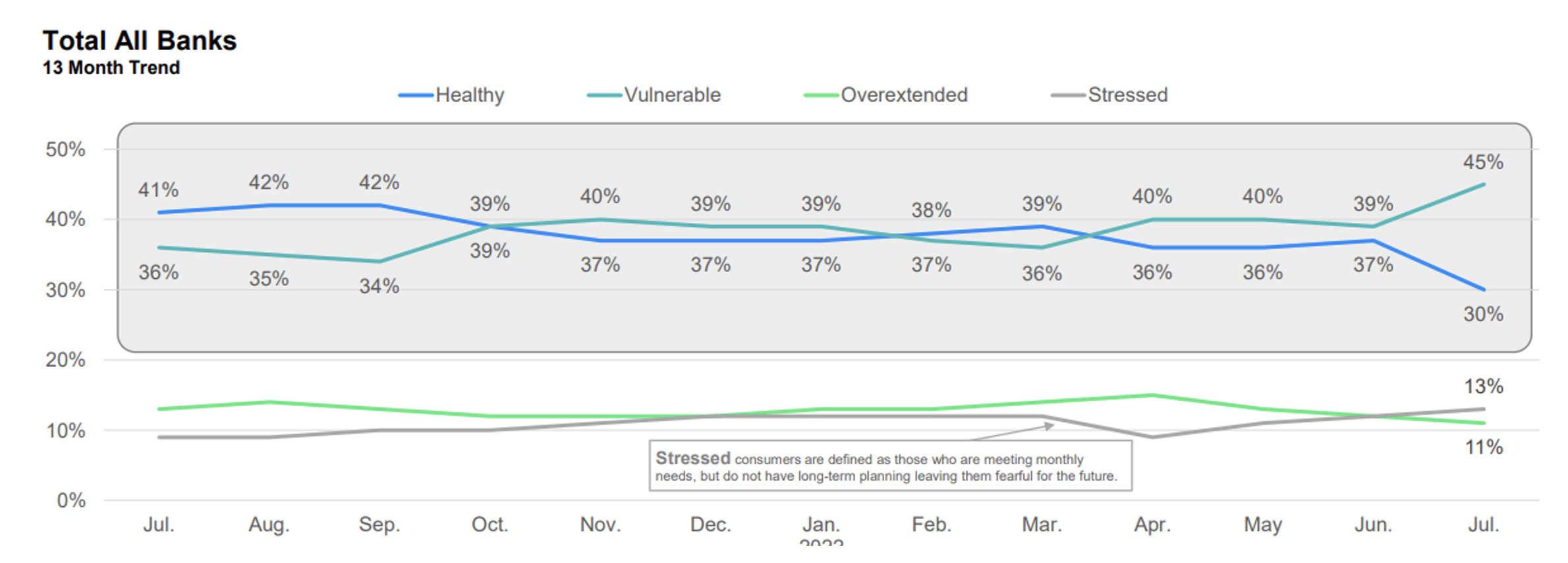
13 month trend showing the levels of stressed, vulnerable, overextended, and healthy banks.


Searching for Answers

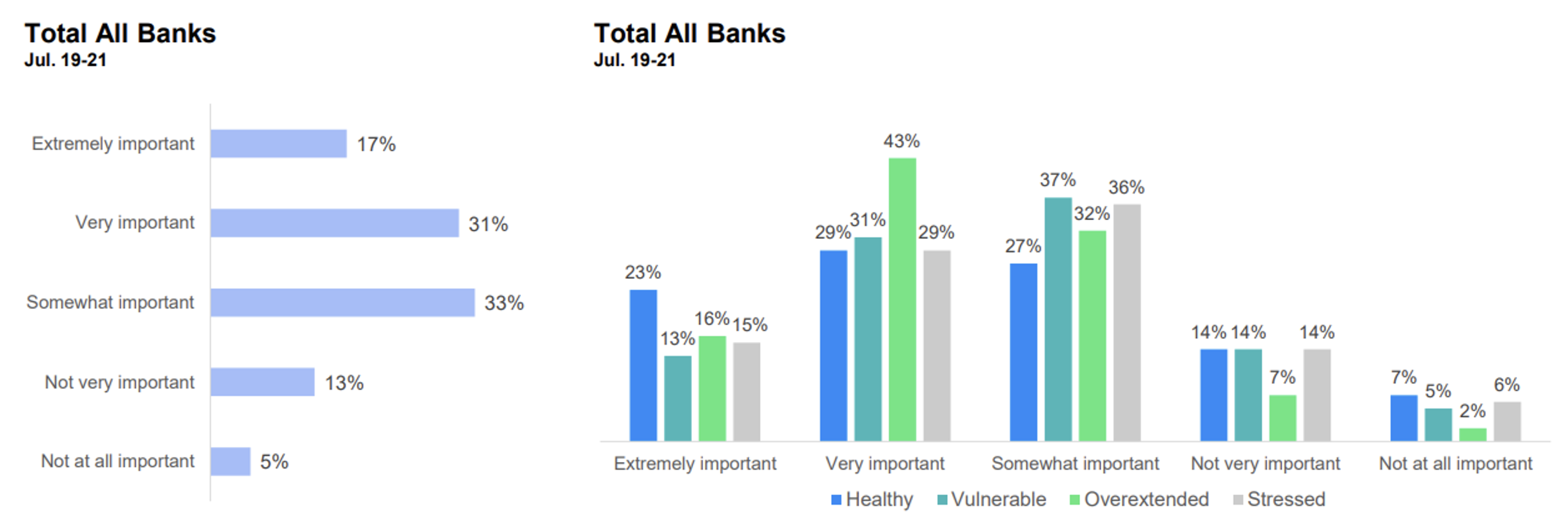
As the country braces for what many economists call a recession, one-third of customers are waiting for a lifeline from their banks. In fact, 81% of customers said that bank support is important to help them manage living with high inflation. That includes 91% of overextended customers.
bar graph demonstrating data pulled from surrounding paragraphs

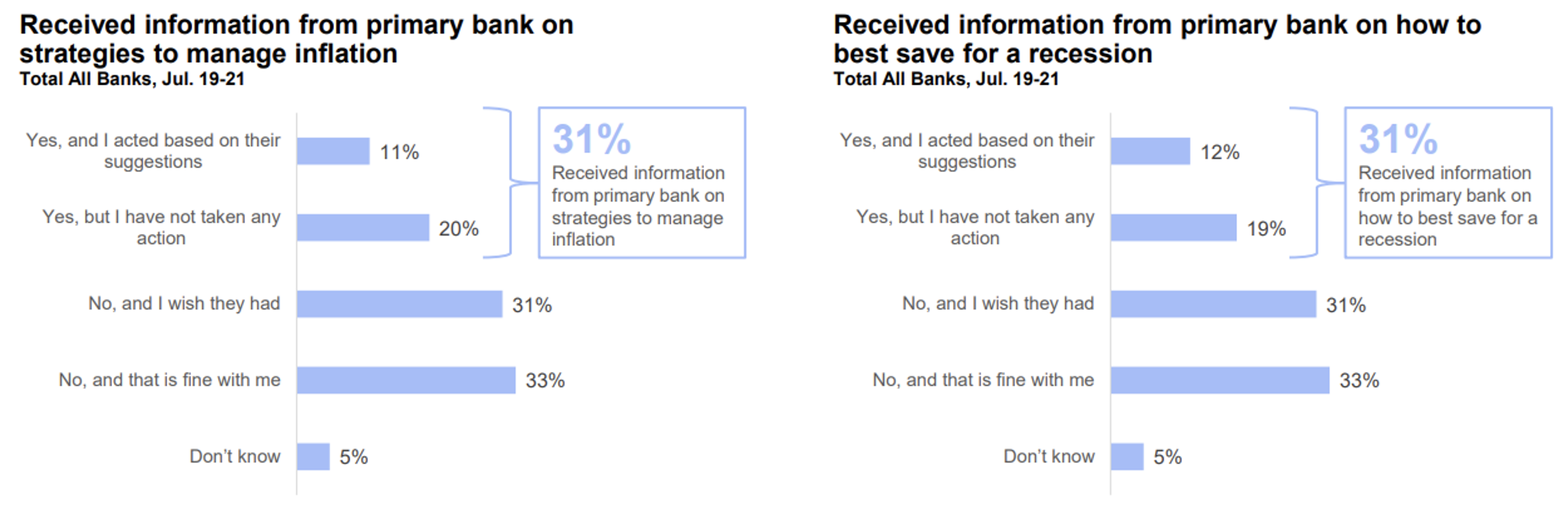
Asked whether banks have reached out with information on how to handle inflation, 31% said they received some form of communication. Another 31% said they had not received any information from their bank, but wish they had – seemingly a missed opportunity for banks to build a valuable relationship with their customers.
bar graph demonstrating data pulled from surrounding paragraphs

ESG Becomes a Priority

Retail banks’ track records on environmental, social and governance issues—by now, well-known by its shorthand (ESG)—have also come under greater scrutiny as bank customers navigate this turbulent economic cycle.

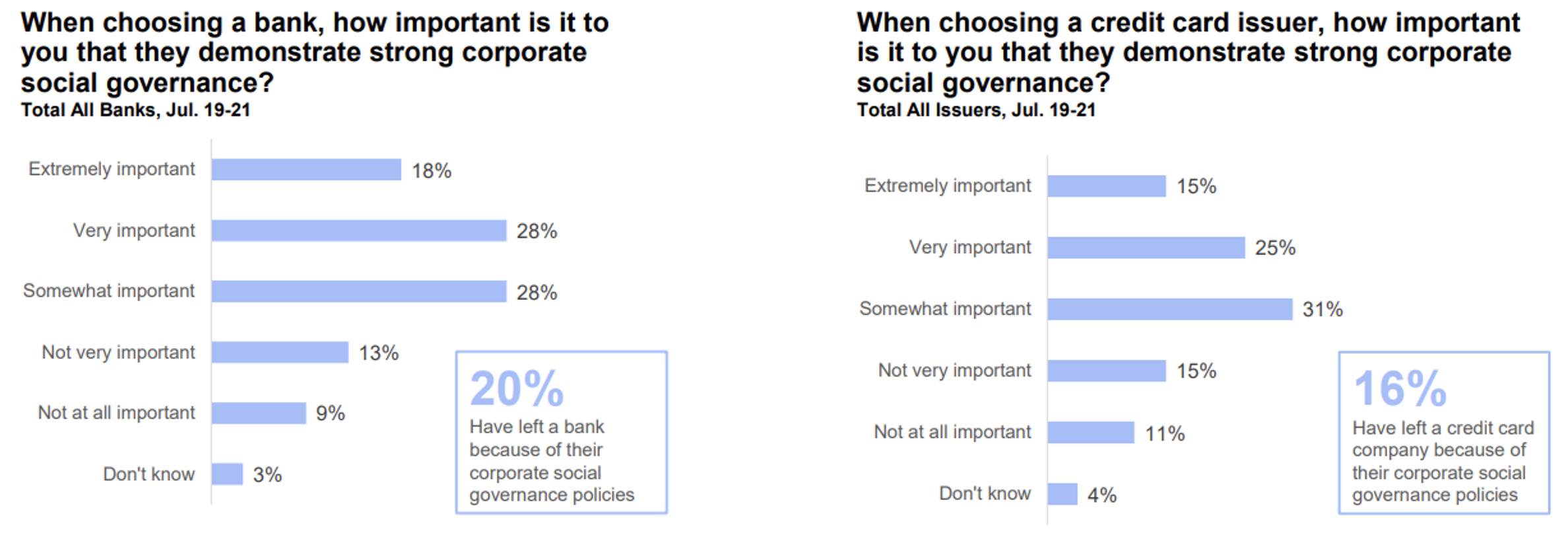
One in five Americans (20%) said they have left their bank because of their corporate social governance policies, and 16% have said the same about their credit card issuer.
bar graph demonstrating data pulled from surrounding paragraphs


While ESG initiatives may not be the determining factor for most, there has clearly been a shift in how banking customers view their financial institutions. Americans no longer want their banks to have a passive role in their finances, nor do they want to be tied to corporations that are disengaged from their communities. And that creates a huge opportunity.

Rising to the Occasion

If banks are going to play a role in helping their customers confront the growing challenges Americans face in this economy, they’ll need to understand what their customers value. Reaching out with pertinent debt-management information—even if it’s not acted on by the customer—or making sure they communicate a strong social agenda, can be just as important as a new product offering or fintech innovation. As Americans find their footing, they’ll remember the institutions that made the right impression in a trying time. It’s up to banks to put their best foot forward right now.

Find out More

This Banking and Payments Intelligence Report is based on responses from 4,000 retail bank customers nationwide and was fielded in July 2022. It was authored by Jennifer White, senior director of banking and payments intelligence at JD Power. Please contact us at the numbers below to connect with Ms. White or to learn more about the underlying research.

Media Contacts

Brian Jaklitsch; East Coast; 631-584-2200; [email protected]

Geno Effler, JD Power; West Coast; 714-621-6224; [email protected]


[1] JD Power measures the financial health of any consumer as a metric combining their spending/savings ratio, creditworthiness, and safety net items like insurance coverage. Consumers are placed on a continuum from healthy to vulnerable.
It’s been nearly 18 months since the world’s largest asset manager, BlackRock, announced that it would put environmental, social and governance (ESG) goals at the center of its investment strategy. That day seemingly foretold a grand portfolio migration to ESG investments, with wealth managers and investors throwing their weight behind more responsible corporate endeavors.

But a year and a half later, it seems that the greater public has very little quantifiable information on which brands deliver on the promises of greener, more equitable corporate citizenship.

In order to get a sense on how effectively corporations have been communicating their ESG strategies, and how important this information is to investors, the latest JD Power Wealth Management Pulse survey asked respondents about the importance ESG, and their awareness of corporations that are making these efforts.

Roughly one-quarter (23%) of respondents couldn’t come up with any brands that are the top-three for investments in ESG/corporate citizenship. Among respondents that did name a company, Amazon, Apple, and Nike were among the most frequently mentioned, despite each of these brands having struggled publicly with environmental or corporate citizenship issues.

Americans Place High Value ESG

While investors and consumers may struggle to find solid information on corporate ESG performance, the majority agree that it should be a critical factor in investment decisions.

When presented with the economist Milton Friedman’s famous “Friedman Doctrine,” which states: “A company has no social responsibility to the public or society; its only responsibility is to its shareholders,” 74% of respondents said they either disagreed or strongly disagreed with the sentiment.

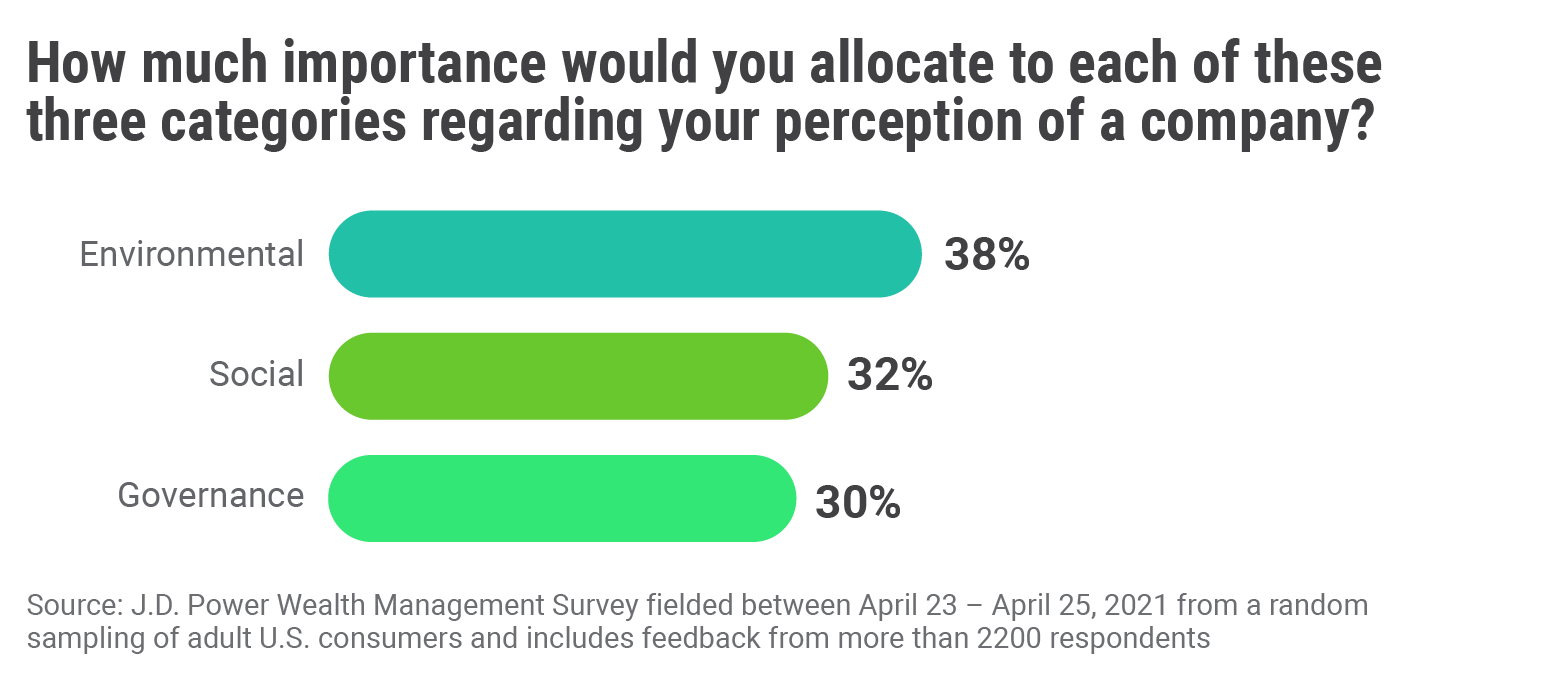
When evaluating the component parts of ESG, 38% of respondents said environmental issues were the most important criteria influencing the perception of a company, followed by social (32%) and governance (30%).

J.D. Power Wealth Insight: Corporate Environmental, Social and Governance Chart 1

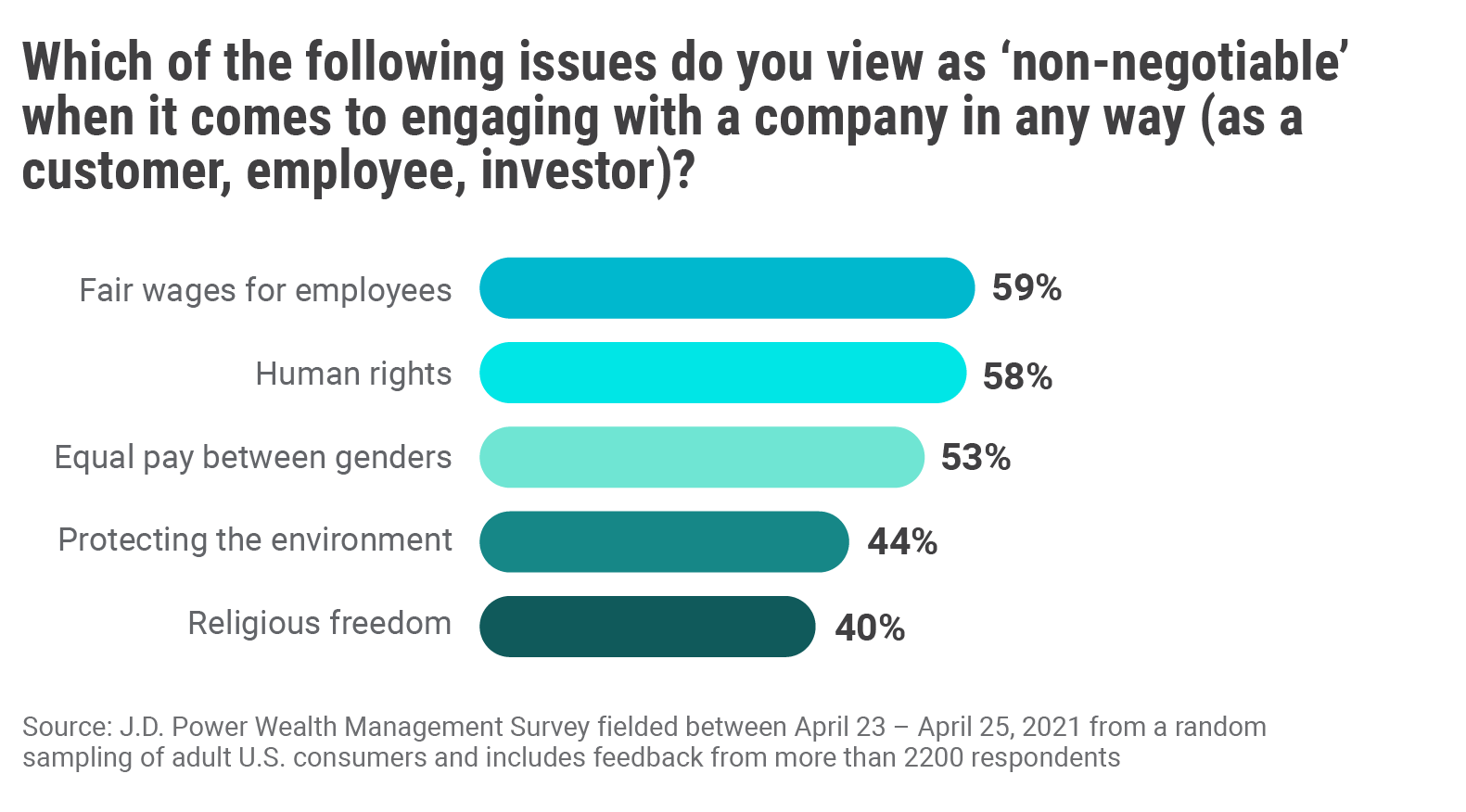
Respondents also indicated that some ESG-related issues were “non-negotiable” to them as a customer, employee, or investor. These included fair wages to employees (59%), human rights (58%), equal pay between genders (53%), and protecting the environment (44%).

J.D. Power Wealth Insight: Corporate Environmental, Social and Governance Chart 2

The sentiment even extended to the world of professional sports. In what has been a polarizing topic since former San Francisco 49ers quarterback Colin Kaepernick’s National Anthem protest sparked the modern social movement, respondents were virtually split down the middle on whether they thought professional sports leagues and athletes should use their platform to further political and social goals: 48% said yes, 52% said no.

Reliable ESG Information is Hard to Find

In spite of how important ESG seems to be to most consumers, they readily admit they haven’t looked very hard to find out which firms are actually delivering on these metrics. And when they have, the information has been hard to come by.

Overall, 29% of respondents said they have never looked for a company’s corporate citizenship activities, while 41% said that information could be either somewhat or very difficult to find. Part of that problem could be the source of information.

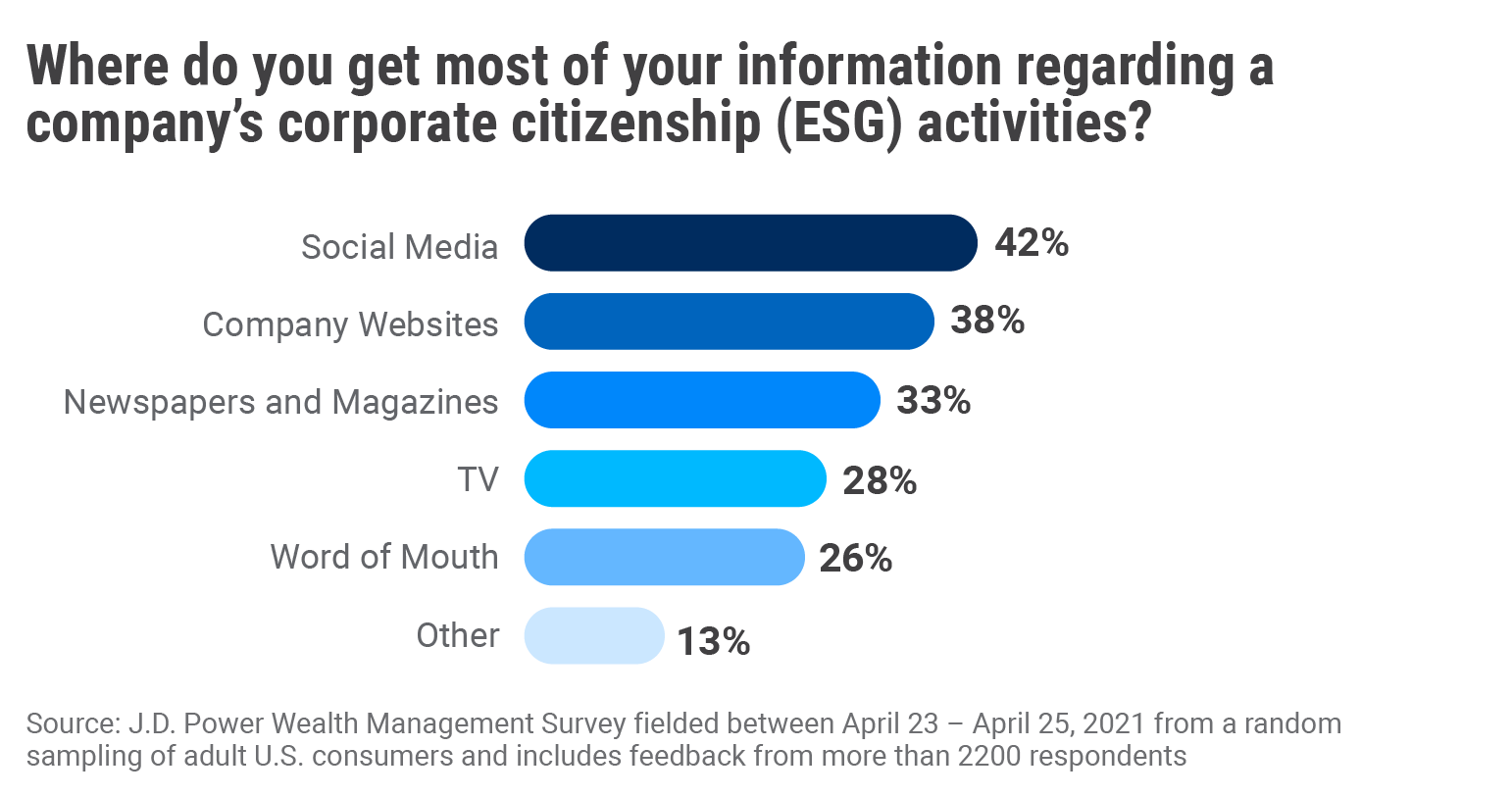
When asked where they got most of their information regarding a company’s ESG activities, 42% said social media and 38% said company websites, with more traditional, legacy media lagging behind, with newspapers and magazines at 33% and TV at 28%. Just over one-quarter (26%) said word-of-mouth.

J.D. Power Wealth Insight: Corporate Environmental, Social and Governance Chart 3

Empowering Investors to Act on ESG Instincts

The burning question is: Does this professed dedication to ESG translate into a shift in consumer or investor habits? According to our data, it already has.

More than one-in-10 respondents (14%) said they currently have ESG-related investments. Nearly two-thirds of respondents (63%) said they have made changes in purchasing or investments in response to a corporation/brand’s actions. The most common action being to reduce spending (36%), while 17% said they changed investments in an organization based on its ESG profile. When the focus is narrowed to the more affluent ($100K+ in investable assets) category activism increases, with 68% taking some form of action, including 24% changing investments and 40% decreasing their spending.

Of course, this begs the question: If information on ESG is hard to find, and consumers and investors are largely dialed into owned social media channels and marketing copy from a brand’s website, is the intelligence they’re acting on reliable? And are the actions they have taken having their intended consequence?

That creates some complicated challenges for both corporations and financial advisors trying to navigate this rapidly moving shift in consumer and investor sentiment. A set of issues with the power to influence massive behavioral changes has become a core area of focus, but few best practices are in place and few clear-cut leaders have emerged to pave the way. What is clear is that proactive communication around ESG will be critical for the foreseeable future and companies that can distinguish themselves with clear, quantifiable ESG metrics that can be easily located and understood by consumers will be in the best position to benefit from increased investor appetite for companies that not only do well, but also do good.

Methodology

This JD Power Wealth Management Insight is based on data collected between April 23 – April 25, 2021 from a random sampling of adult U.S. consumers. It includes feedback from more than 2200 respondents.

Find out More

This JD Power Wealth Management Insight was authored by Craig Martin, managing director, Global Head Wealth & Lending Intelligence at JD Power. Please contact us at the numbers below to connect with Mr. Martin, or to learn more about the underlying research.

Media Contacts:

Brian Jaklitsch; East Coast.; 631-584-2200; [email protected]

Geno Effler; West Coast; 714-621-6224; [email protected]

The COVID-19 pandemic has created a two-headed client management monster for wealth management firms. First, there is the unprecedented market volatility and panic-stricken investors that need to be encouraged not to make bad long-term decisions based on short-term emotions. Then, there is the CARES Act.

Most advisors have weathered the storm of other market disruptions, such as the 2008 financial crisis and the flash crash, so will have lots of experience dealing with the former, though they now lack the ability to use face-to-face interaction to help calm fears.

The latter presents an entirely new set of challenges. Among them, managing an influx of calls from confused clients who want to understand more about what the various provisions of the new law mean for them, a potentially significant hit to assets under management and a flood of noise and misinformation about the details of the legislation.

For those who get the client management side of the equation right, this crisis presents a once-in-a-lifetime opportunity to build trust, gain market share and grow the bottom line. For those who miss the mark, this could be one of the biggest attrition catalysts we’ve ever seen.

The root of the challenge is the newly enacted Coronavirus Aid, Relief and Economic Security (CARES) Act, which includes a host of safety nets designed to help Americans weather the financial storm created by COVID-19. Among them are specific provisions related to retirement accounts. These include waving the required minimum distribution for retirement accounts and beneficiary accounts, and the ability to take up to $100,000 from a retirement account while spreading the tax hit over three years.

Both of these are great news for retirement account investors. For those facing immediate financial hardship as a result of the pandemic, the ability to quickly access retirement savings without major tax hit could provide a critical lifeline. And, for those not immediately impacted, the ability to skip minimum distributions means not having to take huge losses while markets are at their lowest point in the last decade.

As helpful as both may be, neither will necessarily be intuitive for investors. And that means they will be calling their advisory firms.

Dialing In

According to our soon-to-be-published Retirement Plan Participant Satisfaction Study, many of them will be using the phone. Upwards of 50% of retiree investors say their first stop when they have a question about their account is the phone. Just 25% say they have used online and mobile channels.

That’s a potentially big issue at a time like this when huge volumes of customers are flooding phone support lines all at once. Add the fact that advisory firms themselves are dealing with phone support capacity issues as they mobilize remote workforces and the challenge becomes even more pronounced.

Then there are the details which make it hard to apply a one-size-fits all solution for all retirement investors. Questions about changing age thresholds for minimum distributions, individual tax impacts of early withdrawals and overall impact on individual portfolio decisions will all play into each investor’s individual CARES Act strategy.

It’s all the nuances that will make this such a challenging client management exercise for wealth management firms. It will be difficult to provide blanket advice and guidance that applies to every single use case. Wealth management firms will need to tailor their messages to individuals and stay mindful of the potential impacts to assets under management that could result.

The key will be effective engagement. Firms need to act now to create landing pages, detailed self-service tools and proactive communications that help retirees quickly understand how these new laws will affect them.

According to our data, although a relative minority of retiree investors actively use mobile and web-based self-service tools, those that do use them have incredibly high levels of customer satisfaction. In fact, overall satisfaction scores for those who used an advisory firm’s website or mobile app to manage their account are 820 (on a 1,000-point scale). That’s 20 points higher than those who use phone-based support.

Also of note, a large portion of retiree investors (45%) say their preferred means of receiving communication from their wealth management firm is email. Yet, the majority of messages (59%) are still sent from wealth management firms via mail.

In this current environment, with details changing daily, clients of all ages spending more time online than ever before and most folks generally aware of the long customer support hold times that are affecting companies in every industry, the time is ripe for proactive digital communications that hit consumers squarely where they are focused.

The current environment ­— both from a markets and a management perspective — is not easy for any of us. But it does create a make-or-break moment for wealth management firms to truly build trust and advocacy by putting themselves in the shoes of their customers, and giving them actionable information they can use to get through this crisis. Those firms that get that formula right will be positioned for the biggest upside once we start to turn the corner to the post COVID-19 recovery.


Wealth Clients Environmental Social Issues

The wealth management world stood still for a moment this past January when BlackRock, the world’s largest asset manager that oversees roughly $7 trillion in investments, announced that it would put environmental, social and governance (ESG) goals at the center of its investment strategy, immediately halting investments in companies that present a high sustainability-related risk, such as coal producers.

The day of the announcement, the firm experienced its largest one-day inflow ever, with $1.5 billion in new investments pouring into one of its funds. The firm quickly followed the announcement by launching a new sustainability-focused ETF, which received more than $600 million in investment in its first week.

What does this mean for the wealth management industry? Are investors serious about putting social and environmental issues at the forefront of their financial decision-making process?

JD Power has been exploring this issue for several years, taking the pulse of professional asset managers, advisors and individual investors as they make critical decisions about where to invest. The following Wealth Management Insight assembles the collective observations of various wealth management constituencies on the real role of ESG in the investment decision making process.

Advisors Choose Asset Managers Based on ESG

The superstar investment team is dead. Long live the socially-conscious asset manager. According to the JD Power 2019 Advisor Digital Engagement Study, which evaluates how financial advisors interact with asset management firms digitally and how that digital experience affects future intentions to invest client assets, ESG is the second most important factor wealth managers consider when evaluating a prospective new asset manager, right behind “helps me do my job better” and ahead of “solid investment returns.”

By contrast, that asset manager’s reputation for having a “world-class investment team” is fifth on the list of most important considerations for wealth managers.

That’s a big deal. In the current market environment, where wholesalers are disappearing, fees are being compressed and interactions are becoming increasingly digital, asset manager brand image and selection is being driven by perceptions of environmental and social awareness. Returns, of course, are still important, but it is clear that wealth managers are looking for something more for their clients.

Millennials Put Their Money Where Their Hearts Are

Younger wealth management clients appear to be factoring social issues into their investment decision making process. According to the JD Power 2019 Full-Service Investor Satisfaction Study, 58% of investors under age 35 rate their advisory firm a 9 or 10 (on a 10-point scale) on social causes. That compares to just 41% among those over age 40.

Overall, across the study sample, wealth management clients who scored their firm a 9 or 10 for social causes had average satisfaction scores of 919 (on a 1,000-point scale). This compares with an average satisfaction score of 727 for those who scored their firms at 6 or less. Additionally, 76% of clients scoring firms with a 9 or 10 on social causes say they will “definitely” recommend their investment firm to friends and family, versus just 28% among those scoring their firm as a 6 or less.

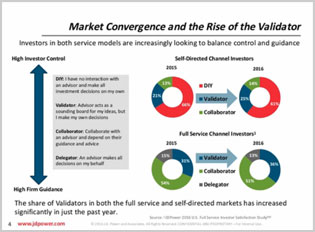
Millennials1 are also much more likely to want to be directly involved in investment selection, even when they are working with a professional advisor, so they are bringing that social consciousness into the decision-making process. Nearly half (44%) of millennials who currently work with a financial advisor describe themselves as “Validators”, who view the financial advisor as a sounding board for their ideas rather than someone they expect to manage investments on their behalf. By contrast, just 19% of Boomers fall into this category, underscoring a significant shift taking place in how investment decisions are made. Millennial preferences may continue to change as their wealth and complexity of needs increases over time, but as the first generation of digital native investors, with always-on access to information on companies and investment research tools, they are unlikely to evolve in the same way Boomers have.

Beyond Lip Service – ESG Gets Real

For many years, ESG was little more than a novelty in the wealth management industry – a specialist category where things like socially-aware mutual funds and sustainability-focused ETFs would appeal to niche subsets of investors. That is no longer the case.

ESG has gone mainstream. While BlackRock sealed the deal with its January manifesto, the movement has been building for some time, as evidence by the perspectives of investors gathered over the last several months of JD Power syndicated studies. It is still early in the industry’s evolution toward a more socially conscious approach to investing, however. Over the next several months, we expect several firms to double-down on ESG, launching new initiatives, new types of investment products and new marketing initiatives that tout their unique approaches to ESG.

For the financial firms at the center of this rapid shift in investor priorities, now is the time to move beyond simply paying lip service to ESG issues. Firms must find ways to more effectively ‘prove’ their commitment and demonstrate to various stakeholders that this is an important topic to the organization. Key questions that leaders must ask include:

  • Are you collecting and communicating the right ESG metrics?
  • Are you delivering that information to the right individuals in the right way?

1JD Power defines generational groups as Pre-Boomers (born before 1946); Boomers (1946-1964); Gen X (1965- 1976); Gen Y (1977-1994); and Gen Z (1995-2004). Millennials (1982-1994) are a subset of Gen Y.

  • Is the quality and accessibility of information adequate?
  • What improvements are needed to achieve the transparency needed for firms to demonstrate they are truly walking the walk and well as talking the talk?

Methodology

This JD Power Wealth Management Insight is based on data collected in the JD Power 2019 Advisor Digital Engagement Study, the JD Power 2019 Full-Service Investor Satisfaction Study, and JD Power 2019 U.S. Self-Directed Investor Satisfaction Study. It includes feedback from more than 11,000 individual investors and asset managers.

Find out More

This JD Power Wealth Management Insight was authored by Mike Foy, director of Wealth and Lending Intelligence at JD Power. Please contact us at the numbers below to connect with Mr. Foy or to learn more about the underlying research.

Media Contacts:

Brian Jaklitsch; Huntington, N.Y.; 631-584-2200; [email protected]
Geno Effler; Costa Mesa, Calif.; 714-621-6224; [email protected]


In this series Mark Miller, Customer Service Solutions Practice Leader at JD Power, sits down with representatives from organizations that have achieved Customer Service Certification to discuss what these top performers are doing to achieve high performance and distinction.

In Episode 6, Rebecca Dillavou, VP – GWIM Group Operations Manager at Bank of America Merrill Lynch, speaks with Mark about their employee ambassador program.

Michael Foy of JD Power Explores How the Wealth Management Sector Can Integrate Human and Technological Touch Points to Maximize Customer Experience
 

Technology is not an end unto itself and it shouldn’t develop in isolation. It has to be woven into the overall customer experience. Someone at the senior level has to have oversight into the entire customer experience, including, but not limited to digital capabilities.” — Michael Foy, JD Power

DATELINE – Digital transformation is changing the way that people buy, get information and invest. Though wealth management is a relative latecomer to digital transformation, today’s wealth management companies and their customers are now relying increasingly on digital processes to purchase wealth management services — as well as for some basic investment advice — says Michael Foy, Senior Director, Wealth Management Practice JD Power, in a new interview for journalists.

 “While the trend toward automated transactions and basic investment advice has resulted in downward pressure on fees, digital transformation forces in the industry are also providing wealth management firms with the ability to improve the customer experience,” he says. 

The key, he says, is to determine how best to integrate technology with the right opportunities to introduce the human touch.

Some tasks traditionally performed by the advisor, such as portfolio rebalancing and account allocation, are rapidly being automated.  However, in other areas technology is empowering advisors to add more value to clients. For example, by leveraging Big Data and enhanced analytics tools  advisors are able to more effectively anticipate their clients’ needs based on patterns with relevantly similar clients,” he says. 

Better Insight, Better Advice

The wealth of information that clients are willing to share — if the right level of trust is established — can provide a life-time of context that can drive long-term relationships. Properly managed and governed, the data provides wealth management advisers with deep insight that can help clients appropriately adjust their financial lives as they move through the different life stages — from funding college to preparing for and living in retirement.

Technology is not an end unto itself and it shouldn’t develop in isolation. It has to be woven into the overall customer experience,” Foy says. “Someone at the senior level has to have oversight into the entire customer experience, including, but not limited to digital capabilities.

Digital connections with clients can provide a continuous feedback loop that will become increasingly essential in meeting the needs of today’s omnichannel customers. This feedback enables wealth management firms to react quickly as client needs and expectations evolve.

Help with a Daunting Process

The transformation process can be  daunting; this is especially true for wealth management firms that are relatively new in their digital journeys.

Over the last 18 months, JD Power has augmented its long history of data gathering and data analysis across industries with digital expertise in the wealth management arena to help firms and financial advisors fill in the gaps in their own digital capabilities.

We are providing valuable guidance on the measurement systems needed to provide actionable customer feedback about usage, value and customer engagement,” he explains.

JD Power can help firms prioritize their digital transformation investments to optimize return on the customer experience, and identify opportunities to improve engagement as clients — and technologies — evolve.

By Michael Foy

While the ultimate fate of the DOL Fiduciary Rule as regulation now appears uncertain, many industry firms are making clear their intention to move forward—regardless of what happens on the regulatory front—with significant business changes originally initiated by expectation of the rule going live in April. Some of these changes have the potential to significantly disrupt the way investors save and plan for retirement. JD Power’s Department of Labor Special Report surveyed more than 1,000 full-service investors in February to understand not only their awareness and perceptions of the rule itself, but also to assess the relative attrition risk faced by firms depending on how they change their products and pricing in response to it.

IRA assets represent an overall market of nearly $8 trillion in the United States1 and while the industry has been directing more of those assets into fee-based accounts for years, Morningstar estimates that the terms of the rule would impact about $3 trillion in client assets and $19 trillion in wealth management industry revenue.2 These are largely assets in commission-based retirement accounts where advisor compensation may depend on the specific investments they sell clients, which, therefore create an inherent conflict with the fiduciary standard. Several firms, including Merrill Lynch, have already committed to eliminating commission-based retirement accounts entirely going forward, regardless of what happens with DOL from a regulatory perspective.

This will leave a substantial number of retail investors currently paying commissions for retirement accounts with a choice:

  • Stay at their firm and switch to a fee-based model
  • Find another full-service firm that will continue to provide a commission-based full-service option
  • Move to a self-directed service model and continue to pay commissions, potentially with access to some limited advice and guidance through a centralized (e.g. call center) firm representative
  • Move to a digital advice model (i.e. robo-advisor) that will provide automated portfolio management based on investor-provided goals and risk tolerance for a lower fee than a traditional advisor would charge

This significant money-in-motion event will undoubtedly create winners and losers among industry firms, with the outcomes determined by how effectively they can communicate and deliver on the unique value proposition they provide to those segments of the market in which they choose to compete.

Fee Aversion

While the annual Full Service Investor Satisfaction Study supports the intuitive hypothesis that current fee-based investors are generally more satisfied with what they pay their firm than those who pay commissions, findings of JD Power’s DOL Special Report show there is significant resistance among those commission-based clients—especially the high net worth—to being forced to migrate to fees.

  • More than half (59%) of investors who pay commissions say they either “probably will not” (40%) or “definitely will not” (19%) be willing to stay with their current firm if it meant being forced to move to a fee-based retirement account.
  • High net worth investors ($1 million+ investable assets) are more resistant to the change than others and are also more sensitive to the specific level of the proposed fee. At a proposed 1% fee, 25% of HNWs say they “definitely would not” be switching from commissions, compared with 52% at a 2% fee who say the same.
  • “Validators,”3 a younger, fast-growing segment of the full-service investor market, are also highly resistant to moving, with 61% saying they “probably would not” (35%) or “definitely would not” (26%) switch.

Channel Switchers

Many larger firms dropping the commission model clearly hope to redirect some of these dislocated retirement assets to a proprietary self-directed or limited advice (e.g., advisor call center) service model or toward a digital advice platform (i.e., robo-advisor). The good news for firms that provide these alternatives is that many younger investors appear open to both, though older and more affluent clients may be more likely to seek another full-service firm that will continue to support commission-based retirement, of which there will be many, especially if the DOL rule is ultimately not implemented and the Best Interest Contract Exemption (BICE) requirement is dropped. Firms that don’t have alternative service models to offer clients are likely to lose clients across the board, and in some cases their advisors may leave with them.

  • More than half (56%) of Gen X and younger investors (ages 52 or younger) would consider a robo-advisor as an alternative to traditional advice vs. just 19% of Boomer and older investors (ages 53 and older).
  • Close to two-thirds (62%) of Gen X and younger investors would also consider self-directed vs. 36% of Boomer and older investors if they want to continue to pay commissions.


1 ICI Research Perspective, January 2017 

2 Morningstar Report “Final Department of Labor Fiduciary Rule’s Effects Are Substantial”, 2016

3“Validators” are defined by JD Power as full-service investors who want to be actively involved in investment decisions and view their FA as a sounding board for ideas.

In 2016, we see fewer self-directed investors now identify as true DIY types and more both value and expect advice and guidance from their provider, even if they’re not looking for a traditional full service dedicated advisor. In this webcast, Mike Foy of JD Power explores this phenomenon and other trends in the wealth management industry, including attitudes towards robo-advisor, key aspects of the onboarding experience, multi-channel interactions, and fee transparency.

Financial institutions must be prepared for what’s to come in 2014.  During 2013, we saw changes throughout the industry that gave us insight into what customers will expect in the coming year. Download this webcast during which we will discuss the following topics: responding to changing channel preference and usage; identifying the drivers of primary relationships and share of wallet; providing quality advice during moments of truth; and preparing for 2014.