The UK saw a small improvement in new-car registrations in October. How could potential government taxation changes challenge this growth? Autovista24 special content editor Phil Curry examines the market.

The UK’s new-car market remained stable in October, with a small 0.5% rise in deliveries. According to the latest data from the SMMT, 144,948 passenger cars were registered in the month. This was just 660 units more than in October 2024.

While the numbers are comparable, the powertrain split has changed dramatically in the last 12 months. Internal-combustion engine (ICE) models are no longer the dominant force in the monthly figures.

Electrified models, including full hybrids (HEVs), plug-in hybrids (PHEVs) and battery-electric vehicles (BEVs), led for the second month in succession.

Across the first 10 months of 2025, UK registrations were up 3.9% with 1,723,120 deliveries. This has been helped by the strong performances in the plate-change months of March and September. These months helped counter five months of declines across the year so far.

The SMMT’s quarterly industry outlook suggests new-car registrations will top two million units for the first time since the pre-COVID-19 pandemic period of 2019. This year is forecast to reach 2.01 million, while the country is expected to see 2.03 million deliveries next year.

Employee Car Ownership challenge

The UK’s new-car market looks set to beat figures from 2019 for the first time since the pandemic. However, there are looming threats that could scupper further recovery in the coming years.

The ending of Employee Car Ownership Schemes (ECOS) is one such challenge. Operated by manufacturers and dealers, these allow employees to buy new cars at reduced prices. This enabled lower monthly repayments and at a low rate of interest.

The Autumn Budget of 2024 laid out plans to end ECOS by April 2026. However, this date has now been pushed back to October 2026. These vehicles will now be categorised as company cars and taxable benefits.

According to the government, this will add £275 million (€312 million) to the exchequer between 2026 and 2027. It states that an estimated 76,000 individuals will become liable for the income tax associated with the benefit in kind (BIK).

‘These individuals may now need to pay the appropriate benefit-in-kind charge or seek an alternative arrangement with their employer. Impacted employees may choose to retain the current vehicle through a normal car scheme, choose a lower-emitting (lower tax) vehicle or choose to go without a company car altogether,’ the government stated.

Revenue lost

The SMMT argues that plans to end ECOS will impact the UK’s automotive market. It could prevent employees from accessing cars at a more affordable price point, while also challenging electric vehicle (EV) adoption. As these cars are expensive, ECOS puts them within reach of many industry workers.

‘With around 100,000 cars supplied via ECOS a year – equivalent to around 5% of the annual new car market – such a step would depress growth and seriously impact the nearly new and used markets,’ the SMMT stated.

‘More than £1 billion in revenue would be lost to industry and 5,000 manufacturing jobs put at risk. Additionally, the Treasury would incur a £500 million hit from lost VAT and Vehicle Excise Duty receipts. The total cost would be more than double that allocated to the Electric Car Grant (ECG), effectively wiping out the growth it is intended to stimulate,’ the body added.

Pay per mile plans for BEVs

A further threat could be announced in the 2025 Autumn Budget. The Telegraph reported that Chancellor Rachel Reeves is expected to unveil plans for per-mile road charging, targeting BEV drivers. Drivers of hybrids also look to be affected by the additional cost, but to a lesser extent.

The plans would see all-electric owners pay 3p per mile, with annual payments based on estimates. Should these prove inaccurate, top-up payments would be required, or any overspend would be rolled into the following year. The plans would help balance lost fuel duty revenue.

According to the publication, the average BEV driver would pay an extra £250 a year. The move looks to be framed as one of fairness, with owners of petrol and diesel cars paying £600 on average in fuel duty.

Yet the plans could distort the total cost of ownership on BEVs, especially for those without off-street parking. The government is reducing red tape, allowing councils to install gullies between properties and roads, enabling on-street parking and charging. However, this requires the ability for drivers to park outside their homes. It does not consider those living in flats, without access to dedicated parking spaces.

In this instance, drivers using only rapid or ultra-rapid chargers would pay around 24p per mile for the energy they use, according to the RAC. Using a home charger, the RAC indicates a charging cost of 8p a mile. With the government plans, 3p would be added on top of every mile. Meanwhile, with fuel duty included, drivers of petrol cars pay around 15p a mile.

Increased ownership challenge

‘We recognise the need for a new approach to motoring taxes, but at such a pivotal moment in the UK’s EV transition, this would be entirely the wrong measure at the wrong time,’ commented the SMMT.

‘Introducing such a complex, costly regime that targets the very vehicles manufacturers are challenged to sell would be a strategic mistake. It would deter consumers and further undermine industry’s ability to meet zero-emission vehicle (ZEV) mandate targets, with significant ramifications for perceptions of the UK as a place to invest. A smarter, fair and future-ready taxation system requires a fundamental rethink, one that must be done in full partnership with the industry and other stakeholders,’ the body added.

The automotive market is already tackling the introduction of vehicle excise duty (VED) for electric cars this year. Additionally, many models are now eligible for the Expensive Car Supplement (ECS), increasing their annual tax cost.

The ECG, introduced earlier this year, has also had a small impact on BEV registrations. Only two cars, the Ford Puma Gen-E and Ford E-Tourneo Courier, are eligible for the full £3,750 subsidy. 38 other models qualify for the lower £1,500 offer.

For the third time this year, BEVs made up more than a quarter of registrations in the UK during October. However, the 25.4% share is still below the ZEV mandate target of 28% for 2025. This will rise to 33% in 2026.

But any change in taxation around BEVs, either with the removal of ECOS or the introduction of per-mile charging, could influence buyer decisions around the technology. Once seen as an affordable way of motoring, these changes could push some models out of reach for many drivers.

Have BEVs benefited from incentives?

Registrations of BEVs increased by 23.6% in October, with 36,830 new units taking to UK roads. This was the second full month of the ECG. It was announced in July, and the first models were revealed in early August.

The volume growth, while encouraging, is the fourth-lowest total of 2025 so far. The share of 25.4%, up 4.7 percentage points (pp), is encouraging. However, it may have more to do with the collapse in the petrol market. While the fuel still dominates figures, it has seen volumes plunge each month.

BEV market growth is also being outpaced by PHEVs. Damaging the benefits of all-electric ownership could tip the balance for a powertrain which is already walking a tightrope.

In the first 10 months of 2025, BEV registrations improved by 28.9%. In total, 386,244 all-electric models left showrooms, an increase of 86,511 units. However, this was down from a peak of 34.6% in June. The year-to-date improvement has slipped steadily downwards since the ECG was announced.

Across this period, BEVs took a 22.4% market share. This is up from 18.1% at the same point last year, but the 4.3pp difference is lower than the 5pp increase recorded in June.

PHEVs’ impressive growth

While the BEV market performs well, its pace of growth is being outpaced by PHEVs. In October, registrations for the powertrain increased by 27.2% year on year, as 17,601 new cars were delivered. However, this only equates to a difference of 3,796 units.

The result gave PHEVs a 12.1% market share in the month, up 2.5pp compared to October 2024. Once again, the technology ended the period close to HEVs in terms of volume and share.

Between January and October, PHEV deliveries increased by 37.1%, with 190,240 registrations. The powertrain gained 2.6pp on its 2024 market share, ending the period accounting for 11% of all registrations.

Combining BEV and PHEV figures, the electric vehicle (EV) market saw volumes improve by 24.7% in October with 54,431 registrations. This allowed for a 7.4pp jump in market share to 37.6%.

Across the first 10 months of the year, EVs were up by 31.5% with 576,484 deliveries. Having taken a third of the market for the first time in September, the technology maintained this trend with a 33.5% share, up 7.1pp.

Electrified models lead UK figures again

The UK counts hybrid registrations differently from other major European markets. Rather than merging mild hybrids with HEVs, it splits them into their respective petrol and diesel categories.

With this in mind, HEV deliveries grew by 2.1% in October, with 19,250 units delivered to customers. This equated to a rise of just 388 cars, compared to the same period last year. The small volume improvement meant the HEV market share remained stable at 13.3%, representing a 0.2pp rise year on year.

From January to October, HEVs saw 8% growth, with 241,919 units taking to the country’s roads. This represented a 14% market share, up 0.5pp compared to the same period in 2024.

Combining HEVs with EVs reveals that for the second time, electrified models led the monthly registration figures over ICE. In total, 73,681 models were delivered, a 17.9% rise, equating to 11,185 more units. This gave the technology a 50.8% market share, up 7.5pp.

However, this slim lead was not enough to change the status quo in the year-to-date figures. With 818,403 registrations, electrified volumes were up 23.5%. They held a 47.5% market share, up from 39.9% at the same point in 2024.

With two reporting periods of 2025 left, a large effort is needed for electrified models to lead the market. Between September and October, the year-to-date share only increased by 0.3pp. However, it does suggest that 2026 could be the first year to see ICE succumb to the electrified sector.

ICE holding on in year to date

The petrol market has been in freefall for some time. Despite a rare instance of growth in September, normal service resumed in October, with an 11.6% decline in volumes. In total, 64,360 petrol cars were delivered, down by 8,471 units. The powertrain still led the overall UK market with a 44.4% share, but this was down by 6.1pp year on year.

This performance added to the year-to-date drop the fuel type is experiencing. Between January and October, petrol deliveries were down 8.5% with 814,154 registrations. The market share of 47.2% is still dominant, but down by 6.4pp.

Diesel’s decline also continued in October. With 6,907 units, volumes were down 22.9% year on year. The 4.8% hold of total registrations was the second-lowest of 2025, and 1.4pp down on last year.

Over the first 10 months of 2025, diesel has seen its volumes decrease by 15.1%, with 90,563 units delivered. This left it with a 5.3% market share, down 1.1pp.

Combining the two powertrains, the ICE market fell 12.9% in October as just 71,267 units made it to UK roads. This was a drop of 10,525 units, leaving electrified models to help the new-car market to its slight growth. The performance left the sector with a 49.2% market share.

However, ICE still led across the first 10 months of 2025. With 904,717 registrations, volumes were down 9.2%. But the technology still held 52.5% of the total market, suggesting it will end the year as the leading powertrain group.

From repair to solid-state advancements, electric vehicle (EV) batteries are a complex equation for fleets. How can these businesses better understand and work with the technology? Autovista24 journalist Tom Hooker assesses the latest battery advancements.

The battery-electric vehicle (BEV) share has grown across Europe this year. In major new-car markets such as France, the fleet sector is a driving force behind electric registrations. Fleet-oriented incentives have helped encourage uptake, as in Germany.

This shift makes it vital for those in the sector to understand the batteries powering their vehicles. In turn, they can make smarter purchasing decisions, optimise maintenance and retain the highest profit margins when defleeting.

Cloud-based battery management

Digital battery health certificates and data can provide clarity for both private consumers and fleets. It can also help increase transparency, streamline remarketing and maximise residual values.

From February 2027, EV batteries sold in the EU must have a Battery Passport. The digital identity will be similar to a vehicle logbook, where battery charge cycles, energy efficiency and degradation trends must be included.

How can fleets stay informed until then? One solution is a cloud-based battery management solution that supports the resale of EVs.

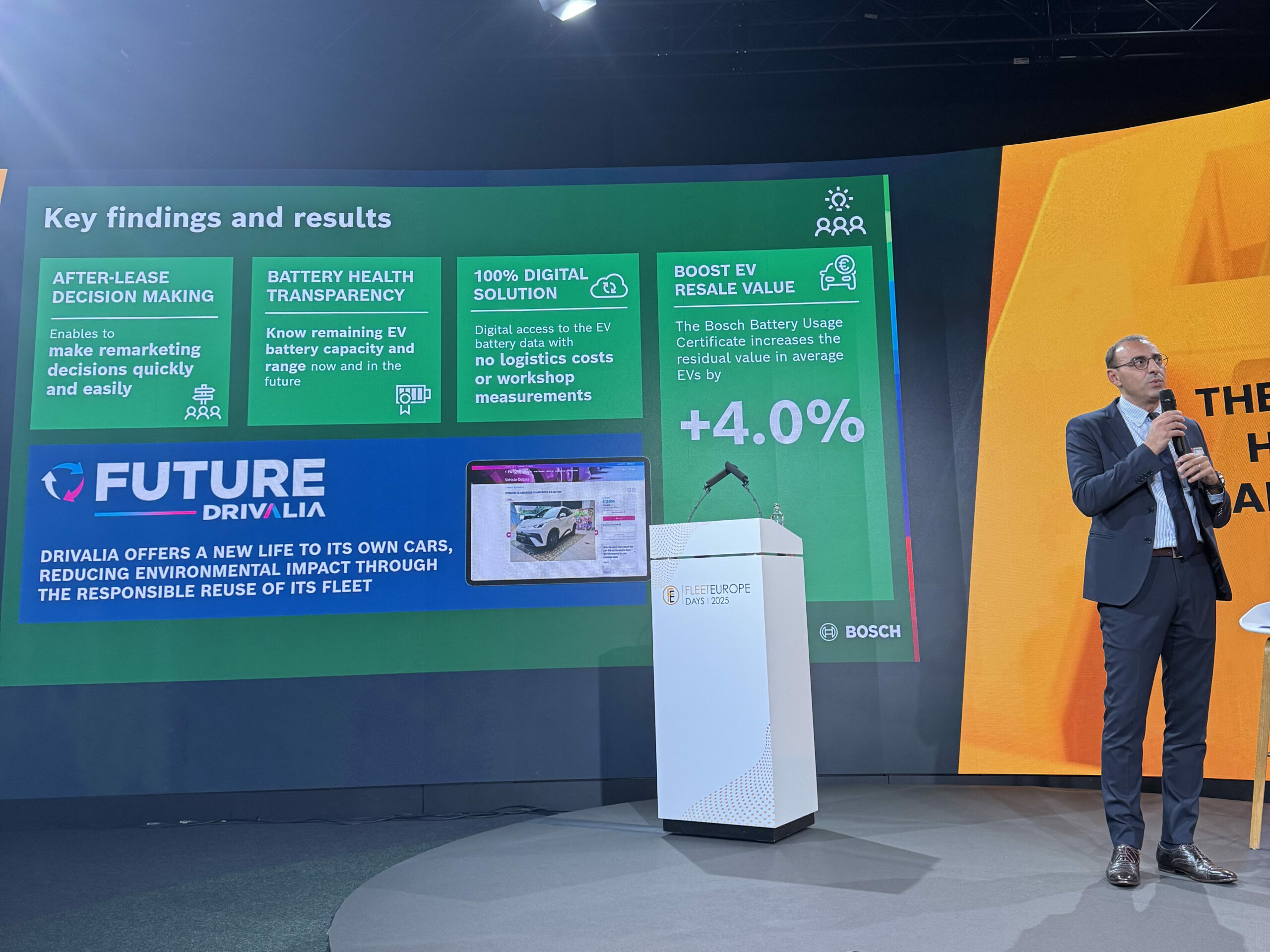
‘Together as leaders in mobility and technology, we have the unique opportunity, especially for EVs, to use remarketing and the right point of resell to make not only a transaction out of it but make it a data-driven business model,’ outlined Christiane Soppa, director of business development at Bosch, at Fleet Europe Days.

Bosch conducted a pilot programme together with European mobility and car rental company Drivalia. This involved monitoring the data of approximately 100 vehicles between January and June 2025.

‘The heart of an EV is the battery. So, we took the heartbeat of the EV and put it online. The target was to take away the EV friction we have in remarketing. We looked at stress factors and anomalies based on very simple data,’ explained Soppa.

Roberto Sportiello presenting at the Fleet Europe Days 2025.
Drivalia CEO Roberto Sportiello.

From transaction to database

There are three steps to the process. Once the EV is connected, data can be collected. Bosch was able to track battery temperature, voltage, charging behaviour and driver usage. This provided a real-time picture of the power-storage unit.

Second, a cell-by-cell digital twin of the battery was created in the cloud. This combined AI machine learning with data taken from 150,000 vehicles tracked by Bosch worldwide to regularly review its algorithm. Third, the system detected anomalies and any battery issues.

‘The twin can completely monitor the battery. By spotting issues very early, you can redesign the right point of resell. We take the battery measurements, the state of health and anomalies before the decision point when you sell the car, not afterwards,’ she stated.

‘That is turning remarketing from a transaction to a database strategy. As a fleet manager or a leasing company, this is changing everything, because you suddenly get into the driver’s seat,’ Soppa continued.

Bosch was also able to produce a certificate at any time, revealing driving behaviour, anomalies, and charging history.

‘You could even use this data to discuss with your clients early, to change their behaviour. Decision making is not a best guess or dependent on lifetime and mileage anymore. It is based on data. What we see from all the pilots we did in the past years, in Bosch and all the data we have, sales can be boosted by up to 4% on average for resale,’ she commented.

However, Soppa highlighted that this requires monitoring of the battery to optimise the point of resale.

‘This is a very important digital platform that will permit the company more in the future to retrieve and collect data from the fleet, and let the company adjust it as best as possible,’ highlighted Drivalia CEO Roberto Sportiello.

Is battery repair the solution?

While Bosch’s tool can be used to boost resales, another way to maximise profit margins within a fleet is to reduce maintenance costs. So, what options do fleet managers have in this instance?

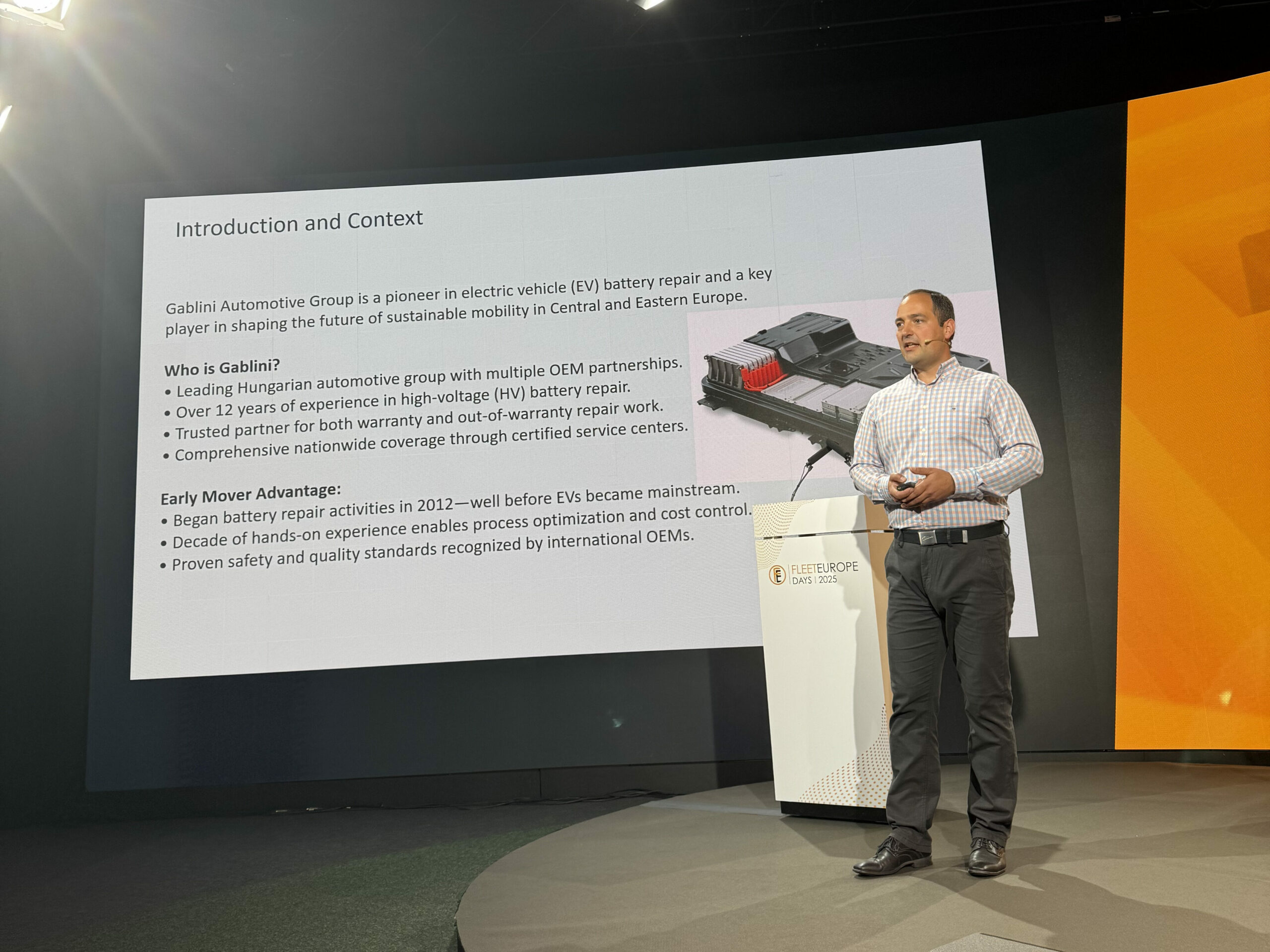
According to Gablini Automotive Group, the cost of repairing a battery pack is around 80% lower than replacing it. This makes battery repair more financially attractive while supporting circular economy goals.

‘To be sustainable, we cannot throw away a 10-year-old vehicle. We should keep it on the road. Because, if we throw it away, the environmentally friendly behaviour of EVs will not be there anymore,’ stated Daniel Pataki, general manager of Gablini Automotive Group, at Fleet Europe Days.

Daniel Pataki presenting at Fleet Europe Days 2025.
Gablini Automotive Group general manager Daniel Pataki.

‘The question is if we can repair the battery packs in case of any failure, because OEMs are not interested in selling battery packs. They are interested in selling new vehicles,’ he said.

Pataki explained how demand for battery repair is growing. As old EVs are getting cheaper, people are beginning to use them as an entrance point to the EV sector. However, he highlighted that an EV with a faulty battery has a resale value of close to zero.

Repair constraints

Pataki presented a diagram of a dismantled EV battery pack. He explained that if one cell has a lower voltage than the rest, this affects the entire battery’s performance. By replacing the module containing that cell, the EVs’ range will improve. The battery management system and thermal management system can also be replaced.

‘If one sensor gets broken in a battery pack and you cannot repair it via the OEM, you should replace the battery pack due to the fault of a €10 sensor. This is not sustainable. You should be able to repair this,’ said Pataki.

However, he explained that there are some constraints. There are still no standard criteria for technicians looking to repair high-voltage batteries. Pataki said that OEMs do invite technicians to their headquarters to get a certificate.

‘According to our experience of more than 12 years, 85% of faulty battery packs were economically repairable. That means only 15% of the battery packs coming to us needed to be replaced,’ he noted.

Pataki pointed out that buying parts from the OEM will mean reduced margins compared with individual battery repair. For a 14-hour job, a profit margin of around 40% to 60% can be achieved Pataki calculated. He highlighted that the solution opens up profit potential within the after-sales process.

‘You will provide sustainability. You will gain customer satisfaction because all customers will come back to you for battery repair. We can reduce waste, we can extend the lifespan of vehicles, we can have high-margin jobs in the workshop, and we can make the customer happy,’ outlined Pataki.

Battery market domination

So, the fleet sector needs to be aware of current battery developments, such as real-time data analysis and battery repair. However, it is equally important to know what to expect in the future.

Currently, the EV market is dominated by lithium iron phosphate (LFP) and nickel manganese cobalt (NMC) batteries. From January to August 2025, these two chemistries accounted for over 90% of the megawatt-hours installed across the global passenger car market, according to EV volumes data. However, the market’s composition could change over the next few years.

Mix and match approach

‘What we see is quite a detailed chemistry layout. In the US, you have the nickel cobalt aluminium (NCA) component that is mainly used by Tesla. While in Europe, you have NMC batteries. In China, you have the majority of vehicles or batteries that are LFP batteries,’ said Octavian Chelu, advisory director at Frost&Sullivan at Fleet Europe Days.

‘You might think the picture is quite clear. The US, Europe and China use a certain technology. It is not that easy. When we look towards the future, what we see happening mainly is the fact that carmakers are going to match certain batteries, technologies and chemistries depending on the type of vehicle and its use, he added.’

‘Carmakers are going to try to mix and match from now on. This is something that is going to be keeping revenue from the remarketing business because it needs to juggle very well between different types of technologies, different battery markers, the degradation of those batteries and how much the residual value is going to be impacted by all of that,’ Chelu explained.

‘We have NMC and LFP; those are the main two technologies being used today. However, we also see a lot of heavy research and development, encouraged by all major governments worldwide, because they want to break dependencies,’ Chelu highlighted. ‘We are trying to find alternatives, so that our batteries and our vehicles are not going to be dependent on one source,’

The next battery technologies

Chelu explained that sodium-ion batteries are the next technology being tested. In China, the first vehicles using this technology have already been seen. There are also solid-state batteries in development. However, he believes both chemistries will not completely wipe out LFP’s market share.

‘We are still going to be dependent on precious materials for quite a while. There are pluses and minuses with all these new technologies,’ he said.

Chelu estimated that in the future, sodium-ion batteries are likely to be 30% to 50% cheaper than their LFP counterpart. They also perform extremely well in cold temperatures. This means vehicles using the chemistry can have better charging cycles.

However, sodium-ion batteries have a lower energy density than LFP units. So, models using the chemistry instead of LFP on a like-for-like basis will have less range. Yet, this does mean the emerging technology is slightly safer, due to it being less reactive.

Chelu noted the emerging technology could be well-suited to last-mile deliveries, but less so for long-range vehicles.

Meanwhile, solid-state batteries are safer and more stable than LFP ones, with no flammable liquid electrolyte. Chelu also pointed to a higher energy density, enabling longer distances and faster charging. However, the new technology will be much more expensive to begin with.

‘Sodium-ion is the next to come in line, not to replace LFP batteries, but as a new technology. Solid-state batteries are not going to happen before 2028 and probably will be fully commercial by 2030,’ Chelu concluded.

Today, nearly every business is using artificial intelligence (AI) and automation in some form. The automotive remarketing sector is no exception, with efficiency and data-driven decisions key to fleet efficiency and profitability. Tom Hooker, Autovista24 journalist, reviews its current applications and future impact.

As AI continues to develop, so too do the use cases within the automotive industry. From production to in-vehicle applications, logistics to fleets, there are many applications for the technology.

Automotive executives anticipate big things from AI, even within the next three years. The technology is expected to increase the perceived value of products by 22% and the value of digital services by 37%, according to IBM.

This acceleration in automotive AI applications underlines the industry’s push for smarter, more connected, autonomous, and software-defined vehicles. 

Carmakers are partnering up with AI specialists to maximise their knowledge and potential in this field. These collaborations include Hyundai Motor Group and Nvidia, Stellantis and Mistral AI, and Volkswagen Group and Amazon Web Services.

Unsurprisingly, AI and automation also present key growth opportunities in the remarketing sector. This involves reselling used vehicles, typically owned by businesses or fleets, through wholesale channels. This often occurs before hitting the retail market.

In this space, AI can enable predictive pricing, automated inspections, automatically adjusted inventory management, and automatic sourcing. These tasks help to maximise turnaround speed and recovery value, two of the major goals in remarketing.

So, how are remarketing companies currently using AI, what benefits are they seeing, and what could the future hold?

AI sourcing

To benefit from high resale margins and fast-turning stock, the right amount of quality vehicles must be quickly sourced. ScaleVoice and AURES Holdings are already using AI to source vehicles and improve response times.

Martin Rezab and Mike Allen presenting at the Fleet Europe days Event.
From left to right: Mike Allen, AURES Holdings member of the supervisory board. Martin Rezab, ScaleVoice chief revenue officer.

The two companies presented their Voice AI solution at the Fleet Europe Days. The AI agents can reportedly handle outbound and inbound calls, schedule trade-ins and update systems in real time.

Voice AI conducts proactive sourcing to find hidden opportunities in the marketplace. It grades adverts by predicted profit margin, stock turn and competitiveness, such as targeting private sellers with price drops. The solution can then contact the seller and schedule dealership appointments.

It also uses reactive sourcing. This means responding to incoming web form leads in under 30 seconds to catch customers in a selling mindset. Unlike a human agent, the AI can do this anytime on any day of the week. The insights gathered can then be used for future marketing and sales operations.

In a 60-day test that compared human agents to Voice AI, the latter generated 7,277 appointments. This returned a 49.2% conversion rate.

‘We had a round robin of leads, one half of the leads went to us [Voice AI], and the second half went to people, and they measured the volume of people that showed at branches. We outperformed people by two percentage points,’ highlighted ScaleVoice chief revenue officer Martin Rezab.

How to automate at scale

Other companies in the remarketing and leasing space are building AI-first cultures. One of these is the car leasing service Lizy, which has embedded automation steps into multiple processes.

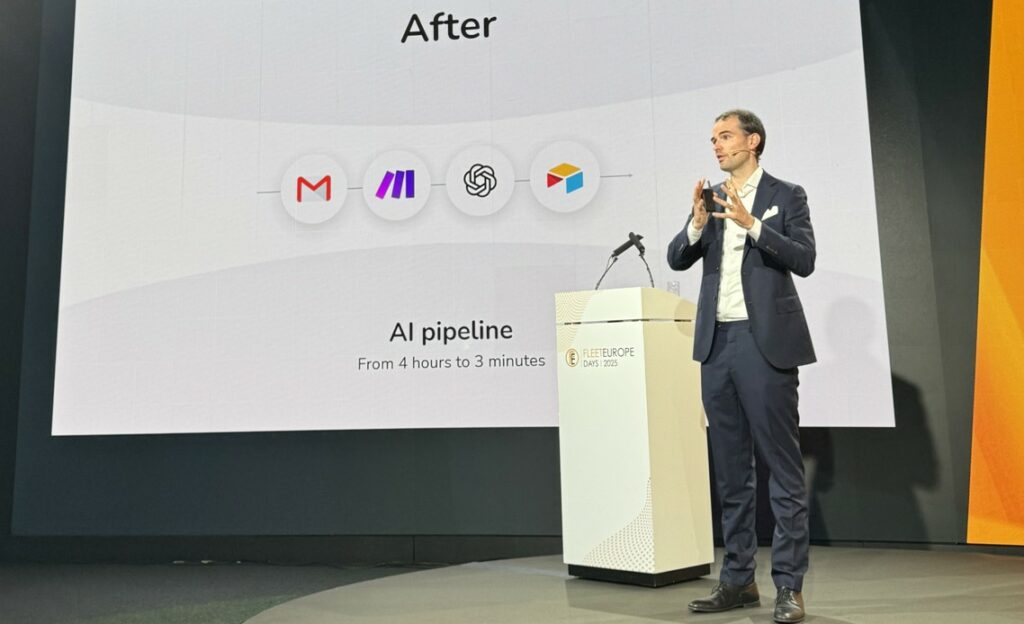
A quarter of Lizy’s remarketing workload is handled without human intervention, with AI performing over 45,000 actions every month. This includes tasks such as pricing and workflow optimisation. New processes are automated across the company weekly.

For example, its paper mail and email workflows have been automated, freeing up time for employees to work on more challenging tasks.

‘We have two types of companies today. We have companies that are writing emails and recording meetings with AI. Then, you have companies that are actually fully automating their back-end processes with AI,’ explained Lizy CEO Sam Heymans.

Sam Heymans presenting at the Fleet Europe Days event.
Sam Heymans, Lizy CEO.

‘It is fine if you are in that first category today, but if, in five years, you are still only doing that, I think you will really suffer. I think for the leaders of our industry, we should make sure that we adopt AI and embrace it, because it will be shaping the future of automotive,’ he added.

AI inspection

An essential part of the defleeting process is inspecting vehicles. This can determine residual values and sales channel selection, while reducing risk by identifying damage, wear or missing equipment.

However, this can be a particularly time-consuming process, especially for fleets processing hundreds or thousands of cars at once. Automated inspection tools can help by reducing lead times and improving accuracy.

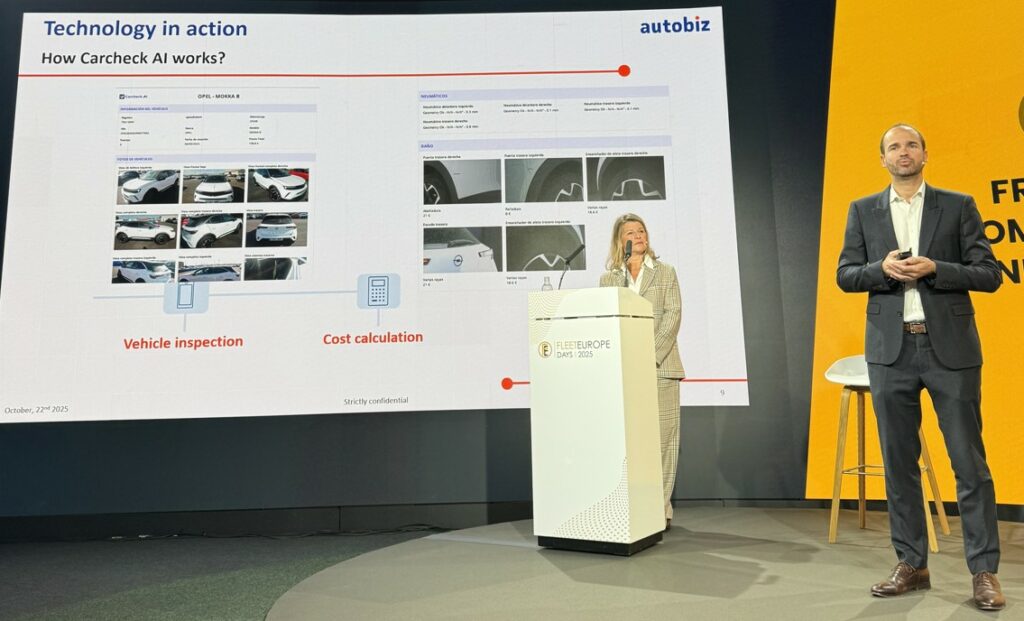
Marina Picard and Bertrand Chataing presenting at the Fleet Europe Days event.
From left to right: Marina Picard, Stellantis head of supply chain, business unit pre-owned vehicles. Bertrand Chataing, Autobiz Group chief sales and development officer.

Carcheck.AI, developed by Stellantis and Autobiz Group, can use a smartphone camera to create a digital scan of a vehicle. In just a few minutes, it calculates the costs of reconditioning the model before resale.

According to Autobiz Group, the system is already being tested at Stellantis fleets in Hordain, France and Madrid, Spain. It is expected to save up to three weeks in the vehicle resale process.

Automated fleet workflow system

BCA Europe and Alphabet International displayed another example of automation at the Fleet Europe Days event. The pair demonstrated a fleet workflow system integrated into an auction platform across European markets.

Tobias Münch and René Lorr presenting at the Fleet Europe Days event.
From left to right. Tobias Münch, BCA Europe chief commercial officer. René Lorr, Alphabet International head of international operations.

The solution optimises fleet visibility across logistics, pricing, sales, and post-sales. In turn, delivering detailed information, a smooth buyer experience, and fast vehicle remarketing. Real-time tracking is also possible, meaning shortened delivery times, improved operational control, and boosted stock rotation.

‘It has been deployed in nine markets. It consists of two main components. One is the workflow system, and that covers the process over the entire vehicle lifecycle. The second one is the auction platform,’ outlined Alphabet International head of international operations René Lorr.

‘We found a way to build up every unified process into one single workflow. I think it is the backbone of the remarketing process by Alphabet, because this system connects the people, the data and the processes together, and it brings it to a very efficient and value-driven system,’ concluded BCA Europe chief commercial officer Tobias Münch.

Latvia, Lithuania, and Estonia have all seen a notable electric vehicle (EV) uptake in recent years. What is behind this growth in the Baltics, and how bright is the future? Joanna Fabiszewska-Solares, market analyst at EV Volumes, examines the data with Autovista24 web editor James Roberts.

While EV adoption, made up of battery-electric vehicles (BEVs) and plug-in hybrids (PHEVs), remains inconsistent across Europe, some markets are pushing forward. In Portugal, every third car registered in the country last year was an EV. In Norway, BEVs account for almost 92% of new car registrations in 2024, according to EV Volumes data.

Three nations can be added to this trend: Latvia, Lithuania, and Estonia. Although not officially affiliated, they are strongly bonded through regional cooperation, historical ties, plus shared strategic and geopolitical interests.

One further thing they share is recent, and significant, uptake in BEVs and PHEVs. In all three light-vehicle markets, accounting for passenger cars and light-commercial vehicles (LCVs), the EV share reached double digits.

Underneath the apparent EV prosperity of these three geographically contiguous economies lies a complex set of circumstances. While Latvia and Lithuania are experiencing overall positive new-car sales spanning all powertrains, Estonia is seeing a more downbeat picture. The trio of markets needs to handle varying incentives, charging infrastructure challenges, and the forging of domestic energy independence.

Latvia leading the way

The second largest Baltic state in terms of population, at nearly 1.86 million, Latvia has developed a significant EV base. According to EV Volumes, between January and August, EVs accounted for 18.4% of the nation’s light-vehicle market.

This meant 2,842 plug-in light vehicles were sold in the country in the eight months. This is compared to 1,156 at the same point last year, with a 10% share of the market.

Between January and August this year, 1,076 BEVs took to Latvia’s roads, claiming a 7% market share. This was just 159 fewer than the 2024 total, which stood at 1,235, suggesting a new high will be achieved this year.

2023 set a high watermark for BEV sales in Latvia, in what was a strong year for the entire domestic automotive market. The powertrain achieved a 9.5% share of light-vehicle sales, with 1,800 units shifted. However, the following year saw a decline in BEV adoption as well as an overall fall in light-vehicle registrations.

Weaker BEV sales in 2024 were largely the result of stricter EU-wide CO2 emission standards and impending 2025 emission targets. This contributed to a year-end push to sell internal-combustion engine (ICE) vehicles across many other EU countries, including Latvia.

Underlining a pan-Baltic trend, PHEVs have enjoyed notable popularity in Latvia so far this year. Between January and August, the powertrain passed the 1,000-delivery mark for the first time, hitting 1,766 units. This is already up from 741 registered across 2024, with the powertrain achieving an 11.4% market share already this year.

Incentives driving EV uptake in Latvia

In 2023, EVs accounted for 11.6% of light vehicles taking to Latvia’s roads. This share remained stable at 11.5% in 2024, thanks mostly to an increased PHEV share. In isolation, the hybrid powertrain took a 2.1% share in 2023, then a 4.3% in 2024.

Amid the wider new light-vehicle market falling by 9.5% in 2024, the BEV market share dropped 2.3 percentage points (pp) last year. Conversely, BEV deliveries fell from 1,800 in 2023 to 1,235 one year later.

This year, major policy changes and increased availability of affordable models are supporting increased EV ownership. In April, the Latvian government raised the total funding support for EV and hybrid adoption by €11 million. This included EV purchase grants, setting subsidy levels at €4,500 for BEVs, and €2,250 for PHEVs.

Coupled with this, falling interest rates have resulted in higher corporate purchases and leasing. This has driven total light-vehicle registrations upwards, despite inflationary pressure.

Aligned with these incentives, BEVs, PHEVs, and hydrogen fuel-cell vehicles (FCEVs) remain exempt from registration tax. The policy amendments also increased the Operation Vehicle Tax (VEN) for internal-combustion engine (ICE) powered vehicles from January 2025.

EV Volumes forecasts that EV sales in Latvia’s passenger car segment alone will grow by 27.5% in 2026. This will be driven by the availability of affordable EVs, as well as the tightening of EU-wide CO₂ regulations.

Lithuania’s vibrant EV market

So far this year, Lithuania, the largest of the Baltic states, has seen a similar PHEV-driven electrification trend to Latvia.

Between January and August this year, the country saw 27,582 light vehicles registered. This puts it on course to meet last year’s total of 30,101 units. So, what percentage of these sales were attributable to plug-in hybrids?

Between January and August this year, 2,532 PHEVs were registered in the country. This is already an increase of 77.1% on 2024’s total, which stood at 1,430. BEV registrations reached 1,616 deliveries in the first eight months of this year. This is on course to exceed 2024’s total of 1,720. However, this is likely to be below 2023’s record of 2,034 units.

EV sales accounted for 15% of the Lithuanian light-vehicle market between January and August this year. This was up from 9.5% registered in the first eight months of 2024. EV growth has been mostly driven by increased PHEV registrations. The powertrain represented a 9.2% market share in the first eight months of this year, compared with just a 4.1% across the same period last year.

Looking further back, EV registrations have surged since reaching 8.1% in 2022. EV sales in the passenger car segment are projected to continue growing. A year-on-year increase of 36.5% is expected by the end of 2025, according to EV Volumes.

Varied EV incentives in Lithuania

Since 2021, EV purchase subsidies have been available in Lithuania. These include €5,000 for individuals, as well as a €1,000 scrappage bonus, extending to €4,000 for companies. BEVs are also exempt from road tax until the end of 2025. From 2026, these vehicles will receive a 75% discount.

Additionally, green tax reforms were introduced in January this year. This included the Corporate Income Tax Act (CIT), which is aimed at increasing taxable deductions for lower-emission vehicles. The sliding scale provides a maximum deduction of up to €75,000 for zero-emission vehicles (ZEVs).

Like Latvia, Lithuania’s EV sector has also benefited from falling interest rates. A growing number of leasing and renewal contracts from rental companies has helped push EV registrations up too.

When it comes to EV charging infrastructure, Lithuania leads the way in the Baltics. The country benefits from a higher density than Latvia and Estonia. According to EV Volumes, Lithuania has a total of 1,618 public EV charging locations. This is compared to 1,180 in Estonia and 1,172 in Latvia.

Estonia’s complex EV landscape

Compared with Latvia and Lithuania, Estonia’s new-car market is experiencing notable headwinds. While the three Baltic states all suffer from high inflation, Estonia possesses the second-highest rate in the EU at 6.2%.

This factor is contributing to a decline in domestic new light-vehicle sales. According to EV Volumes data, between January and August 2025, total light vehicle sales fell by 39.6%. This equated to just 8,275 units taking to Estonia’s roads in the period.

In particular, ICE sales have dramatically fallen since January. This increasing void has boosted the overall market share of EVs in the country, albeit compared with a low baseline. Although the longer-term forecast for relative EV growth is promising.

However, in volume terms, EV sales in Estonia are declining. Between January and August this year, 1,262 EVs were registered. This is compared with 1,387 in the same period last year, representing a 9% decrease. However, the EV share of passenger cars in Estonia increased to 17.3%, compared to 10.2% at the same point last year.

Estonia powertrain breakdown

Across the first eight months of 2025, BEVs held a 7.1% share of the overall light-vehicle market. Meanwhile, PHEVs took a 10.2% slice. In 2024, EVs accounted for 9.7% of the overall market, which amounted to 2,454 units. This was up from 2022, when 1,995 new EVs were registered.

Like fellow Baltic states, Estonia has rolled out incentives to boost EV uptake. The Motor Vehicle Tax Act was introduced in January. Like incentives in Latvia and Lithuania, it offers reduced vehicle tax for owners of EVs.

According to EV Volumes forecasts, passenger car registrations in Estonia will increase moderately by 3.9% year-on-year in 2026. EVs are forecast to expand, supported by ongoing tax exemptions and the EU-wide tightening of CO₂ emission standards. As a result, BEV and PHEV numbers are expected to grow by 42.8% year-on-year.

The pace of electric vehicle (EV) sales growth has slowed globally. But which countries, powertrains and models are at the forefront of this trend? Autovista24 editor Tom Geggus investigates the latest data from EV Volumes.

Including battery-electric vehicles (BEVs) and plug-in hybrids (PHEVs), 1,802,584 EVs were sold globally during August. This marked a 21.5% year-on-year increase, according to EV Volumes. However, this rate of growth has slowed consistently since April, when deliveries were up by 37.9%.

Between January and August, 13,062,688 EVs hit the roads, equating to a year-on-year increase of 31.2%. Whether this rate of growth is further stunted will be a matter of several interlocking factors.

EV powertrain performance

First, it will depend on the performance of the two powertrains. BEVs have seen a varied performance across 2025, from a 57% boost in February to a slower 25.2% rise in May. In August, global all-electric sales increased by 27.4% to 4,740,276 units. In the first eight months of 2025, a total of 8,322,412 BEVs were sold, up 33.5%.

Unfortunately, PHEV declines have been far more consistent. Following a 44.3% spike in sales during May, the powertrain has seen its rate of growth drop month after month. In August, deliveries were up by 11.8% to 630,356 units. This put the cumulative total to 4,740,276 sales, up 27.4%.

This trend has been driven by the powertrain’s performance in China. In August, 75.2% of all PHEV sales took place in the country. However, its sales volume grew by just 4.7%. This follows a slow July, which produced the powertrain’s worst year-on-year performance since June 2020.

This was behind the US, where deliveries rose 24%, and Germany, where sales increased by 77.7%. However, these two countries only made up 5.4% and 3.8% of the global PHEV market, respectively.

In September’s report, European countries like the UK and Germany can be expected to see even greater EV sales. This will be the result of regional effects, such as changes to incentives and registration plates. It seems unlikely that this will be enough to bolster results in the year-to-date, however.

So, PHEVs have slowed global EV growth, and China’s market for the powertrain has cooled. But how have individual models been impacted by these trends?

Poor PHEV growth performance

Only four PHEVs in August’s top 10 managed to avoid year-on-year sales declines. However, these models only became available within the last 12 months, so no comparisons are possible.

Meanwhile, established models in the top 10 all saw declines in the month. These cars are seeing a slower market, as well as increased competition from younger, more advanced vehicles.

The BYD Qin Plus saw deliveries drop by 18.1% compared with August 2024. Its volume of 26,833 units equated to a market share of 4.3%, down from 5.8% a year prior. While this downturn will be bad news for the carmaker, it was one of the smallest falls in the top 10.

EV Volumes categorises extended-range electric vehicles (EREVs) alongside PHEVs. This powertrain uses a combustion engine as a generator for the battery system, instead of directly powering the wheels.

The technology has received increasing attention and popularity, with the Aito M8 coming second in August. It recorded 21,537 sales and a 3.4% market share. However, the model is relatively new to the market, with its first sales recorded in April this year.

The BYD Song Plus, also known as the Seal U in select markets, came third with 20,097 sales. This equated to a drop of 36.8%, as its market share fell by 2.4 percentage points (pp) to 3.2%.

The BYD Seal 6 finished fourth as its deliveries dropped by 44% to 19,031 units. This meant its market share was halved from 6% in August 2024 to 3% in August 2025. Fifth place went to the BYD Song Pro, which saw sales fall by 30.5% to 16,154 units. This meant its share slid by 1.5pp to 2.6%.

New entrants pack a punch

With sales first recorded in June this year, the BYD Sealion 06 has stepped up deliveries. The model reached 15,019 units, taking a 2.4% market share in August. This posed issues for established models in the top 10.

In seventh, the BYD Qin L’s market share fell by 4.4pp to 2%. It saw the largest delivery drop in August’s top-selling PHEV table, down 65% to 12,600 units. There was increasing pressure from newer Geely models as well.

The Galaxy A7 first recorded sales in June 2025 and took a 1.9% share in August with 12,078 units. Meanwhile, the Galaxy Starship 7 hit the market in November 2024, and 10 months later, it recorded 11,431 sales. This gave it a 1.8% market share in August, putting it ninth. However, the model’s performance has slowed after a strong start to the year.

The Li Auto L6 was knocked downwards as its hold on the global PHEV market loosened by 2.6pp to 1.8%.  It recorded 11,313 deliveries, equating to a drop of 54.6%.

BYD’s changing places

Between January and August, the BYD Song Plus managed to retain the top spot with a 5% market share. Having moved 239,110 units, its nearest competitor was the BYD Qin Plus, which moved up to second place. It recorded 162,564 sales and a 3.4% share.

This knocked the BYD Song Pro into third as it represented 3.3% of the market with 158,617 deliveries. The BYD Seal 6 finished fourth with a 3.1% share and 147,383 sales.

The first non-BYD model in this top 10 was the Li Auto L6 with 122,637 units and a 2.6% market share. It was followed by three more BYD models, highlighting the brand’s relative dominance.

The Qin L was sixth with a 2.5% share and 119,200 sales in the first eight months of the year. Then came the Song L with 99,885 deliveries and a 2.1% hold. Only 1,442 units behind was the BYD Destroyer 05, also known as the Seal 05. It recorded 98,443 sales and a 2.1% share. Neither the Song L nor the Destroyer 05 placed in August’s top 10.

The Galaxy Starship 7 came ninth with a 1.9% hold and 91,288 deliveries. The Auto M8 moved up to 10th, taking the place of its sibling, the Aito M9. The M8 recorded 83,327 sales and a 1.8% share.

Tesla Model Y maintains growth

The Tesla Model Y held on to the top spot in August’s global BEV top 10. Its deliveries increased by 7.8% year on year to 105,904 units, accounting for 9% of the total market. However, this was down by 3.7pp from a year ago. Having struggled at the start of the year, August marked the third consecutive month of volume improvement for the US model.

After first recording sales in September last year, the Geely Geome Xingyuan claimed a 3.9% market share. Its 46,057 sales allowed it to secure second, ahead of the Tesla Model 3, which moved 43,556 units, down 4.2%. Accordingly, the sedan’s market share dropped by 1.2pp.

In fourth, the Wuling Mini’s deliveries increased by 43% to 37,838 units. Its grip on the market tightened by 0.3pp to 3.2%.

BYD places four BEVs

The first of four BYD BEVs arrived in fifth. With 29,331 sales, the BYD Seagull, also known as the Dolphin Surf, saw deliveries decline by 33.2%. Its market share reached 2.5%, down from 4.8% a year prior.

The BYD Yuan Up, also known in some markets as the Atto 2, came sixth. Its sales increased by 10.6% to 21,634 in the month. This meant its market share grew by 0.3pp to 1.8%.

The Xiaomi SU7 followed with a 1.7% share and 19,877 deliveries. This was the largest sales growth recorded in the top 10, up 51.3%. Its grip on the market also increased by 0.3pp to 1.7%.

While the BYD Dolphin was only 238 units behind with 19,639 sales, this equated to a delivery drop of 8.3%. Its share also declined, from 2.3% to 1.7%. However, this was better than the BYD Yuan Plus, also known as the Atto 3. Taking ninth, its sales nosedived by 43.7% to 18,683 units. Accordingly, its share hit 1.6%, down 2pp.

Taking 10th was the Xiaomi YU7. After first recording deliveries in June this year, it claimed a 1.4% market share with 16,295 sales.

Tesla’s top two

The annual BEV chart remained static for the second month in succession, with no position changes. Between January and August, Tesla held the top two spots, with the Model Y in first and the Model 3 in second.

The all-electric crossover recorded 657,313 sales and claimed a 7.9% share. Its sedan sibling took less than half this amount with a 3.6% share and 302,914 deliveries.

The Geely Geome Xingyuan came third as it continued to close the gap with the Tesla Model 3. Its cumulative 295,434 sales were only 7,480 units away from second place as it made up 3.5% of the market.

The BYD Seagull made up 3.1% of the global BEV market with 259,615 sales. The Wuling Mini finished fifth with 235,315 deliveries and a 2.8% share. With a 2.4% hold, the Xiaomi SU7 came sixth with 200,132 sales.

The BYD Yuan Plus was seventh with a 2% share and 163,576 sales. In eighth, the BYD Yuan Up recorded 142,771 deliveries and a 1.7% share. The BYD Dolphin came ninth with a 1.6% share and 136,049 sales. Then in 10th place was the Wuling Bingo, accounting for 1.4% of all BEV sales, with 119,978 units.

For the second consecutive month, China’s plug-in hybrid (PHEV) market experienced slower growth. Which models fuelled this trend? Autovista24 special content editor Phil Curry examines the latest data from EV Volumes.  

China’s PHEV market continued to struggle into August, following a dramatic dip in volume growth during July.

In total, 474,234 new PHEVs were sold in the country during August, according to data from EV Volumes. This represented a 4.7% year-on-year increase, and is the second consecutive month of single-digit growth for the market.

July saw the powertrain’s worst result since July 2020, which saw an increase of 4.1%. A month prior, the market had fallen by 51.4% year on year. Deliveries then increased continuously by two to three-digit figures each month from August 2020.

It appears China’s PHEV market has plateaued following this period of exceptional growth. The results of the last two months have also impacted yearly improvements. Between January and August 2025, 3,376,609 PHEVs took to China’s roads, up 25.4%. This sits in stark contrast to the 35.8% increase in sales across the first two quarters of 2025.

While PHEV sales slowed, the battery-electric vehicle (BEV) market continued to post strong growth. However, its 24.3% increase over August 2024 was the second-lowest improvement in the first eight months of the year.

In total, 718,128 new BEVs took to China’s roads in the month. In the year to August, BEV deliveries have increased by 39.3%, with 4,852,413 units delivered.

BYD’s PHEV struggles

In China’s top 10 best-selling PHEV table for August, four models had gone on sale within the last 12 months. The other six models failed to see any volume improvement, highlighting a slowdown.

The BYD Qin Plus led the pack in the month, with 25,800 deliveries, according to EV Volumes data. This was a drop of 19.6% year on year, although it was the model’s best volume in the first eight months of 2025. Its market share fell by 1.7 percentage points (pp), to 5.4%.

For the second consecutive month, the Aito M8 finished second, denting the dominance of BYD. The model achieved 21,537 sales in August, with a 4.5% market share in its fifth month of recorded sales.

BYD models took the next four positions, with the Seal 06 in third, thanks to 17,414 units. This was a drop of 47.1% year on year, while its share of the PHEV total dropped 3.6pp, to 3.7%.

Next came the BYD Sealion 06, making its top 10 debut with 15,000 sales. This capped an impressive performance, which saw limited deliveries in its first two months on sale. As its other models struggled, BYD will be hoping the Sealion 06 can carry some momentum. It took 3.2% of China’s PHEV market in August.

The BYD Song Pro ended the month in fifth thanks to 12,681 deliveries. This was a drop of 34.3% compared with August 2024. Its market share of 2.7% was down 1.6pp year on year.

New PHEV models gain ground

Having started the year well, the BYD Qin L has struggled. August saw its best placement since April, as the model ended up in sixth. Its total of 12,600 units was down 65%, the largest decline in the top 10. This also gave the model a 2.7% market share, a drop of 5.2pp.

Another top 10 debutant took seventh. The Galaxy A7, which first recorded sales in the market in June 2025, saw 12,078 deliveries during August, with a 2.5% market share.

The model beat its stablemate, the Galaxy Starship 7, which achieved 11,431 sales. The model, which first recorded sales in November 2024, claimed first place in January and looked set to challenge BYD. However, it has not sustained this success, failing to rank higher than eighth since its strong start.

Just 214 units behind was the Li Auto L6. It too struggled, with 11,217 sales down by 54.9%. This equated to a 3.1pp drop in market share, reaching 2.4%.

Rounding out the table was the BYD Song L. It posted 11,000 deliveries in the month, a 34.4% year-on-year drop, which meant its share fell by 1.4pp to 2.3%.

Change at the top

In the first eight months of the year, the PHEV top 10 saw a change in leadership. Despite its decline in sales in August, the BYD Qin Plus took first place, with 154,212 deliveries. This equated to a 4.6% market share.

After struggling in August, the BYD Song Plus fell to second, with 145,213 deliveries and a 4.3% market share. The result means the Qin L took the lead by 8,999 deliveries.

There were no position changes between third and ninth. The BYD Seal 06 remained in third with 137,013 sales between January and August. This gave the model a 4.1% share of the yearly PHEV total. Next came the BYD Song Pro, with 124,701 deliveries and a 3.7% market hold.

The Li Auto L6 remained in fifth, thanks to 122,401 sales and a 3.6% market share. The BYD Qin L placed sixth, taking 199,200 sales and 3.5% of the market.

Seventh went to the BYD Song L, which ended the eight-month period with 99,500 deliveries and a 2.9% market share. In eighth was the Galaxy Starship 7, thanks to 91,288 deliveries and 2.7% of the market. Ninth went to the BYD Destroyer 05, with 84,174 sales, and 2.5%.

The Aito M8 rounded out the top 10, which entered the cumulative chart for the first time. With 83,327 sales, it was just 847 units behind the BYD Destroyer 05. The Aito model held 2.5% of the PHEV total across the first eight months of 2025.

Geely domination continues

The Geely Geome Xingyuan continued its impressive run to head the Chinese BEV market in August. Its total of 46,057 units was enough for a 6.4% share in its 12th month on sale in the country. It has topped the monthly best-seller list five times across the first eight months of 2025.

Second went to the Tesla Model Y, with 39,413 units delivered. This was a 13.1% decrease year on year, as the model’s struggles continued. Its 5.5% market share was a 2.3pp drop compared to August 2024.

The Wuling Mini placed third, with 37,828 units. Following a strong start to the year, the model wavered in the second quarter of 2025. However, it recovered, ending up third in August for the second consecutive month. In total, 37,828 units were delivered, a 43% rise. This gave the model a 5.3% market share, up 0.7pp.

In fourth, the BYD Seagull struggled with a 43.8% decline, as it saw 23,031 units hit the roads. This resulted in a 3.9pp dip in share, to 3.2%.

Finishing in the top half of the table was the Xiaomi SU7. With 19,848 sales in August, it achieved a 51.4% improvement year on year. This was good enough for a 2.8% share of total BEV sales in the month.

Tesla’s bounce continues

The BYD Yuan Up took sixth in August’s BEV chart, with 19,647 sales in China. This was an increase of 1.6%, with the model slowly improving its figures this year. However, in an increasingly competitive market, this small rise in volumes did not boost its share. It represented 2.7% of total BEV sales in the month, down 0.6pp.

The Tesla Model 3 re-entered the table in seventh after dropping out in July. The US model has struggled in China this year, only placing as high as fifth in February. Ahead of the usual Tesla spike in September, 17,739 units were delivered to Chinese customers, a 2.1% year-on-year decrease.

However, its market share only decreased by 0.6pp, the same as the BYD Yuan Up. It ended the month making up 2.5% of deliveries.

In only its third month on the market, the Xiaomi YU7 made its top 10 debut in eighth, with 16,295 sales. This gave the model a 2.3% hold of the BEV market. It was followed by the Xpeng M03, with 15,333 deliveries and a 2.1% market share.

Rounding out the top 10 was the Changan Lumin. The model saw 14,570 deliveries in August. This was down 7.2% compared to the same month last year. The model did take a 2% market share, down by 0.7pp.

Top spot back in domestic hands

Spanning the first eight months of 2025, the Geely Geome Xingyuan led the way. It recorded 295,434 sales, meaning a 6.1% market share.

Geely has shaken up the BEV chart with the Geome Xingyuan, placing the market in the hands of domestic carmakers. This follows two years of Tesla domination. The US brand is still going strong, however, with its Model Y finishing second. It achieved 241,670 deliveries for a 5% market share.

However, this result places the Model Y 53,764 units behind the Geome Xingyuan. Aside from a blip in March, the Geely model has consistently been in the top two. Conversely, the Tesla model has experienced more of a rollercoaster year. With the Chinese BEV having hit its stride, it could be difficult for the Model Y to catch up before the end of the year.

Third in the yearly chart went to the Wuling Mini, which climbed back towards the top at the expense of the BYD Seagull. With 235,249 sales between January and August, it took a 4.8% market share. The Chinese model was 6,421 units behind the Model Y. But with the US brand’s customary spike in September, finishing second in 2025 could be a long shot.

The BYD Seagull dropped one place to fourth after eight months, with 220,884 units, and a 4.6% market share. Fifth went to the Xiaomi SU7, which held its place as deliveries grew to 199,950 units. This was enough for a 4.1% share of the total.

Gap too big to close?

The BYD Yuan Up maintained sixth, with 132,688 deliveries between January and August. The model held a 2.7% market share, with the gulf between fifth and sixth places seemingly too big to bridge.

The Tesla Model 3 moved up one spot to seventh after eight months of 2025. Its 119,509 total was 13,179 units behind sixth. Even with the end-of-quarter push, the US model may struggle to catch its rival.

The Xpeng M03 remained in eighth, with 117,388 sales and a 2.4% market share. Having not placed in August’s top 10, the Wuling Bingo fell two positions to ninth, with 116,942 deliveries. This was just 446 units behind the Xpeng, suggesting a tighter battle for the lower end of the table.

Finally, the Geely Panda Mini held 10th, thanks to 111,842 sales between January and August. This gave the Chinese model a 2.3% share of total BEV sales in the period.

As plug-in hybrid (PHEV) deliveries continue to soar, Tesla is quietly running away with Europe’s best-selling battery-electric vehicle (BEV) title. But is it too late for domestic rivals to catch up? Tom Hooker, Autovista24 journalist, analyses the data from EV Volumes.

The latest data from EV Volumes shows that the European PHEV market grew by 53.9% year on year in August. This equated to 82,308 new units featuring the technology hitting the roads.

This was an improvement on July’s result, which itself was the best volume improvement since June 2021. The result marked a sixth month of consecutive double-digit improvement, highlighting the powertrain’s growing appeal. 

Meanwhile, 158,225 battery-electric vehicles (BEVs) were delivered in the month. This equated to a 24.6% jump in sales, as its streak of double-digit increases extended. All-electric model deliveries have seen volume growth every month so far in 2025.

These unwavering performances meant BEVs saw a larger cumulative improvement than PHEVs between January and July. Yet, August proved to be a turning point. PHEV volumes rose by 28.3% in the first eight months of the year, with 789,268 units. Meanwhile, BEVs managed a 25.8% increase. However, it retained the greater volume, with 1,544,223 deliveries in the period.

Combining the two powertrains, electric vehicle (EV) deliveries soared by 33.3% in August, to 240,533 units. In the first eight months of the year, 2,333,491 new EVs took to European roads, marking a 26.7% increase.

BEVs continued to make up the majority of EV deliveries, but their grip loosened slightly compared to one year prior. The technology accounted for 65.8% of overall EV deliveries in August, down 4.6 percentage points (pp) compared to August 2024. The smaller drop occurred in the cumulative figures, with its share dropping from 66.6% to 66.2%.

Tesla extends lead

This year has been a rollercoaster for the Tesla Model Y. Looking at Europe’s BEV best-sellers table, the crossover has either finished first or ninth since February.

This can be partially explained by its quarterly delivery cycle. The model’s two highest volume months came in March and June. However, at the start of the following quarter, the BEV dropped down the table. It then gained momentum again in the following month. The Model Y continued this trend by topping the table in August, after a disappointing July.

The crossover recorded 8,451 sales to take its fifth win of the year, 2,191 units ahead of its nearest competitor. However, it was not all good news for the Tesla Model Y. Its volumes dropped by 37.3% compared to one year prior. In turn, its market share halved compared with August 2024, down to 5.3%.

Skoda Elroq remains popular

July’s best-selling BEV, the Skoda Elroq, secured second in its 10th month of sales. The model’s 6,260 delivery total translated to a 4% market share. After entering the top 10 for the first time in April, it has only placed in the first three positions.

Behind was the Tesla Model 3, making its fourth top-three appearance in 2025. Its deliveries rose by 9.9% to 6,177 units. The sedan captured 3.9% of BEV volumes, down 0.5pp year on year. The US model has also had a rollercoaster ride across the first eight months of 2025. It has only placed in the top 10 on four occasions.

Volkswagen’s (VW) ID.3 finished fourth, with 5,554 units, up 58.8% compared to August 2024. The hatchback has maintained consistent deliveries throughout 2025, with monthly volumes ranging between 5,399 units and 6,932 units. However, its positions have been mixed.

BMW’s good form continues

After enjoying a year-best result of fourth in July, the BMW iX1 continued to prove a popular choice, placing fifth in August. The SUV recorded 4,966 sales, up 33% compared with 12 months ago. The model saw its share grow from 2.9% to 3.1%.

In the shadow of its younger sibling, the Skoda Enyaq took sixth. It sat just 15 units behind the BMW iX1 with 4,951 deliveries. This represented a decline of 20.4% year on year and was its lowest volume month of 2025 so far. Its share subsequently fell by 1.8pp to 3.1%.

Conversely, the VW ID.4 in seventh saw deliveries grow by 18.3%. However, its 4,786-unit total was also the crossover’s lowest monthly volume of 2025. Due to increased competition, its market share also dropped by 0.2pp to 3%.

In eighth place, with a combined total of 4,678 units, was the Renault 5 and Alpine A290. This equated to a market share of 3%. The Kia EV3 placed ninth, with 4,253 units in its 11th month on the market. The model accounted for 2.7% of overall BEV volumes. Apart from June, it has featured in every monthly top 10 table so far this year.

The VW ID.7 took 10th, its lowest finishing position across the first eight months of 2025. It also recorded its lowest monthly delivery figure of the year, with 4,131 units. Yet, this was still a considerable improvement from 12 months prior, equating to a 46.6% uptick in sales. The ID.7 made up 2.6% of the market, up 0.4pp.

Can Tesla hold on?

After its victory in August, the Tesla Model Y extended its lead in the yearly chart. It looks set to become Europe’s best-selling BEV this year.

The crossover has seen 83,194 deliveries across the first eight months of the year. A gap of 32,569 units now separates it from its nearest competitor, as it claims a market share of 5.4%. It seems highly unlikely that the Tesla Model Y could be caught by the end of the year.

The model’s closest rivals have struggled to cross the 10,000-unit threshold in any month this year. The only other BEV to achieve this feat is the Tesla Model 3.

In the Model Y’s lowest volume month in April, it still managed 4,568 deliveries. If the crossover were to replicate this result until December, its competitors would still need a significant increase in volumes to mount a challenge.

Seven-way BEV battle

The battle for second remains hotly contested, with 8,320 units separating the runner-up spot from 10th place. The VW ID.4 held second, with 50,625 deliveries and a 3.3 % market share.

Its sibling, the ID.3, sat just 682 units behind. It moved up one place from July’s cumulative standings, with 49,943 sales. The hatchback, as well as the next four positions, all held a 3.2% share of BEV volumes at the end of August.

The Skoda Enyaq remained in fourth with 49,748 units, while the combined total of the Renault 5 and Alpine A290 fell two spots to fifth with 49,554 deliveries.

The Tesla Model 3 moved up from seventh in July, recording 49,524 deliveries across the first eight months of 2025. This is a promising move ahead of another quarterly-reporting period.

Another BEV that made ground was the Skoda Elroq. Thanks to another strong month, the SUV moved up one place, posting 48,678 units. This came at the expense of the VW ID.7, after a disappointing August. Its total of 47,693 deliveries translated to a 3.1% market share.

The Kia EV3 came ninth, accounting for 2.9% of overall BEV volumes with 44,560 sales. The BMW iX1 closed out the top 10, posting 42,305 deliveries and a 2.7% share.

Three in a row for VW

In Europe’s PHEV market, the VW Tiguan has now recorded three monthly victories in a row. This follows its first ascent to the top in June. August, however, was its most emphatic victory.

The SUV’s 4,010-unit total represented a 275.5% year on year increase. Its share also soared from a 2% share to 4.9%.

The Tiguan led its nearest competitor, the Volvo XC60, by 667 deliveries. The second-place SUV achieved a 27.7% improvement in volumes during August, with 3,343 units. However, as the PHEV market has become even more crowded, the XC60 saw its share drop by 0.8pp to 4.1%.

Third went to the BYD Seal U, with 3,253 units. The PHEV continues to impress, after a slow start to deliveries in 2024. It took a 4% market share, up 3.5pp year on year. The Ford Kuga finished fourth, replicating its July result. It posted 3,195 sales, up 11.1% on August 2024. However, the model’s market share fell from 5.4% to 3.9%.

MG deliveries surge

In fifth was the MG eHS, repeating its best finish of the year in July. The SUV’s 2,943-unit total represented an 819.7% surge in deliveries. Consequently, it captured 3.6% of overall volumes, up 3pp from 12 months prior.

The BMW X1 trailed the MG eHS by just 14 units in sixth. It recorded 2,929 deliveries, equating to a 2.4% growth year on year. Yet, its market share dropped by 1.7pp to 3.6%.

The Toyota RAV4 followed in seventh, thanks to 2,811 deliveries in August. This marked a surge of 160.5% compared to one year prior. It made up 3.4% of the PHEV total, up from 2%.

Eighth went to the Mercedes-Benz GLC, its lowest finishing position since March. Its deliveries fell by 5% compared to August 2024, with 2,577 units. Meanwhile, the model’s market share dropped by 2pp to 3.1%.

The BMW X3 made its first monthly top 10 appearance this year in ninth. This was thanks to 2,318 sales, a significant improvement of 318.4%. Unsurprisingly, its market share grew by 1.8pp to 2.8%.

Rounding out the top 10 in August was the Hyundai Tucson, its fourth foray into the table in the first eight months of 2025. The PHEV posted 2,176 deliveries, denoting a 68.6% uptick in volumes. This translated to a 2.6% market share, up by 0.2pp compared to 12 months prior.

Interestingly, all these models fit into the C and D-Segment SUV category, compared to six SUVs in the BEV top 10. However, these models could face restrictions in cities such as Cardiff in the future. Higher parking charges may be applied to vehicles over a certain weight, as reported by the BBC.

Tiguan inches ahead

Europe’s PHEV market continued to be dominated by three SUVs. The VW Tiguan, Volvo XC60 and BYD Seal U have placed in the top three every month since April. A total of 3,251 units separate the models, meaning changes could occur by the end of the year.

The VW Tiguan continued to lead the pack, with 38,962 units from January to August and 4.9% market share. It has been a consistent performer, with a worst finish of fourth in March.

Volvo’s XC60 has been even more consistent in second, with no finish outside the top three in any month of 2025. It posted 36,757 units after eight months of the year, equating to a 4.7% share.

Chasing both SUVs down is the BYD Seal U, even after a slow start to the year. However, it has remained inside the top three since March. The PHEV recorded 35,711 units between January and August, capturing 4.5% of overall volumes.

Ford falls out of touch

Once in the hunt for the lead, the Ford Kuga now appears out of touch, thanks to average performances in April, May and June. The SUV’s 30,203-unit total gave it a 3.8% share, placing it in fourth. Behind was the BMW X1, representing 3.4% of overall PHEV figures with 26,863 units.

In sixth was the Toyota C-HR, thanks to 23,580 deliveries and a 3% share. The Mercedes-Benz GLC accounted for 2.8% of total volumes in seventh, posting 21,748 deliveries. Then came the MG eHS, just 144 units behind. The PHEV saw 21,604 models handed over to customers in the first eight months of the year, giving it a 2.7% share.

Cupra’s Formentor remained in ninth, with 19,673 sales and a 2.5% market share. The BMW 5-Series captured 2.4% of PHEV volumes in 10th, posting 18,840 units.

For the first time since 2023, new-car registrations in Germany recorded year-on-year growth for three consecutive months. This increase was propelled by a surge in electric vehicle (EV) deliveries. Could new incentives push this result further? Autovista24 journalist Tom Hooker examines the market.

The German new-car market celebrated year-on-year registration growth of 12.8% in September, reaching 235,517 units.

This marked the country’s third consecutive month of improvement, two of which were double-digit increases. According to KBA data, this feat was last achieved between June 2023 and August 2023.

rn

‘September 2025 shows another significant recovery in the German passenger car market after the promising figures in August and July,’ said Robert Madas, Autovista Group’s regional head of valuations.

This is in stark contrast with the market’s performance over the last two years. Between September 2023 and June 2025, Germany only saw double-digit improvements in January and April 2024.

September also denoted Germany’s biggest registration uptick since August 2023. However, results were skewed by the end of commercial customer purchase incentives for battery-electric vehicles (BEVs) in the following month.

‘The growth is deceptive. It is taking place in an overall weak and declining market,’ explained ZDK president Thomas Peckruhn.

Last month’s sales total was set against the third-largest drop for the German new-car market in 2024. The country faces a more representative challenge next month, as registrations grew by 6% year on year in October 2024.

A total of 2,110,336 new models were delivered to customers between January and September 2025. This figure was down 0.3% year on year, meaning the country could enter the green if results stay strong. It is also a significant improvement on the 4.7% cumulative decline recorded from January to June.

Are BEVs still behind?

BEVs recorded a 31.9% rise in deliveries during September, with 45,495 units. This caps nine months of consecutive improvements for the powertrain, eight of which were double-digit increases.

Last month’s performance could be seen as a slowdown compared to greater growth in August and July. However, the powertrain’s share says otherwise. BEVs represented 19.3% of all registrations in September. This was the technology’s largest share in 22 months and was up 2.8 percentage points (pp) year on year.

rn

Across the first nine months of 2025, BEV deliveries totalled 382,202 units. This equated to a growth of 38.3% and an improvement of 105,812 registrations. The technology took an 18.1% market share in this period, up from 13.1%.

However, the VDIK stated that this share is still not at the level required to achieve CO2 limit value targets.

‘We must support the current upswing with sustainable framework conditions to make a BEV share of well over 20% achievable,’ commented VDIK president Imelda Labbé.

‘To achieve the CO2 targets, we should be open to hybrid powertrains and other technologies. To ensure that the transformation is not accompanied by penalties and job losses, we need a master plan for the ramp-up of electric mobility that focuses on the future viability of the automotive industry,’ she highlighted.

PHEV market soars

One powertrain that can be used in the transition to BEVs is plug-in hybrids (PHEVs). The technology enjoyed a strong September, with an 85.4% delivery increase to 27,685 units.

This continued the technology’s perfect streak of double-digit improvements since January. The powertrain captured 11.8% of overall sales, up by 4.6pp year on year.

Overall, this meant September marked the biggest monthly PHEV volume, growth and market share since December 2022. This month saw a distorted result, due to the imminent axing of PHEV incentives.

In the year-to-date, PHEVs have seen the best growth of any powertrain, up 63.9% to 217,760 units. Their market share of 10.3% in this period was also up, by 4pp year on year.

Combining BEV and PHEV figures, Germany’s new EV market continued its unbreakable run of double-digit growth, with a 48.1% upswing in September.

A total of 73,180 registrations gave plug-in models a 31.1% share of the sales total. This was up 7.4pp year on year. From January to September, EVs posted a 46.6% surge in volumes to 599,962 units. In turn, its cumulative market share soared from 19.3% to 28.4%.

EV purchase incentives return

EVs could soon see demand boosted by incentives. The German government has agreed on new purchase incentives for zero-emission vehicles worth €3 billion through to 2029, according to Bloomberg. The country has not provided any EV purchase subsidies since December 2023.

‘The automotive industry is a key industry for prosperity, jobs and innovation in Germany. We want to strengthen their competitiveness. For this, it is important to further advance electromobility, but at the same time to allow more flexibility and openness to technology in regulation. For this, our industry needs good conditions so that it can survive in international competition with successful products,’ said German Chancellor Friedrich Merz.

The VDIK stated that the focus of the incentives is to be on households with low and medium incomes. However, some of these buyers may only be considering used EVs, which could be affected by the new programme.

‘The announced EV purchase incentives will be a welcome additional step towards accelerating the transition to emission-free mobility, even if not all details are clear yet. The new-car market will benefit from these incentives. However, this will also lead to an additional supply push on used-car markets in the next years, putting further pressure on residual values,’ explained Madas.

‘Now it is important to quickly design residual value-saving incentives for all private customers. The announced measures can only be successful if they are embedded in a master plan that creates framework conditions, such as charging infrastructure and fair electricity prices,’ added Labbé.

Tax exemption extended?

The government also wants to extend the EV vehicle tax exemption until 2035. According to Handelsblatt, this could see vehicles registered by 31 December 2030 available for the incentive. However, it is still unclear whether PHEVs would be included in this scheme.

‘The tax exemption has proven to be an effective incentive and would currently no longer apply to new registrations from 2026 onwards, with unforeseeable consequences for the further ramp-up of passenger cars,’ outlined VDA president Hildegard Müller.

‘If the tax exemption expires at the end of the year, fully-electric vehicles would be taxed even higher than plug-in hybrids – a contradiction that the coalition urgently needs to resolve,’ she added.

Meanwhile, the ZDK highlighted that to achieve a broad ramp-up of EVs, the confidence of private customers must also be strengthened.

‘What we finally urgently need are clear and long-term signals from politicians. Without reliable framework conditions, electromobility remains a risk for many customers,’ Peckruhn said.

Planning security is the basis for investments. This applies to both customers and motor vehicle companies,’ he added.

Hybrids maintain solid growth

Hybrids, including full and mild powertrains, enjoyed a 14.9% growth in September. The result completes 12 months of consecutive improvement for the powertrain. This underlined a significant achievement considering wider new-car registration declines.

A total of 69,527 hybrids took to Germany’s roads last month. This translated to a 29.5% share for the technology, up 0.5pp on September 2024.

More importantly, the hybrid share was 2.7pp ahead of petrol, the biggest advantage ever recorded by the powertrain. In contrast, hybrids trailed petrol by 3.1pp 12 months prior.

In the year-to-date, the technology recorded a 10.6% rise in sales to 603,270 units. It captured 28.6% of overall volumes during the first nine months of 2025. This was 0.6pp ahead of petrol and up 2.8pp year on year.

Adding hybrids to EV figures, the electrified market took a dominant 60.6% share in September, up 8pp year on year. The powertrain grouping posted growth of 29.8%.

The electrified share was lower in the first nine months of the year, at 57%. However, this was still a positive development from its 45.1% market hold recorded between January and September 2024.

Petrol market slows declining trend

Deliveries of petrol-powered cars dropped by 5.9% last month to 63,047 units. While this fits the narrative of falling sales for the fuel type, a positive can be taken from September’s performance. The result ended eight consecutive months of double-digit decline. It also denoted the smallest registration drop since November 2024.

However, when looking through a different lens, petrol’s performance looks dire. Its monthly share of 26.8% was the powertrains’ lowest since December 2022. During this month, buyers rushed to purchase EVs before subsidies were lowered. Meanwhile, last month’s share was claimed from a relatively stable market.

In the year-to-date, registrations of petrol-powered cars slumped by 23.5%, making it the worst-performing powertrain in Germany in terms of declines. The fuel type’s total of 589,951 units translated to a 28% market share, down from 36.4%.

Meanwhile, diesel-powered cars suffered an even steeper 7.2% fall in September to 28,871 deliveries. The powertrain follows a similar story to petrol.

Diesel has managed three consecutive months of single-digit declines, an improvement on its run of double-digit drops, which lasted from December 2024 to June 2025. Yet, diesel’s 12.3% share, down 2.6pp year on year, is the fuel type’s lowest since December 2022.

The powertrain saw sales decline by 18.9% between January and September, with 308,001 units. It made up 14.6% of total new-car volumes, down from 17.9%.

A glimmer of hope for ICE?

Germany’s chancellor, Friedrich Merz, has vowed to ‘do everything’ to stop the EU’s ban on the sale of new cars powered solely by internal-combustion engines, according to Barron’s.

The regulation, which prevents the sale of new petrol or diesel models after 2035, was also discussed in a meeting between the chancellor, some of Germany’s carmakers and automotive industry bodies on 9 October.

The ZDK has backed these efforts, regarding it as ‘a long overdue step towards a greater sense of reality in the European CO2-Fleet regulation.’

‘We need a climate policy that is not regulated from the top down, but is designed with a sense of proportion, through incentives that consumers take with them, and not through bans that bully car dealers and vehicle manufacturers,’ explained ZDK President Thomas Peckruhn.

‘A blanket ban on new registrations of combustion engines jeopardises urgently needed investments and undermines confidence in the reliability of political decisions,’ he added.

The ZDK also said that for the maximum reduction of CO2 emissions, alternative solutions are needed. This looks to include efficient ICE models powered by synthetic or biogenic fuels.

‘Our companies are set up to be open to technology, and so should politics. Not every customer, not every fleet and not every mobility need can be mapped purely electrically,’ Peckruhn concluded.

Electric vehicle (EV) registrations continued to help Spain’s new-car market shine in September. But there are concerns that an end to incentives could derail growth. Autovista24 web editor James Roberts delves into the data.

Spain’s new-car market recorded a 13th consecutive month of growth in September. According to ANFAC data, the country saw 85,167 registrations. This marked a 16.4% rise, compared with 12 months prior, equating to an increase of 12,023 units.

Between January and September, the country’s market was up 14.8% with 854,612 units registered, based on Autovista24 calculations. This positive momentum is at odds with fellow major European new-car markets, which continue to see monthly fluctuations. In contrast, Spain’s new-car registrations have risen consistently since August 2024, which was the last month of recorded decline.

rn

‘September was the first month since the pandemic in which total sales exceeded the figures for the same period in 2019,’ confirmed Félix García, director of communication and marketing at ANFAC.

‘This is excellent news, further reinforced by the fact that in recent months, the market share of plug-in passenger cars has grown and stabilised at around 20% year to date. These positive figures lead us to expect that total passenger car sales will exceed 1.1 million units by the end of the year,’ he added.

BEV and PHEV share shines

September’s strong new-car market performance was assisted by high demand for electric vehicles (EVs).

Combined, battery-electric vehicles (BEVs) and plug-in hybrid vehicles (PHEVs) accounted for 20,474 registrations according to Autovista24 calculations. This was the fourth-highest total this year, pushing the plug-in market share to 24%. This marked a year-on-year increase of 9.8 percentage points (pp).

rn

In the year to date, EVs held an 18.6% market share, continuing a skyward trend and a 7.8pp improvement. In these nine months, 158,732 new EVs took to Spain’s roads, a 97.9% year-on-year upswing.

For the fifth consecutive month, PHEVs registered triple-digit monthly gains. Based on Autovista24 analysis, registrations of the powertrain totalled 10,365 units in Spain during September, a 155.1% year-on-year surge. This gave the powertrain a 12.2% market share, up from 5.6% a year ago.

This continues a distinct preference for PHEVs among Spanish consumers. The technology has increased its hold on the new-car market throughout 2025. Spanning the first nine months of the year, PHEV deliveries totalled 86,662 units, a new high year-on-year growth of 105.2%.

EV take off

Between January and September, BEVs accounted for 72,069 new registrations in Spain. This was 34,075 units more than in the same period in 2024, Autovista24 calculates. This ensured an 89.7% year-on-year boost. With this, the powertrain established a new market share high of 8.4%, up 3.3pp.

In September, BEVs recorded growth of 59.7% with 10,109 all-electric cars hitting the roads. Reaching a new high for 2025, the powertrain captured a market share of 11.9%, up from 8.7% a year prior.

‘After several years at the bottom of the European rankings, 2025 has been the year of the take-off of electric vehicles in the Spanish market, with a particular acceleration in recent months,’ outlined Ana Azofra, regional head of valuations and insights at Autovista Group. ‘This technology is working very well in Spain, not only in new vehicles but also in used vehicles.’

‘A more accessible product offer, greater variety in terms of brands and prices, increasingly attractive models, expansion of segments, and, of course, government subsidies, via the MOVES plan, are driving demand for EVs,’ concluded Azofra.

Spain’s EV growth on shaky ground?

This year, electrification in Spain has been boosted by the reintroduction of the MOVES III incentive scheme. This fact was underlined in September, as nearly one in four Spanish passenger car sales was either a BEV or a PHEV.

MOVES III is Spain’s national programme to accelerate the transition to sustainable and electric mobility. It is funded by the EU’s NextGenerationEU recovery funds and is managed in collaboration with Spain’s regional governments. The general objective is to provide financial incentives for both EV purchases and the installation of charging infrastructure.

Notably, this tranche of incentives is due to end on 31 December this year. Amid the irresistible uptake of EVs in Spain, there is concern that consumer interest could be derailed by changes to, or a removal of, current incentivisation guidelines.

Raúl Morales, director of communication at automotive employment association Faconauto pointed out that: ‘According to our surveys, 78% of buyers would not consider purchasing an electrified vehicle without these government incentives.

’Regarding the MOVES programs, we are concerned about the lack of visibility and the absence of budget continuity in those regions where funds have already been exhausted. It is worth remembering that without these MOVES programs, we would hardly be talking now about a market penetration of electrified vehicles approaching 25%, as occurred in September,’ Morales commented.

These concerns were echoed by ANFAC. ‘We are concerned that the exhaustion of the budgets of the MOVES III plan in the main autonomous communities will mean a paralysis of the electrified market. Our employment and our economy need this good market momentum to continue, and to be accompanied by support for industrial investment,’ stated García.

Hybrids continue to lead the way

Mirroring Europe’s wider automotive landscape, hybrid powertrains, including both full and mild-hybrid technologies, continued to lead Spain’s new-car market. This was, however, with the powertrain’s third-lowest total of 2025 in the country.

In September, 35,293 new hybrid cars left dealerships in Spain, based on Autovista24 analysis of ANFAC data. This provided an 18% increase year on year, securing a 41.4% share of the overall new-car market. The enduring appeal of this powertrain was underlined by its share growing by 0.5pp year on year.

Between January and September, 354,741 new hybrid models joined Spain’s car parc, a year-on-year increase of 28.1%. This resulted in a market share of 41.5% for the third consecutive month, a 4.3pp uptick year on year.

Spain’s strong electrified landscape

Overshadowing concerns of the removal of EV incentives, Spain’s electrified market returned to strong growth in September, following the traditionally quiet August.

Combining hybrid and EV figures, the total electrified passenger car sector saw year-on-year growth of 38.4%, with 55,767 units registered. This established a 65.5% market share, the second highest of the year. It also marked a 10.4pp year-on-year jump in share.

In the year to date, electrified powertrains commanded 60.1% of Spain’s new-car market, capping a trend of annual incremental increases. This amounted to a considerable 12.1pp improvement on 12 months ago.

ICE prominence slides downhill

Echoing wider European trends, petrol and diesel registrations in Spain continued to fall in September.

Amid electrified powertrain gains, the overall market share of internal-combustion engine (ICE) vehicles fell to a low of 28.9%, Autovista24 calculates. This equated to a year-on-year nosedive of 12pp. September’s outcome was accompanied by the second-lowest sales volume of the year, at 24,571 deliveries.

In September, petrol registrations fell by 14.5%, with 20,082 units delivered, according to Autovista24 calculations. This gave the fuel type a 23.6% share, a drop of 8.5pp year on year.

Across the first nine months of 2025, petrol power controlled 29.4% of Spain’s new-car market, with 250,936 units leaving national forecourts. Crucially, despite considerable increases in electrified registrations, petrol’s market share has proved resilient.

Until December 2024, diesel prevailed as Spain’s third most popular fuel type. This went against the wider European grain. That is no longer the case as a new low was reached in September. The fuel type rounded out the first nine months of 2025 with 47,238 units registered, and a 5.5% market share, down 4.6pp year on year.

In September, diesel achieved just 4,488 registrations, Autovista24 analysis shows. This left the powertrain with a 30.5% decline compared to September 2024. The technology’s market share was 5.3%, a drop of 3.5pp.

Assessing Spain’s new-car market between January and September reveals a significant decline in combined ICE registrations. An 18.1% slide amounted to 298,174 deliveries this year. This was combined with a new market share low of 34.9%, down 14pp.

With so many hurdles to overcome, is there still hope for electric vehicle (EV) markets around the world? Neil King, head of forecasting at EV Volumes, outlines what is expected to happen to sales with Autovista24 editor Tom Geggus.

EV Volumes expects global light vehicle sales, made up of passenger cars and light-commercial vehicles (LCVs), to grow by 3.6% in 2025. This exceeds the expected 1.1% increase outlined in the previous update.

The reason for this improved outlook is resilient demand in China and the non-Triad region. This forecast factors in US automotive tariffs. However, these are likely to have a smaller impact, with carmakers taking a more cautious approach with their pricing strategies. Other factors taken into consideration include political instability, conflicts, energy prices, and inflation.

Global EV deliveries, including battery-electric vehicles (BEVs) and plug-in hybrids (PHEVs), are forecast to increase by 24.5% this year. This means 22.1 million units are expected to hit the roads. The new forecast is up from the 19.7% growth expected in the previous update.

The improved outlook comes despite some governments phasing out purchase incentives and tax breaks amid mounting national debt, particularly in Europe.

The global EV share of the light-vehicle market is projected to grow to 24% in 2025 and 26.7% in 2026. In the following years, this is predicted to rise to 42% in 2030, before hitting 64.1% in 2035, and 83% in 2040. However, budget pressures and policy shifts may threaten investment in incentives and charging infrastructure.

European EV barriers

Western and Central Europe’s light vehicle market is currently facing a barrage of barriers to growth. There is uncertainty about changing goods tariffs, conflict in Ukraine, and tensions in the Middle East concerning European light-vehicle sales.

On top of this, there are the ongoing risks of increasing inflation, oil prices, and energy costs. Furthermore, the September 2025 OECD Economic Outlook predicts that GDP in the Euro area will only grow 1.2% in 2025. This is slightly higher than the 1% growth in the previous forecast. However, this rate is projected to retreat to 1% in 2026, down from 1.2% predicted previously.

Due to weaker goods exports to the US and a struggling services sector, LCV demand was affected by trade frictions and tariffs. Passenger vehicle sales quickly followed suit. Political uncertainty and rising debt levels are also curtailing light-vehicle demand.

More positively, the EU proposed tariff reductions in August 2025 to implement the EU-US trade agreement. This would see duties on the automotive sector reduced from 27.5% to 15%. The EU-Mercosur and EU-Mexico free-trade agreements have also strengthened the competitiveness of the region’s automotive industry. The UK has also negotiated a more favourable 10% tariff rate with the US.

A lower EV outlook

Reflecting the barriers the region faces, EV Volumes has lowered its European light-vehicle sales outlook for 2025. Volumes are now expected to decline by 1.1% year-on-year by the end of 2025. This is lower than in the previous forecast, which projected a 0.3% decline.

The 14.8 million units now expected this year are far below the 18 million registered in 2019. EV Volumes does not expect the European market to return to that level within the current forecast horizon, up to 2040. A 1.9% growth in light-vehicle sales in 2026 hinges on a complex interplay of regulatory and economic factors.

Stricter EU CO2 emissions targets are driving EV sales alongside lower prices, discounting, and the launch of new models. Additionally, the EU Commission plans to adopt a binding regulation in 2026 on vehicle recycling. This will require manufacturers to use more recyclable or reusable materials in new cars and vans.

Meeting the lower emissions targets and circularity requirements will necessitate a major increase in EV sales. In turn, this could even trigger a price war, supported by lower lithium costs. Manufacturers may also restrict the supply of internal combustion engine (ICE) vehicles to avoid costly emissions fines.

Schemes and incentives

On a positive note, Italy announced €597 million in funding for a scrappage scheme. Meanwhile, Germany is considering the reintroduction of BEV incentives, although this is uncertain due to the coalition government and prevailing economic conditions.

In July 2025, the Electric Car Grant was launched in the UK. EV subsidies were increased for low-income households in France. Social leasing and a conditional extra financial incentive for electric models were launched at the end of September. Spain has also reactivated subsidies under the MOVES III scheme.

Meanwhile, more affordable BEVs are entering the market, and leading Chinese carmakers are planning further moves in the region.

PHEV registrations have exceeded expectations so far this year. This has been driven by eased CO2 targets, expanded Chinese PHEV offerings, and delayed launches of low-cost BEVs. Additionally, the UK’s ZEV mandate relaxation means hybrids can be sold until 2035, exempting them from the 2030 new-car ICE ban.

As a result, EV sales in Europe are expected to grow 26.7% year-on-year in 2025 to 3.88 million units. This accounts for 26.2% of total light-vehicle sales, up from 20.5% in 2024 and 21.3% in 2023. BEV volumes are forecast to grow 23.8% year-on-year, accounting for 67.1% of the 2025 BEV and PHEV mix. Meanwhile, PHEV sales are expected to increase by 32.8%.

So, what do new model launches, lower prices, and stricter emissions targets mean in the following years? EVs are forecast to reach a 30.6% share of European light-vehicle sales in 2026 and 36.5% in 2027.

The forecast for 2035 and beyond includes some tolerance for timing interpretations of the new-car ICE sales ban. It also allows for exemptions for vehicles that may be deemed unsuitable for full electrification.

Chinese resilience

Automotive demand and economic resilience have remained firm in China. The OECD recently upgraded the country’s 2025 GDP growth outlook to 4.9%. Meanwhile, EV Volumes has upgraded its light-vehicle market forecast for China. A total of 27.7 million sales are now expected by the end of 2025, equating to year-on-year growth of 6.7%.

This year has seen China’s scrappage programme extended beyond the original January 2025 deadline. However, it has now been suspended in several cities. This could disproportionately reduce demand for EVs given their higher bonus levels.

However, the country has recently announced a plan to stabilise growth in the automotive industry. Accordingly, China is targeting sales of approximately 15.5 million new energy vehicles (NEVs) this year. Alongside this, it is aiming for a 48% NEV penetration rate.

The country also pledged to reduce its greenhouse gas emissions at the latest UN General Assembly. By 2035, China will look to reduce its emissions by up to 10% from their peak levels. This marks the nation’s first commitment to absolute emissions cuts.

Chinese OEMs continue to launch new PHEVs and extended-range electric vehicles (EREVs). Meanwhile, BEVs are regaining momentum, bolstered by aggressive discounting initiated by BYD.

As such, BEVs are forecast to account for 60.1% of EV sales in 2025 and about two thirds by 2031. EVs are forecast to represent 51.6% of light-vehicle sales in 2025, rising to 73% in 2030, then 88.3% in 2035, and 95.7% in 2040.

Forecast volumes are based on retail sales, not wholesale. This excludes exports and inventory build-up, which explains differences from the typically higher wholesale-based figures published by other agencies.

Tariffs, bills and incentives

On 26 March, the US government announced 25% vehicle import duties. However, a two-year ‘import adjustment offset’ program has been implemented for manufacturers producing vehicles in the US.

According to J.D. Power, average new car prices in the US are expected to increase by 5% by the end of 2025. This could lead to an 8% drop in sales. However, many manufacturers did initially absorb the extra costs.

The ‘One Big Beautiful Bill’ act was signed into law in July 2025, ending EV tax credits on 30 September. Any resulting pull-forward effect so far in 2025 is expected to be offset by weaker demand in the final quarter.

Funding for Canada’s iZEV programme ran out in January 2025, with BEV uptake falling and no replacement scheme announced. In response to economic and trade pressures, the Canadian federal government also paused the 2026 Electric Vehicle Availability Standard. This mandated that 20% of new light-duty vehicle sales be zero-emission. The government initiated a 60-day review to assess and potentially adjust future targets.

EV Volumes has updated the 2025 light-vehicle sales forecast for Northern America, covering the US and Canada. The region is now expected to record just over 18 million sales, up 1.2% year-on-year. However, the year-on-year growth outlook was adjusted downward for 2026 to 2029.

The EV share is now expected to reach 10.1% in 2025 and rise only modestly to 10.2% in 2026. This is primarily supported by a more affordable Tesla model. EV shares are forecast to climb to 21.4% in 2030, before achieving 39.8% in 2035, and 59.1% in 2040. This is well below the predicted global EV share of over 80% in 2040.

Non-triad markets weather tariffs

Light-vehicle sales in non-Triad markets have weathered the economic impact of US trade tariffs better than expected. Accordingly, EV Volumes increased its 2025 sales growth forecast to 4.8%.

Japan increased the budget for EV subsidies under the Clean Vehicle Energy Subsidy Programme in early 2025. Meanwhile, India cut import duties for premium EVs as part of a new manufacturing programme in June 2025.

Indonesia introduced VAT exemption for low-emission vehicles in January 2025 and a reduced VAT rate. Finally, in response to US tariffs, South Korea launched temporary stimulus measures. This included financing support and higher EV subsidies.

Budget constraints driven by economic concerns may limit future incentive schemes. Several countries have also implemented, or plan to introduce, new tariffs on imported vehicles. This includes a 50% tariff in Mexico and up to 30% duties in Turkey. Indonesia is also looking to end incentives for imported, completely built-up BEVs, starting in 2026.

Against this backdrop, the EV share in non-Triad countries is forecast to reach 6.7% in 2025. This equates to around 2.1 million units. This percentage is projected to reach 16.9% in 2030, then 41.8% in 2035, and 76.8% in 2040. The region generally lags the global adoption curve by about five years.

How have plug-in hybrid (PHEV) sales fared in China? Is it too early to celebrate EU registrations growth? Plus, updates following the cyber-attack on JLR. Autovista24 special content editor Phil Curry examines the latest news in the Automotive Update podcast.

In this week’s episode, a look at China’s faltering PHEV registrations, as well as Europe’s booming electric vehicle (EV) sector. Additionally, an assessment of what a positive August meant for the EU new-car market, and what lies ahead for the cyber-attack-hit JLR and its suppliers?

Subscribe to the Autovista24 podcast and listen to previous episodes on SpotifyApple and Amazon Music.

China’s PHEV market hits five-year low

China’s PHEV market suffered its worst year-on-year performance since June 2020. The latest data provided by EV Volumes showed powertrain sales grew by just 3.2%, compared with July 2024. This is the worst result since a 51.4% decline during the height of the COVID-19 pandemic.  

For the first time this year, the BYD Seal 06 topped the monthly PHEV chart. In second place was the Aito M8. The model first saw sales recorded in China in April.  

Meanwhile, the country’s battery-electric vehicle (BEV) sector recorded an improvement compared to July 2024, with an increase of 34.5%. The Geely Geome Xingyuan remained the standout BEV performer. It topped the chart once again by a considerable margin over the second-placed Tesla Model Y.

Europe’s EV market upswing

Europe’s PHEV market recorded its biggest monthly growth since June 2021, according to EV Volumes. Totals soared by 53.5% year-on-year in July. The performance continued a run of double-digit PHEV improvements that began in March, following two consecutive monthly declines. 

BEVs continued their consistent improvement, with double-digit increases every month so far this year. Compared to 12 months prior, all-electric deliveries rose by 33% in July.

In the PHEV sector, Volkswagen (VW) led the way with the Tiguan topping the chart in July, for the second consecutive month. Second was the BYD Seal U, which has remained inside the top three since March.  

The Skoda Elroq led Europe’s BEV market for the second time this year. The Czech marque locked out the top two positions, with the Enyaq in second.

Further growth for EU new-car market

EU new-car registrations rose 5.3% in August to 677,785 units, marking a second straight month of growth, according to the latest data from ACEA. However, year-to-date volumes remain down 0.1%, with 7,168,847 cars registered so far in 2025.

Of the larger markets, Spain continued to shine with a 17.2% gain, while Germany and France recorded single-digit improvements. Sales in Italy slipped by 2.7%, and despite positive returns in August, while France remains more than 7% behind on a year-to-date basis. Electrification drove much of August’s momentum, as electrified vehicles captured more than 62.2% of the market. Petrol and diesel registrations continued to fall.

Despite positive signs, industry group ACEA warns that EV uptake is still ‘below the pace needed’ to meet EU climate goals, making any celebrations premature.

JLR’s cyber-attack pain continues

Following a cyber-attack at the beginning of September, JLR has stated that it will continue its production pause until at least 1 October, according to Autocar

The attack forced the carmaker to shut down its internal computer systems, resulting in production at all its global plants coming to a halt. This has also created issues with parts ordering, impacting suppliers and retailers.

According to the BBC, the stoppage is costing JLR around £50 million (€57.2 million) each week, and the UK government are considering financial support for impacted suppliers.

Yangwang’s new speed record

Yangwang, the luxury sub-brand of BYD, has set a new global production-car top-speed record of 496.2kph (308.4mph). The feat was achieved with Yangwang’s latest U9 Xtreme, an electric-powered hypercar.

‘This record was only possible because the U9 Xtreme simply has incredible performance,’ stated driver Marc Basseng. ‘Technically, something like this is not possible with a combustion engine.’

While battery-electric vehicle (BEV) sales in China continued their impressive growth in July, plug-in hybrids (PHEVs) struggled. Autovista24 special content editor Phil Curry examines the latest figures from EV Volumes.

China’s PHEV market suffered its lowest year-on-year result since June 2020, as deliveries of new models struggled in July.

In total, 446,913 PHEVs were sold in China during the month, according to the latest data from EV Volumes. This represented a 3.2% increase compared to July 2024. It is the worst result since a 51.4% decline during the height of the COVID-19 pandemic.

Meanwhile, the country’s BEV sector recorded an improvement compared to July 2024, with an increase of 34.5%. In total, 633,311 sales were recorded, as the technology continued to dominate the Chinese electric vehicle (EV) market.

Difficult month for PHEVs

For the first time this year, the BYD Seal 06 topped the monthly PHEV chart, with 23,787 units delivered. The model has slowly climbed the chart this year and has overtaken its stablemates to top the table. Its sales improved by 9.8% compared to July 2024, while its 5.3% market share was up 0.3 percentage points (pp).

In second place was the Aito M8. The model first saw sales recorded in China in April, with deliveries increasing each following month. July saw 21,564 units take to the roads, meaning a 4.8% market share.

The BYD Qin Plus, which topped the market in June, dropped to third in July, with 20,000 units delivered. This was a fall of 31.2% compared to the same point last year. The model lost traction across the first seven months of the year, with this volume in July down by 31.2%. This meant its market share fell by 2.2pp, to 4.5%.

Fourth went to the BYD Destroyer 05, with 16,180 units taking to Chinese roads. This was a slide of 13.4%, while its percentage of the overall PHEV total fell 0.7pp, to 3.6%.

Completing the top half of the table was the BYD Song Plus, with 15,000 units, a decline of 47%. Having not been out of the top two across the first half, this was a drop for the model. It lost volume in six of the first seven months of 2025. Whether this is a trend of position decline or an anomalous result remains to be seen. The model lost 3.2pp of its market share year on year, to 3.4%.

Mixed results for BYD

The Li Auto L6 ended July in sixth, with a drop of 40.3%, to 14,830 units. Its 3.3% share of the market was down by 2.4pp compared to the same month last year. Seventh went to the Buick GL8, which re-entered the table with 12,437 deliveries. This represented a 210.8% increase compared to last year, with a 1.9pp jump in market share, to 2.8%.

A trio of BYD models rounded out the top 10. In eighth was the Song L, with 12,000 units, up 18.3%. It represented 2.7% of the market, up 0.3pp. Ninth went to the BYD Qin L, with another 12,000-unit total, but this was down by 63%. It saw the biggest share drop in the top 10, with a 4.8pp decline to 2.7%.

Finally, the BYD Song Pro ended the month in 10th, with 11,880 deliveries, a decline of 35.2%. It held a 2.7% share of the PHEV total, a drop of 1.6pp compared to the same month last year.

PHEV table tightens

The monthly results have tightened the top of the annual PHEV chart in July. While the BYD Song Plus retained its top spot, its lead over the BYD Qin Plus almost halved.

rn

The Song Plus sold 134,213 units over the first seven months of the year, for a 4.6% market share. However, with 128,412 deliveries, the Qin Plus was just 5,801 units behind, with a 4.4% hold of the market.

Thanks to its strong performance in July, the BYD Seal 06 jumped into third. It recorded 119,599 sales between January and July, and a 4.1% market share. Its gain was at the cost of the BYD Song Pro and Li Auto L6, which ended the period in fourth and fifth, respectively.

The Song Pro saw 112,020 deliveries in the seven month period, and a 3.9% market share. Just 836 units back, the L6 achieved 111,184 sales and a 3.8% share.

Sixth went to the BYD Qin L, with 106,600 sales and 3.7% of the market. The BYD Song L ended in seventh, with 88,500 deliveries and a 3.1% share. The Galaxy Starship 7, which showed much promise at the beginning of the year, remained eighth. It reached 79,857 sales and a 2.8% market share.

Having not placed in July’s top 10, the Starship 7 lost ground to the BYD Destroyer 05. It remained ninth, but its 78,038-unit total in the first seven months of the year was just 1,819 models behind. It held 2.7% of the PHEV total in the period.

Finally, the Aito M9 remained in 10th, despite not featuring in the monthly top table. Its 67,298-unit volume represented 2.3% of China’s PHEV market.

Geely Geome Xingyuan impresses

The Geely Geome Xingyuan took the monthly top spot in July, as it continues its impressive run in the country. Having first gone on sale with limited numbers in September 2024, the Xingyuan has been a standout BEV this year.

rn

In total, 44,286 units were delivered in China, meaning a 7% market share. This put it 13,520 sales ahead of the Tesla Model Y in second.

The US model had its strongest volume month outside of the quarterly end periods of March and June. However, its 30,766-unit total was not high enough to prevent a decline. The Model Y experienced a 7.6% drop year on year, while its market share fell 2.2pp, to sit at 4.9% in the month.

The Wuling Mini achieved 26,789 sales, bouncing back into the top three, a feat it has not achieved since topping the table in April. This was an improvement of 69.9% over July 2024, with a 0.9pp increase in its hold of the BEV market.

Fourth went to the Xiaomi SU7, another model that has performed well in 2025, but without the high volumes of the Xingyuan. Still, July saw the model achieve 24,410 sales, up 86.1% year on year. It represented 3.9% of the BEV market in the month, up 1.1pp.

Rounding out the top five was the BYD Seagull. The model struggled in July, with 22,941 deliveries, a 34.1% drop. The model suffered the biggest market share decline in the top 10 as a result, with figures 3.8pp down, to 3.6%.

Further model growth in China

The Xpeng M03 took sixth in July. Having gone on sale in August 2024, the model achieved 15,704 sales, with a 2.5% market share.

In seventh, the Changan Lumin saw a 28.8% rise in sales, with 13,186 units. Having joined the top 10 in June, its strong growth did not result in a boost to its market share. The Lumin took 2.1% of total BEV sales, a decline of just 0.1pp year on year.

Just like the PHEV market in July, BYD rounded out the top 10 with a trio of models. The Dolphin topped this pile, up 3.4% in eighth with 12,865 units delivered. However, with increased competition, it dropped 0.6pp in its market share, to 2%.

The BYD Qin L, which started sales in March, ended July with 12,490 units, and a 2% market share. The top 10 was completed by the BYD Yuan Up, with 12,451 deliveries. This was a 10.9% year-on-year jump. But its market share also declined due to increased competition, with its 2% hold down 0.4pp.

Extending its lead

Thanks to its good July performance, the Geely Geome Xingyuan extended its lead in the first seven months of 2025. In total, the model achieved 249,377 deliveries, with a 6% market share.

rn

Jumping into second was the Tesla Model Y, with 202,257 sales between January and July. This was 47,120 units behind the Xingyuan. It will need to work hard to overcome this gap if it wants to retain its title as the market’s best-selling BEV. It ended the period with a 4.9% share of total BEV sales.

Falling to third after a weak July was the BYD Seagull, with 197,853 sales and a 4.8% market share. Just 432 units behind in fourth was the Wuling Mini with 197,421 units. It represented 4.8% of BEV deliveries between January and June.

There was no change in fifth, with the Xiaomi SU7 totalling 180,102 units and a 4.4% market share. Sixth went to the BYD Yuan Up with 113,041 sales and 2.7% of deliveries. Seventh was the Wuling Bingo, with 104,864 deliveries and a 2.5% share.

The Xpeng M03 jumped into eighth thanks to a good performance in July. It achieved 102,055 sales and a 2.5% share of the market. This meant the Tesla Model 3 and Geely Panda Mini dropped into ninth and 10th, respectively.

The US model saw 101,770 deliveries in the seven month period, just 285 units behind the Xpeng M03. It recorded a similar 2.5% market share. Just 246 sales further back was the Panda Mini with 101,524 sales, and another 2.5% market share.